
Tuesday, June 23, 2026

Today in History (general history)/ On This Day in Confederate History/ Confederate General Birthdays, June 23.

Click 👉Today in History (general history) June 23. 

On This Day in Confederate History, June 23.

1863: Attack on Brashear City, La.: Maj. Gen. Richard Taylor's audacious plan to attack the large Federal supply depot west of New Orleans at Brashear City (modern-day Morgan City) is a complete success. With his small Army of Western Louisiana, he managed to coordinate a land-sea attack on Brashear City that came off like clockwork which began at about 6 a.m. both by land and sea by widely scattered Confederate forces. The Yankee soldiers were taken completely by surprise and were overwhelmed and surrendered by 7:30 a.m. Besides mountains of supplies taken, there were also 1,000 enemy soldiers captured, 10 heavy siege guns, two train engine cars, small arms, uniforms, food rations, and large quantities of cotton, and between 200 and 300 wagons and tents. Also captured by Brig. Gen. James Patrick Major's cavalry brigade were the railroad stations east of the city, including 300 blue coat garrison troops, and more mountains of food. The usually hungry Confederates temporarily lost control of themselves feasting on captured food. But Mouton's Louisiana Infantry Brigade soon had order and discipline restored. The Confederates lost 3 men killed and 18 wounded. Federal casualties were 46 killed, 40 wounded, and the prisoners.

Brig. Gen. James P. Major and staff. Major is
standing in the center wearing a kepi.
(Avery Island, La. Archives) (Click on the image to enlarge)

1864: On the last day of the Battle of Jerusalem Plank Road, Va. the Federal VI Corps made a second attempt to take the Weldon Railroad. The Federals briefly took it and were beginning to tear up the railroad tracks when Maj. Gen. William Mahone's Division counterattacked and drove the Yankees off. The Federals suffered 2,962 casualties to 572 for the Confederates. 

In the ongoing Wilson-Kautz Raid, the Federal raiders were challenged by Confederate Brigadier General Rooney Lee's Confederate cavalry. The Federals managed to damage 30 miles of track of the Richmond and Danville Road. The Confederates were able to make quick repairs.

Confederate General Birthdays, June 23.

Maj. Gen. Daniel Smith Donelson was born on this day in 1801 in Summer County, Tennessee. He graduated from West Point in 1825 but resigned from the Army six months later Jan. 26, 1826, and became a planter in Tennessee. Donelson also served in the Tennessee State Legislature and became a general in the Tennessee militia.  He died of disease on April 17, 1863, near Knoxville, Tennessee. Fort Donelson, Tennessee was named in his honor. He became a brigadier general in the Confederate Army and commanded a brigade in Gen. Robert E. Lee's Western Virginia Campaign, the Battle of Perryville, Ky., and was promoted to major general rank from Jan. 17, 1863. His career was cut short when he died of disease on April 22, 1863, near Knoxville, Tenn., and was buried in the Presbyterian Cemetery in Hendersonville, Tenn.

Maj. Gen. Daniel S. Donelson
👱

Brigadier General Young Marshall Moody was born on this day in 1822 in Chesterfield County,  Virginia. Prior to the war, he was a teacher, merchant, and clerk of the circuit court in Marengo County, Alabama. During the war, he became a captain and company commander of Company A, 11th Alabama Infantry in the Army of Northern Virginia, and later lieutenant colonel of the 43rd Alabama Infantry in the Army of Tennessee and before the end of the war in the ANV again. He was promoted to brigadier general on March 4, 1865. His battles and campaigns included the Battle of Perryville, Ky., the Battle of Chickamauga, Ga. the Siege of Chattanooga, Tenn, the Siege of Knoxville, Tenn., and the Battle of Bean's Station, Tenn. Moody then went back to Virginia and fought in the Battle of Drewry's Bluff, Va., the Battle of Proctor's Creek, the Bermuda Hundred Campaign, and in the Siege of Petersburg, Va., was wounded Dec. 2, 1864. Moody was leading a brigade when captured on April 8, 1865, at Appomattox Court House and was paroled the next day. After the war, he moved to Mobile, Ala. to continue his business career but died of yellow fever on Sept. 18, 1866, in New Orleans, La., and was buried in Greenwood Cemetery there.

Brig. Gen. Young M. Moody

Monday, June 22, 2026

 Click 👉Today in History (general history) June 22

On This Day in Confederate History, June 22.

1861: Pro-South Missouri Gov. Claiborne Fox Jackson continues his support for the Confederacy after a pro-Union convention meets and votes to establish a new state government in St. Louis. Missouri's secessionist state government continued throughout the war, mostly in absentia. The state also had a number of battles and skirmishes on its soil, including one of the first, the Battle of Oak Hill (Wilson's Creek). It supplied men and regiments to both armies, North and South.

1863: Under pressure to relieve besieged Port Hudson, La., Confederate Maj. Gen. Richard Taylor launches an attack on the large Federal supply base at Brashear City, La. Taylor plans a complex attack involving a cavalry raid on the railroad between New Orleans and Brashear City and a seaborne attack from Berwick's Bay. Some of the boats moved out on the night of June 22, some troops paddling the 12 miles there in sugar coolers for a coordinated attack the next morning. It was one of the most audacious plans in the war.

Brig. Gen. Thomas Green's
volunteers for Taylor's "Mosquito
Fleet" for the attack on Brashear
City, La. was drawn from his brigade
and the 2nd La. Cav. (Archives, Tex. State Lib.)

1864: The second day of the Battle of Jerusalem Plank Road near Petersburg, Va. continues with Lt. Gen. A.P. Hill's Third Corps of the Army of Northern Virginia preventing Lt. Gen. U.S. Grant's II Corps and VI Corps from capturing the Weldon Railroad. 


Also on this day, Grant launches the Wilson-Kautz Raid to destroy railroad tracks south and southwest of Petersburg. Carrying out the raid is Brig. Gen. James H. Wilson and Brig. Gen. August Kautz's divisions. 

Confederate General Birthdays, June 22.

None.

Sunday, June 21, 2026

Today in History (general history)/ On This Day in Confederate History/ Confederate General Birthdays, June 21.

Click 👉Today in History (general history) June 21. 

On This Day in Confederate History, June 21.

1863: Gettysburg Campaign: As the Confederate Army of Northern Virginia progressed toward Pennsylvania in Gettysburg, there were skirmishes near Gainesville, Va., Frederick, Md., and an engagement at Upperville, Va. The Army of Northern Virginia was at the peak of its power, coming off tremendous victories at Fredericksburg, Va., and Chancellorsville, Va. General Robert E. Lee had established himself as a military genius who had the confidence of the Confederate people. The ANV at that time totaled between 75,000 and 80,000 battle-hardened veterans. The army also included 270 artillery pieces and some 9,500 crack cavalrymen led by Maj. Gen. J.E.B. Stuart. The three corps were under the command of Lieutenant Generals James Longstreet, First Corps; Richard S. Ewell, Second Corps; and A.P. Hill, Third Corps.

Pvt. Robert M. Wilson, Co. G, 5th S.C. Inf.
wearing a Richmond Depot shell jacket like those issued to the ANV.

Confederates of the ANV marching through Frederick, Md., in 1862 or 1864. Click on the image to enlarge

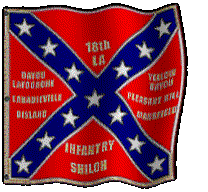
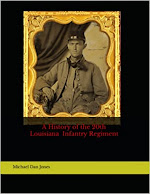
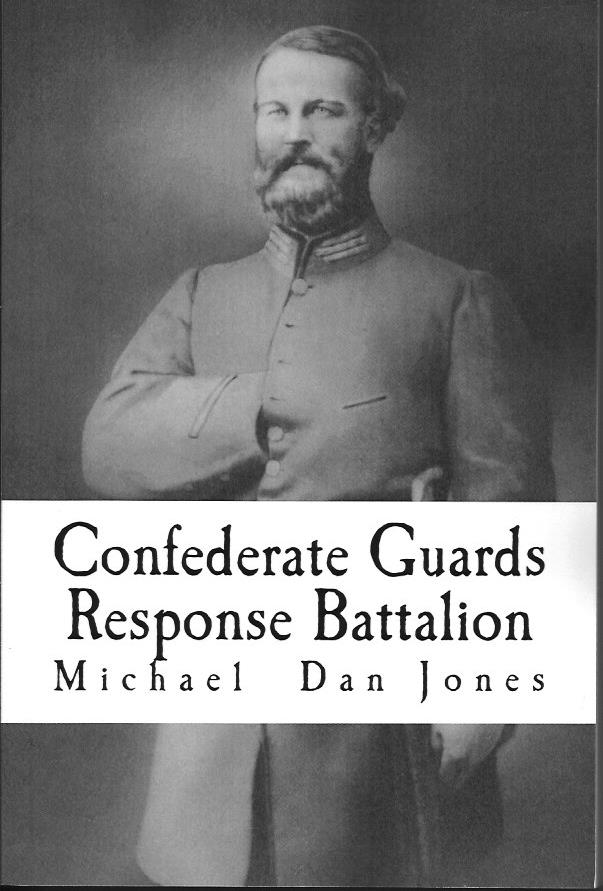
This is the history of one of the hardest-fighting Louisiana units in the War for Southern Independence, the Confederate Guards Response Battalion. It covers the organization in New Orleans, the Battle of Shiloh, and their campaigns in Louisiana. The book includes photographs, maps, illustrations, a bibliography, and an index.

On the second day of the Battle of LaFourche Crossing, La., Colonel Charles L. Pyron's 2nd Texas Mounted Rangers of Confederate Brig. Gen. James P. Major's brigade and Federal Lt. Col. Albert Stickney resume skirmishing in the late afternoon, and there is an artillery duel at 7 o'clock P.M. The Confederates then returned to Thibodaux. The two days of fighting resulted in 48 casualties for the Federals and 219 for the Confederates.

1864: The Battle of Jerusalem Plank Road, Va. began on this day as the Confederates under Lt. Gen. A.P. Hill and Brig. Gen. William Mahone battled to stop Federals under Maj. Gen. David Birney and Maj. Gen. Horatio Wright extended their line at Petersburg, Va., to cut off supplies to the Confederates from the three remaining railroads open to Petersburg. Mahone, a railroad engineer before the war and familiar with the terrain, set up an ambush for the blue coats for the following day.

Maj. Gen.William Mahone 

Confederate General Birthdays, June 21.

Brigadier General John Decatur Barry was born on this day in 1839 in Wilmington, North Carolina. He was a graduate of the University of North Carolina at Chapel Hill and was working as a clerk in Wilmington when the war started. He joined the 18th North Carolina Infantry as a private at the beginning of the war. However, when the Confederate Army was reorganized in April 1862, he was elected captain. Promotions followed to major, colonel, and brigadier general. Barry was wounded at the Battle of Frayser's Farm in 1862. He was then in the Battle of Sharpsburg and at the Battle of Chancellorsville in 1863, where he gave the command to his regiment to fire on approaching horsemen, which resulted in the mortal wounding of Lt. Gen. Stonewall Jackson. But he went on to be promoted to colonel of the 18th North Carolina. Barry led his regiment at Pickett's Charge at Gettysburg. He was appointed temporary brigadier general when the leader of his brigade was wounded at the Battle of Cold Harbor in 1864. Barry was then wounded in the hand at the First Battle of Deep Bottom on July 27, 1864, and because the wound rendered him physically unfit for field command, his temporary appointment as a brigadier general was canceled. He finished the war as a colonel in command of a department in North Carolina. He was still in poor health after the war and died on March 24, 1867. He was buried in Oakdale Cemetery in Wilmington.

Brig. Gen. John D. Barry.

Saturday, June 20, 2026

Today in History (general history)/ On This Day In Confederate History/ Confederate General Birthdays, June 20.

Click 👉Today in History (general history) June 20. 

On This Day in Confederate History, June 20.


Pvt. Benjamin W. Varnell
Co. B, 1st Texas Cavalry Regiment
(Liljenquist Collection, Library of Congress)

1862:  A skirmish occurs between Confederate Col. Edwin Waller Jr.'s 13th Battalion Texas Cavalry and the 8th Vermont Infantry at Bayou des Allemands, La.

Col. Edwin Waller Jr.
13th Bn, Tex. Cav.

1863: The Battle of LaFourche Crossing takes place near Thibodaux, La., between the Confederate cavalry brigade of Brig. Gen. James P. Major and a Federal detachment of 838 men under Lt. Col. Albert Stickney. The Confederates drove Stickney's detachment out of Thibodaux and down Bayou Lafourche. They exchanged fire with the Federals before the Confederates returned to Thibodaux and feasted on the Northern food supplies they captured there. The skirmishing would continue the next day.


Click👉Randal's Texas Brigade

This is the history of one of the finest bodies of Confederate infantry in the War for Southern Independence. General Kirby Smith and Lieutenant General Richard Taylor considered Randal's Texas Brigade to be the best infantry brigade in the Trans-Mississippi West. The brigade was principally made up of the 11th Texas Infantry Regiment, 14th Texas Infantry Regiment, the 28th Texas Cavalry (Dismounted) and the 6th Battalion (Gould's) Texas Infantry. It fought in such major Trans-Mississippi Department battles, in all or part, as the battles of Bayou Bourbeau, Mansfield, Pleasant Hill, all in Louisiana, and Jenkins' Ferry in Arkansas. The men of Randal's Texas Brigade played a major roll in keeping Texas largely free of the destruction wrought on other Southern states in the war.

1864: Confederate Capt. James A. Ware of the First Texas Cavalry at Fort Duncan, Eagle Pass, Texas, reported on June 20, 1864, that on the day before, he had been attacked by 80 to 100 renegades (Federal recruits under U.S. officers) on the Texas side of the Rio Grande River. Ware said he had but 34 men guarding the post. He received some poorly armed reinforcements from Texas home guard units. When the enemy attacked the town, they were repulsed. He said he was briefly captured when trying to communicate with the town, but managed to escape. The enemy only managed to get away with a few horses. Ware said four men were severely wounded on the Confederate side. He said the enemy lost one man killed and six wounded. Ware noted that Mexican authorities had allowed the formation of the renegades on the Mexican side of the river. 

Confederate General Birthdays, June 20.

Brig. Gen. John Tyler Morgan was born in 1824 in Athens, Tennessee. A prewar lawyer in Alabama, Morgan was a presidential elector for John C. Breckinridge in the 1860 election. With the coming of war, Morgan served as a private in the 5th Alabama Infantry and fought in the First Battle of Manassas, Va. He received promotions to major and lieutenant Colonel but resigned in 1862 to raise his own regiment, the 51st Alabama Partisan Rangers. With that unit, Morgan served in Gen. Nathan Bedford Forrest's cavalry in the Battle of Chickamauga, Ga., and the Knoxville Campaign. Morgan was promoted to brigadier general on November 16, 1863. He then served in the Atlanta Campaign and fought against Sherman's March to the Sea in 1864. Following the war, and was active in resisting the Reconstruction policies in the South, and was elected from Alabama to the U.S. Senate, where he served until he died in Washington, D.C. on March 4, 1907, and was buried in Live Oak Cemetery in Selma, Alabama.

Brig. Gen. John Tyler Morgan

Friday, June 19, 2026

Today in History (general history)/ On This Day in Confederate History/ Confederate General

Click 👉Today in History (general history) June 19. 

On This Day in Confederate History, June 19.

1863: The Battle of Middleburg, Va. takes place from June 17 to 19 in 1863 in the Gettysburg Campaign. It occurred when Maj. Gen. J.E.B. Stuart's cavalry, which was screening Gen. Robert E. Lee's ANV, clashed with the Federal cavalry of Brig. Gen. David McM. Gregg. Confederate pickets near Middleburg were attacked by Federals and fell back to Middleburg. Federal Brig. Gen. John Buford's Division then skirmished with Confederate Brig. Gen. William "Grumble" Jones' Brigade. The skirmishing continued through the afternoon, and the Confederates finally fell back to a more secure position. The Confederates lost about 40 men, killed or wounded, and the Federal casualties totaled about 97.

This is the story of one of the most heroic and hardest fighting regiments in the Confederate Army, the 13th Louisiana Infantry. The men of this regiment were largely from the New Orleans area and fought in such famous battles as Shiloh, Perryville, Murfreesboro, Chickamauga, Atlanta (Campaign), Franklin, and Nashville in the main Confederate Army of the in the western theater of operations. They served under such great Confederate generals as P.G.T. Beauregard, Braxton Bragg, Joseph Johnston and John Bell Hood.

1864: Atlanta Campaign: Captain Samuel T. Foster of Granbury's Texas Brigade in the Army of Tennessee reacts in his diary to the decision by President Davis to replace Gen. Joseph E. Johnston as commander with Gen. John Bell Hood. He writes: "The noise and confusion were kept up all night. Genl Johnson (sic) was serenaded, and if Jeff Davis had made his appearance in this army, he would not have lived an hour. This morning, in order (I suppose) to quiet the men, it is reported that Hood refuses to take command and that Johnson will remain in command until after the fight at Atlanta. In the afternoon, we are put in position, build breastworks, and by night, we are ready for the Yanks." (One of Cleburne's Command, 1980)

Confederate Corporal Sam Watkins of Co. H. 1st Tennessee Regiment wrote, "General Joe Johnston is relieved, Generals Hardee and Kirby Smith have resigned, and General Hood is appointed to take command of the Army of Tennessee." ... "Five men of that picket--they were just five--as rapidly as they could, took off their cartridge boxes, after throwing down their guns ... They marched off, and it was the last we ever saw of them."


Cpl. Sam R. Watkins, Co. H. 1st Tenn. Inf.

Confederate General Birthdays, June 19.

None.

Thursday, June 18, 2026

Today in History (general history)/ On This Day in Confederate History/ Confederate General Birthdays, June 18.

 Click 👉Today in History (general history) June 18. s

On This Day in Confederate History, June 18.

1863: Confederate Brig. Gen. John C. Vaughn reports on the activities on his part of the line at the Siege of Vicksburg, Miss. The usual sharpshooting along my line yesterday; considerable cannonading on the right during the early part of the day; also some artillery fire on my left about 11 a.m. Everything was unusually quiet last night. One killed in the Sixty-second Tennessee Regiment."

Pvt. W.P. Ward, Co. F, 40th Bn. Ga. Inf.
The battalion served in Barton's Brigade during the Siege of Vicksburg.
(Liljenquist Collection, Library of Congress)

Unidentified Soldier of Co. D, 17th Va. Inf.
in Longstreet's Brigade.
(Liljenquist Collection, Library of Congress)

1864: At the Second Battle of Petersburg, Va., Gen. P.G.T. Beauregard gets more reinforcements with the arrival of the divisions of Maj. Gen. Joseph B. Kershaw and Maj. Gen. Charles W. Field. The reinforcements now give Beauregard over 20,000 men. Lt. Gen. U.S. Grant also receives reinforcements, and his numbers are now up to 67,000 men available. Maj. Gen. George Meade, commander of the Army of the Potomac, tries another frontal assault and is repulsed. Beauregard's new defense line brings the Federal onslaught to a halt, and Grant realizes it will take a siege to conquer Petersburg. The battle has cost the Federals 1,688 killed, 8,513 wounded, and 1,185 missing or captured for a total of 11,386. The Confederates lost 200 killed, 2,900 wounded, and 900 missing or captured.

General P.G.T. Beauregard
(CDV M.D. Jones Collection)
The 2nd Battle of Petersburg shows how
Beauregard had become one of the greatest tactical
generals of the war and also his genius of managing
a battle in progress.

Confederate General Birthdays, June 18.

None.

Wednesday, June 17, 2026

Today in History (general history)/ On This Day in Confederate History/

Click 👉Today in History (general history) June 17. 

On This Day in Confederate History, June 17.

1861: President Davis appointed the following to the rank of brigadier general: Barnard E. Bee, Richard S. Ewell, William J. Hardee, Benjamin Huger, Thomas J. Jackson, David R. Jones, James Longstreet, John B. Magruder, John C. Pemberton, Henry H. Sibley, and E. Kirby Smith.

1863: Confederate Brig. Gen. John C. Vaughn at the Siege of Vicksburg, Miss., writes: I would respectfully report the usual sharpshooting along my lines; some cannonading in the evening. The enemy opened fire from a new position in front of my left near Edwards' negro quarters and between them and the river. One killed in Sixty-second Tennessee Regiment." Also, Confederate Brig. General Isham W. Garrott was mortally wounded at Vicksburg while shooting at Federals on the skirmish line. His commission to the rank of brigadier general, dated May 28, was received after his death but was never confirmed by the Confederate Senate.

At the Siege of Port Hudson, La., Confederate Col. William R. Miles writes: "The ordinary shelling of the fleet last night was productive of nothing except its noise. There has been but little firing from land batteries today, resulting in the severe wounding of 1 man. The sharpshooters on parts of my line have been very active, but have hit no one today. The work on the hill opposite my right area is progressing rapidly. I have no means of stopping them."

1864: On the third day of the Second Battle of Petersburg, Va., about 600 Confederates were captured when Federal Gen. Robert B. Potter's brigade attacked early in the morning and took about a mile of Confederate earthworks. However, the blue coats are stopped by a secondary Confederate defense line. The Federals launched another frontal assault that afternoon but were repelled. That night, Gen.  P.G.T. Beauregard pulls his Confederates back to a stronger defensive line while awaiting reinforcements from Gen. Robert E. Lee.

General Beauregard

This is a concise history of the Battle of Chickasaw Bayou,
 Mississippi from December 26-29, 1862. Also covered are the 
preliminary cavalry raids of generals Earl Van Dorn and Nathan Bedford Forrest.
 The book contains maps, photographs and illustrations, bibliography and index.

Confederate General Birthdays, June 17.

Brigadier General Richard Montgomery Gano was born on this day in 1830 in Bourbon County, Kentucky. A graduate of Louisville Medical Institute, Ky., Dr. Gano practiced medicine in Kentucky. Louisiana, and Texas before the war. During the war, he organized two squadrons of cavalry and served under Col. John Hunt Morgan in the 2nd Ky. Cavalry. He took part in Morgan's Raid on the Louisville & Nashville Railroad in August 1862. After that his two squadrons became part of the 7th Ky. Cav. and he was promoted to colonel. He also took part in the Battle of Perryville, the Battle of Lexington, and the Battle of Chickamauga. After a period of sick leave, Gano was promoted to brigadier general and assigned to the Trans-Mississippi Department and commanded a cavalry brigade in the department. His brigade captured Waldron, Arkansas, and led an attack on Fort Smith, Arkansas in 1864. Gano also fought at the Battle of Cabin Creek and was wounded there and in a raid on a federal supply train. Gano was recommended for promotion to major general but the war ended before it could take effect. After the war, he returned to live in Kentucky and was ordained a minister in the Disciples of Christ. He then moved back to Texas in 1870 and combined his ministry with ranching, real estate, and banking, and was active in the United Confederate Veterans. He and his wife had 12 children. He died March 27, 1913, in the home of his daughter in Dallas, Texas, and was buried there in Oakland Cemetery. One of his great-grandsons was the Texas billionaire Howard Hughes.

Brig. Gen. Richard M. Gano

Tuesday, June 16, 2026

Today in History (general history)/ On This Day in Confederate History/ Confederate General Birthdays, June 16.

 Click👉Today in History, June 16

 On This Day in Confederate History, June 16.

1862: In the Battle of Secessionville, S.C., Confederate troops repulse a Federal attack on a fort on St. James Island. Northern Brig. Gen. Henry Benham with 6,600 troops against Southern Brig. Gen. Nathan G. Evans with 2,000 troops. The attack was part of a Federal attempt to capture Charleston, S.C. The main attack was on Fort Johnson, commanded by Col. T.G. Lamar, with 750 men. The Federals lost 607 casualties to 204 for the Confederates.

1863: At the Siege of Vicksburg, Miss. Confederate Brig. Gen. John C. Vaughn writes: "The usually sharpshooting on my line yesterday. The artillery fire was directed altogether on my right. The enemy is strengthening their works near the Edwards house and has some new ones in the process of construction, but not any nearer than those erected sometime since. One killed in the Sixty-first Tennessee."

At the Siege of Port Hudson, La., Col. William R. Miles writes: "The fleet was again quiet last night. The land batteries have fired at intervals during the day. Sharpshooting, as usual, resulted in the killing of 1 man. The enemy's works on my right continue to progress rapidly toward completion. They threw up a parallel and traverse last night, the parallel distant about 150 yards from the brow of the hill upon which Battery No. 11 is placed. The enemy's fatigue parties have been driven from their work several times during the day by shells thrown by Capt. [S.M.] Thomas' pieces in the outer work on the Troth road. He has instructions to fire at distant intervals during the night, to prevent any further work, if possible.

Maj. Boling R. Chinn
9th Battalion, Louisiana Infantry
served in brigade of Col. W.R. Miles at Port Hudson
In the Battle of Baton Rouge and Siege of Port Hudson
This is the history of the 9th Battalion Louisiana Infantry 
which fought at the Battle of Baton Rouge and the Siege of Port Hudson, 
Louisiana in the War for Southern Independence. The unit took part in the 
famous charge of Allen's Brigade at Baton Rouge. The men of the unit were
 fighting in defense of their own home area since most were from 
East Baton Rouge and nearby parishes.

1864: On the second day of the Second Battle of Petersburg, Va., Gen. P.G.T. Beauregard managed to assemble 14,000 to repel Lt. Gen. U.S. Grant's 50,000 Federals. While outnumbered, the Confederates have the advantage of fighting from well-built fortifications. Grant launches attacks by three corps, but all are repelled by the fiercely fighting Confederates.

Confederate General Birthdays, June 16.

None.

Monday, June 15, 2026

Today in History (general history)/ On This Day in Confederate History/ Confederate General Birthday, June 15

Click 👉Today in History (general history) June 15. 

On This Day in Confederate History, June 15.

1862: Maj. Gen. J.E.B. Stuart's command finished its historic ride around the Yankee army on this day. Stuart gathered vital intelligence for General Robert E. Lee, who was planning his Seven Days Campaign to drive the Federal Army away from Richmond, Virginia.

Featured on the cover is Pvt. Edwin Francis Jemison,
Co. C, 2nd La. Inf. Regiment, who lost his life on
1 July 1862 at the Battle of Malvern Hill, VA.

1863: At the Siege of Vicksburg, Miss., Brig. Gen. John C. Vaughn wrote this report: "I would respectfully report but little sharpshooting on my line yesterday. The enemy's land batteries were unusually quiet until the evening, when they opened on my left. The enemy's water battery on the Peninsula threw a few shells on the left of my line, but the proximity of their own line has prevented them from shelling it to any extent. Last night the enemy opened fire from the land batteries, on what was supposed to be some boats going in the direction of the gunboat Cincinnati, with what result could not be ascertained."

Pvt. Henry Bitner, Co. B, 2nd Tex. Inf.
Captured at Vicksburg, Miss. July 4, 1863
(Liljenquist Collection/Library of Congress)

At the Siege of Port Hudson, La., Col. William R. Miles writes: "The fleet shelled us last night. The land batteries have fired on us at intervals throughout the day, and the sharpshooters have been more than ordinarily energetic, productive of no casualties, however. Opposite my extreme right, the enemy busily engaged in throwing up a new chain of rifle pits, which we are unable to prevent."

1864: The Second Battle of Petersburg, Va., started today. The South had its two best generals, both outstanding military engineers, Robert E. Lee and P.G.T. Beauregard, on June 15, with between 5,400 and 38,000 troops. Federal Lt. Gen. U.S. Grant and Maj. G.G. Meade had between 13,700 and 62,000 troops. Beauregard, however, through skillful handling of the situation, thwarts Grant's plans to quickly take Petersburg and Richmond.

Confederate General Birthdays, June 15.

None.

Today in History (general history)/ On This Day in Confederate History/ Confederate General Birthdays, June 14.

Click 👉Today in History (general history) June 14. 

On This Day in Confederate History, June 14.

1863: At the Siege of Vicksburg, Mississippi, Brig. Gen. John Vaughn writes: "The usual sharpshooting from the enemy yesterday; some cannonading during the day. One wounded in the Sixtieth (Tenn.); one wounded in Sixty-second (Tenn.); one wounded in Loring's division."

At the Siege of Port Hudson, La., Maj. Gen. Franklin Gardner's Confederate garrison handily beats back an all-out Federal frontal assault on all parts of the Confederate defense line. Maj. Gen. N.P. Banks demanded the surrender of the garrison on June 13, but Gardner summarily rejected it. The attack began at 3:30 a.m. on June 14 but was poorly coordinated and was a debacle for the Yankees. The resulting casualties were perhaps the most lopsided in any single major battle of the war. The Federal casualties amounted to 1,792, while the Confederates lost only 47.

Cpl./2nd Lt. Albert Florestin Aucoin, Co. A,
9th Bn. La. Inf. fought at Port Hudson.
He was killed in action during the siege.
(Port Hudson State Historic Site)

In the Gettysburg Campaign, Lt. Gen. Richard Ewell staged a double-flank attack on the Federal fortifications at Winchester, Va. Fighting continues throughout the day until that night Maj. Gen. Milroy and other officers decided to cut their way out of the trap they are in, starting at midnight. But Maj. Gen. Edward Johnson anticipates Milroy's retreat and positions his division to cut it off at Stephenson's Depot early the next day.

1864: Lt. Gen. Leonidas Polk was killed in action on this day on Pine Mountain, Georgia in the Atlanta  Campaign. He was killed instantly when struck by a Federal shell while meeting with generals Joseph Johnston and William Hardee. Polk was a graduate of West Point and was the Episcopal Bishop of Louisiana when the war began. He was a greatly beloved Christian gentleman by his soldiers and by friends and colleagues throughout the South.

Lt.Gen. Leonidas Polk

Confederate General Birthdays, June 14.

None.

Saturday, June 13, 2026

Today in History (general history)/ On This Day in Confederate History/ Confederate General Birthdays, June 13.

 Click 👉Today in History (general history) June 13.

On This Day in Confederate History, June 13.

1863: The Second Battle of Winchester, Va., brings an early victory to the Confederates en route to Pennsylvania in the Gettysburg Campaign. Lt. Gen. Richard S. Ewell's Second Corps of the Army of Northern Virginia, numbering 12,500 men (of 19,000 in the corps), fights Maj. Gen. Robert H. Millroy's 7,000 garrison troops occupied Winchester. On the first day of the battle, the Confederates attack, and the Yankees are driven into their forts around the town.                                                                                     

At the Siege of Vicksburg, Miss., Brigadier General Francis Shoup reports on his part of the defense line: "June 13.—Enemy again at work on the right. Hid a little last night, but something. Again, urge that the engineers construct inner works. No particular change is observable at other points. This morning, the enemy is unusually active on the right, firing on the [stockade] redan; has cut away the parapet very considerably; Sharpshooting very bitter. Sharpshooters take aim at exposed points, and when one exposes himself in the least a number of guns are discharged simultaneously."

Pictured is Pvt. Thomas Booker, Co. B, 28th La. (Thomas') Inf. Reg't.
Shoup's Brigade in the  Siege of Vicksburg. This picture
was probably taken in Vicksburg, since his unit was never
stationed in Corinth, MS, which is the usual place where 
that famous prop, "Jeff Davis and the South" sign, is identified
with. Thomas's 28th Louisiana Infantry Regiment was 
stationed in Vicksburg from May 1862 until July 1863.
(Liljenquist Collection, Library of Congress)
The Vicksburg 28th/29th Louisiana Infantry Regiment was involved in the 1862-63 defense of the "Gibraltar of the Mississippi," Vicksburg, from the first attack by the Union fleet of Admiral Farragut, to the final siege by Lt. Gen. Ulysses S. Grant. The regiment had its finest hour in the war during the Battle of Chickasaw Bayou, Miss. on Dec. 28, 1862, when it was compared to the Spartans at the Battle of Thermopylae in Ancient Greece, for holding off an enemy force many times its size. The regiment was made up of men from throughout Louisiana who endured incredible hardships and danger for their sacred cause of Southern Independence. Included in the book is a roster of the regiment, photographs, maps, footnotes, bibliography and index.

At the Siege of Port Hudson, La., Col. William R. Miles reports from his part of the defense line: ON THE FIELD, June 13, 1863. Very nearly this morning, we were quite severely cannonaded. Later on in the forenoon, the most tremendous affair of the siege came off. From the fleet in the river and from every gun in position onshore came the quick flash and angry roar of threatening annihilation. The air grew thick with smoke and hoarse with sound. After some hours spent in this manner, it became apparent that the enemy was making preparations for a charge. Gen. Beall's line being most threatened, I sent o­ne battalion to his support, keeping the balance of my force in position to repel an attack should o­ne be made on my own line, or move to the further support of Gen. Beall. No attack was made on me, and, after trying several times to bring their lines to the assault, the enemy beat a hasty retreat. Nothing but a few of his sharpshooters approached the breastworks, and the neighborhood soon grew too hot for them. How many of them were killed and wounded, I do not know. Of the battalion sent by me to Gen. Beall's support, 2 men were severely wounded. Besides these, I have lost on my lines today, 1 man killed and 1 wounded. Yesterday, on the extreme right, where Lieut.-Col. [Fred. B. or G.] Brand commands, there were of the pickets 1 man killed. 1 wounded, and 5 captured. I am, Major, very respectfully, your obedient servant, W. R. MILES, Col.

Pvt. Harden West
Co. H, Miles' Louisiana Legion
He was born about 1845 in St. Landry Parish,
into a large farming family.


Confederate General Birthdays, June 13.

Brigadier General Benjamin Jefferson Hill was born on this day in 1825 in McMinnville, Tennessee. Before the war, he was a Tennessee businessman and state senator. He entered the Confederate service as the colonel of the 5th Tennessee Militia regiment, which became the 35th Tennessee Infantry in the Confederate Army. He and his regiment fought in Brig. Gen. Patrick Cleburne's brigade at Shiloh and at Corinth, Miss. His other battles included Richmond, Ky., Perryville, Chickamauga, Missionary Ridge, and Franklin, Tenn. Hill was promoted to brigadier general on Nov. 30, 1864, and assigned a cavalry brigade in Lt. Gen. N.B. Forrest's Cavalry Corps which fought at Nashville, Wilson's Raid and was paroled May 16, 1865, at Chattanooga. Hill returned to his business career and practiced law. Hill died Jan. 5, 1880, at McMinnville, Tenn., and was buried there in the Old City Cemetery.

Brig. Gen. Benjamin J. Hill

Friday, June 12, 2026

Today in History (general history)/ On This Day in Confederate History/ Confederate General Birthdays, June 12.

Click 👉 Today in History (general history) June 12.

On This Day in Confederate History, June 12.

1862: Confederate General J.E.B. Stuart, cavalry commander, began his "Ride around the Army of the Potomac" to gather intelligence for General Robert E. Lee. On the ride, he commanded about 1,200 gray-clad horse soldiers to gather intelligence and disrupt the Federate supply line, as well as enemy communications. It was a spectacular event that garnered much publicity. Only one of his men was killed by enemy action. Captain William Latané, 9th Virginia Cavalry, was given a Christian funeral, which was depicted in the famous painting, "The Burial of Latané" by a Virginia artist, William D. Washington.

Maj. Gen. J.E.B. Stuart

Stuart's Ride Around McClelland's Army
(Library of Congress)

The Burial of Latané by William D. Washington, 1864

1863: Confederate Brigadier General John C. Vaughn filed his report on the previous day's activities on his part of the Siege of Vicksburg, Miss. defense line: "The usual sharpshooting from the enemy yesterday, which was replied to by my command for the purpose of discharging the guns that were exposed to the rain during the previous day. Some cannonading during the morning resulted in the disabling of one 24-pounder siege gun. One killed in Sixty-second Tennessee Regiment; one wounded, Mississippi State troops."

At the Siege of Port Hudson, La., Col.  William R. Miles writes a report on this day's activities on his part of the Confederate defense line: "Last night the guns and mortars from the fleet, as well as the guns and mortars from the numerous batteries on shore, kept up a brisk fire upon us, resulting in no loss of life, or wound, even. During the day, their fire has slackened considerably and would fain hope tapering to its final end. Neither of the 24-pounder guns was yet mounted on my lines, and if no more attention shall be given in directing the labor of the large nightly details I am called on to furnish more than has been bestowed heretofore, it is a mere matter of conjecture when they will be put in position. No casualties were reported during the day. The 30-pounder Parrott gun at the extreme right has been dismounted today by the enemy's land batteries. I am, Major, very respectfully, your obedient servant, W. R. MILES, Col."

1864: The Battle of Trevalian's Station reaches a conclusion this day. Confederate generals Wade Hampton and Fitzhugh Lee, with 6,762 cavalrymen, repel seven assaults by 9,286 Federal cavalrymen under Maj. Gen. Philip Sheridan. The Northern horse soldiers withdrew and were prevented from destroying the Virginia Central Railroad. The Federals lost 150  men killed, 738 wounded, and 624 captured or missing. The total Confederate casualties are 803. 

The 1st Louisiana Infantry Regiment was one of the
 hardest fighting units of the Confederate Army of Northern Virginia
 in the War for Southern Independence. Raised largely in New Orleans from
 local militia units and the immigrant population in 1861,
 the Fighting First fought in the Peninsula Campaign, the Seven Days, 
Cedar Mountain, 2nd Manassas, Sharpsburg, and Fredericksburg
 in 1862; Chancellorsville, Winchester No. 2, Gettysburg,
 and Mine Run in 1863; the Wilderness, Spotsylvania Courthouse, 
Cold Harbor, Monocacy, Winchester No. 3, Fisher's Hill, and Cedar Creek in
 1864, Petersburg, Hatcher's Run, Fort Stedman, and Appomattox 
Courthouse in 1865. The men of the Fighting First fought
 with courage, gallantry, and self-sacrifice for the causes
 of Southern Independence, States Rights, and limited, 
constitutional government. This is their story.

Confederate General Birthdays, June 12.

General Samuel Cooper was born on this day in 1798 in Hackensack, New Jersey.  Cooper graduated from West Point in 1815, ranking 36th out of a class of 40 cadets. In his long U.S. Army career, his highest rank achieved was a colonel and Adjutant General in 1852. He was active in the Second Seminole War and the Mexican American War. Cooper sided with the South in 1861 and was made the highest-ranking Confederate general, adjutant general, and served directly under President Jefferson Davis. He is credited with bringing the organizational knowledge of creating an effective army for the Confederacy. Following the war, Cooper made his living farming on his plantation, called Cameron, near Alexandria, Va. He died December 3, 1876, at home and was buried in Christ Church Cemetery in Alexandria, Va.

General Samuel Cooper