Saturday, November 20, 2010

FORTS RANDOLPH AND BUHLOW OPENED

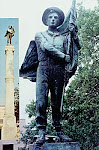
Confederate soldier
(Library of  Congress)
PINEVILLE, La. - Forts Randolph & Buhlow State Historic Site opened to the public, Thursday, Nov. 18, with a free day in the park and dedication ceremony. Following the ceremony, there were site tours and a live performance of War For Southern Independence-era music.

In an earlier press release, Lt. Gov. Schott Angelle said, "I am excited to announce the opening of Forts Randoph & Buhlow State Historic Site. This site represents an incredible piece of Louisiana's history and is an invaluable new tourism opportunity for Central Louisiana."

The $4.4 million project was funded by a combination of Capital Outlay funds and monies provided by the Red River Waterway Commission (RRWC), a spokesman said.

"Forts Randolph and Buhlow State Historic Site will be a wonderful addition to our system," said Dr. Stuart Johnson, Assistant Secretary for the Office of State Parks. "the Red River Waterway Commission and the City of Pineville are great partners, fully supporting this site and the Office of State Parks' mission to preserve and interpret our state's history."

Forts Randolph and Buhlow were built after the Red River Campaign during the War for Southern Independence. Johnson said that interpretation and programs at this site connect with Mansfield SHS and Port Hudson SHS on the whole Campaign and the subsequent events.

After the Battle of Mansfield, halting the Union advance to the West in Spring of 1864, Forts Randolph and Buhlow were constructed on the Red River at Alexandria by Confederates in order to repel future Union attacks through Northwest Louisiana. The earthen forts, constructed using local plantation slave labor, where fortified with cannon and troops, and never saw battle.

Fort Randolph & Buhlow State Historic Site is located on Red River in downtown Pineville. It includes visitor center with War For Southern Independence exhibits, an elevated boardwalk around both fort sites, and an overlook near the southern portion of the Bailey's Dam site. The site has an open field for War For Southern Independence re-enactments. Admission to the site is $4 per person; children (12 and under) and senior citizens (62 and over) are admitted free. For more information about the site, click Fort Randolph & Buhlow SHS or call 1-888-677-7437 toll free or 484-2390 locally.

Wednesday, November 17, 2010

150--YEARS AGO -- SOUTH ARMS FOR WAR

A well armed  Confederate.
Pvt. William H. Rockwell,  Co. H. 18th North
Carolina State Troops. (Library of Congress)
[Excerpt from UT Tyler Digital Archives]

DAILY ADVOCATE [BATON ROUGE, LA], November 28, 1860, p. 2, c. 1


Extensive Purchases of War Munitions for the South.—Those Republican editors, preachers and lecturers who think that the indignation of the south is best put down by ridicule, and who, therefore, lavish the resources of their buffoonery upon every reported attempt of a Southern State to arm her citizens for an impending conflict, will find in the following facts more evidence that the South is in earnest, and that the calamities of disunion, which they would laugh away with their ill-timed jests, are actually imminent.

Yesterday there arrived by the steamer City of Hartford, from Hartford, 180 cases of Sharp's patent carbines, containing 10 pieces each, making in all arms for 1,800 men, and 40 cases of conical balls, each containing 1,000 bullets, or 40,000 cartridges in the aggregate. These arms and ammunition were ordered by telegraph from the Governor of Georgia, and will be sent to Savannah by the next steamer. The same factory has also received orders from Alabama for 1,000 stands of the same death-dealing weapons.

Cooper & Pond, of this city, receive from twenty to fifty orders daily from South Carolina, Alabama, and Georgia—and people who suppose that the South is not a paying customer may be astonished to know that their business transactions in this line are strictly on a cash basis. Cash within thirty days is their invariable rule. Most of the orders are for rifles and navy revolvers, though Cooper & Pond supply an immense number of flint-lock muskets. They lately sent twenty gun carriages to Georgia, and have done a brisk business in all kinds of small arms and ammunition with all the principal Southern States.

Another large house in this city has filled orders for about 5,000 stand of muskets of the United States pattern, and has sold large quantities of artillery swords and army pistols. Its orders come from all the Southern States, but mainly from those in which secession is regarded as the only remedy for Southern grievances. A third extensive establishment has supplied an immense number of Colt's revolvers and rifles to Georgia, principally to Columbus. All the wholesale houses and agencies in the city have been hard pressed to supply the orders for every imaginable species of weapon. To the above list may be added Aime's Manufacturing Company, which has furnished Georgia with cannon and with 300 artillery swords, and has done a large miscellaneous business with all the aggrieved States.

Pvt. Andrew Skidmore, Co. E, 17th Virginia Infantry
Mount Vernon Guard.
(Library of Congress)
The Southern States, living until recently in peace and happiness under the roof-tree of a common Union, have neglected the establishment of firearm factories within their own borders. During the past year, Virginia first recognized the necessity of starting a State armory, and appropriated $100,000 for the work. Some commencement has already been made on it, but it is certain that the armory will not be completed within one year, and in the meantime she must depend on the North. Various statements have been circulated about the present armament of Virginia. It is believed that she can, as asserted, bring 25,000 men into the field, but the tremendous batteries of rifled cannon which have been said to belong to her, do not exist. We understand, from good authority, that she has but one rifled cannon. Indeed, in the matter of heavy ordnance, all the Southern States appear to be far behind the North.

South Carolina is the only Southern State which has an armory of her own. It has been in operation some years, and turns out good work, though at a cost not less probably than that of the same class of arms in the North.—Journal of Commerce.

Friday, November 5, 2010

150-YEARS-AGO --- SOUTHERN REACTION TO LINCOLN"S ELECTION


Louisiana Gov. Thomas Overton  Moore
who led the state out fo the Union.
(Mansfield State Historic Site)

[Excerpts from UT Tyler Digital Archives]

DAILY ADVOCATE [BATON ROUGE, LA], November 7, 1860, p. 2, c. 1


A Quiet Election.—One of the quietest, most orderly and pleasant elections ever held in this country occurred at our polls on Tuesday. Not a harsh word passed between the sovereigns in our hearing throughout the day. No drunken rowdies blocked up the passageway to the ballot-box; no illegal votes were polled, nor none attempted to be polled when it was ascertained that they were illegal. Good humor and friendly intercourse characterized the proceedings of the day, and while the "working men" of the respective parties were unusually active to advance the interests of their favorites, not an incident occurred to mar the universal harmony and kindly feeling that prevailed.
DAILY ADVOCATE [BATON ROUGE, LA], November 12, 1860, p. 2, c. 2
Revolution in South Carolina.

Immediate Secession Anticipated.

The Flag of Independence

A Red Star on a White Ground.

Convention Called.

Resignation of Senator Chesnut.

Great Excitement at Charleston.

Removal of Government Arms Attempted.
Special correspondence of the Delta.

Columbia, S. C., Nov. 10.—The bill calling a State Convention to meet on the 17th of December, for the purpose of taking measures to assert and maintain the independence of the State, has passed both Houses of the Legislature by a unanimous vote.

Senator Chesnut has resigned his seat in the United States Senate.

The flag of secession—a red star on a white ground—is waving in all the public places and from all public edifices. . .
DAILY ADVOCATE [BATON ROUGE, LA], November 12, 1860, p. 2, c. 3-4
From the N. O. Delta.

A Large and Enthusiastic Meeting. . . .

The Blue Cockade and South

Carolina Indorsed. . . .
. . . A sample of the blue cockade was shown, and every person desirous of obtaining one, (and no person will presume to wear one unless he can, and is willing to sustain the cause, and be not ashamed of the badge,) can find the means of procuring them at the Armory Hall this day. . .
DAILY ADVOCATE [BATON ROUGE, LA], November 13, 1860, p. 2, c. 6

The Charleston papers of the 8th come to us filled with accounts of the recent exciting proceedings in Charleston and Columbia. The Mercury has the following paragraphs:
The States Rights Flag Thrown to the Breeze.
. . . The most exciting incident was the unfurling of the State flag of South Carolina from an upper window of the Mercury office, which was greeted with vociferous cheers, proclaiming, in trumpet tones, that the "colors were to be nailed to the mast." . . .

At 12 o'clock was unfurled from our windows, and stretched across the street, a red flag with the Palmetto and the Lone Star. A shout from below, and twice three hearty cheers, greeted its appearance. . .

DAILY ADVOCATE [BATON ROUGE, LA], November 13, 1860, p. 2, c. 4

The following dispatch, dated Galveston, November 12th, was received here last evening:

"Considerable excitement here about the election of Lincoln. Disunion poles are being raised, and Lone Star Flags are flying. Declarations of Independence are being signed and military companies raised."

ELECTION OF 1860 in Louisiana

Southern Militia Officer
(6th Plate Tintype, author's collection)
By Mike Jones

The election of 1860 in Louisiana was quiet, orderly and showed no unusual alarm. On the ballot were John C. Breckinridge of Kentucky, who was the nominee of Southern Democrats; John Bell of Tennessee, nominee for the Constitutional Union Party, which was made up of old Whigs and Know-Nothings; and Stephen A. Douglas of Illinois, who was the nominee of the  regular Democratic Party. Abraham Lincoln of the Republican Party did not appear on the ballot in the state.

Breckinridge won the state by a plurality of the vote with 22,680. Bell received 20,204 and Douglas 7,625. Louisianians, before the election, were clearly split on the question of secession from the Union. But the election of Lincoln rapidly drove them into the pro-secession camp.

A visitor to New Orleans at this time recorded his observation:
"The excitement about the result of the election seems to increase fast. 
The most talk I hear now [in New Orleans] is about the state of the
country. Some anxiety appears to be felt as to the result. The
Southern people think the result of the election is a sort of declaration
of hostility by the North. Nearly every day Lincoln's effigy is hanged
in the principal streets and squares. When it is run up it is saluted
with the firing of cannon & cheers. Secession is openly talked of,
apparently with increasing confidence in its success." (Charles Schultz, “New
Orleans in December 1860” Louisiana Historical Quarterly.)

Governor Thomas Overton Moore, a secessionist leader, called for a Secession Convention in January. Louisianians got to vote on the question when they  elected representatives to the convention. On January 7 voters went to the polls and elected 80 immediate secessionists and 50 cooperationists, meaning they wanted to cooperate with other Southern states before seceding individually.
Also in the period after the election Louisianians started organizing military companies to defend the state. The groups took on such names as the "Crescent Rifles," "Minute Men," "Home Guards," and "Defenders of
Southern Rights." Groups already organized, such as volunteer firemen, steamboatmen and others, formed their own military units. The Louisiana Legislature convened in December in special session to establish a military board headed by the governor and authorized it to appropriate $500 million to arm and equip companies.

Events followed with rapidity: the election of delegates to the secession convention were elected January 7, 1861;  the the U.S. Arsenal in Baton Rouge was seized by  Louisiana troops January 10, Forts Jackson and St. Philip January 11, and Fort Pike and the United States barracks near New Orleans on January 14. Fort Macomb on Chef Mentur Road, guarding the eastern water approaches, was taken January 28, 1861.
'Pellican' flags were flying in all directions, companies drilling. . ." the northern visitor observed at the time. Louisianians were deadly serious about defending their sovereign and independent rights.

Saturday, October 23, 2010

LETTERS OF A LOUISIANA LIEUTENANT

A Louisiana Confederate officer
in Virginia in 1861. (A.C. Redwood
Century Magazine) 
By Mike Jones

      Edward Auguste Seton, a 20-year-old Confederate soldier from Lake Charles, Louisiana was lying on the ground in a plain canvas army tent when he took pen in hand on July 1, 1861, and began a remarkable series of 38 letters to his mother, brother and sister detailing his experiences in some of the nation's most historic events.
     The letters were carefully preserved by his descendants, the late Mrs. Violet Stone and her son, Layne Stone, who donated them to McNeese State University Archives in 1990, where they have been professionally preserved ever since. Lt. Seton was the brother of Mrs. Stone's grandfather.
     Seton was born August 20, 1840, in Opelousas, the son of Edward A. Seton and the former Bazilde Belome. His father, who died when Edward was a child, was reportedly related to the family of Saint Elizabeth Ann Seton, the first American-born Catholic saint. His mother, Bazilde, was born Feb. 18, 1816, in Opelousas, the daughter of Gregoire Belome and the former Francoise Arnaud, both of New Orleans.
     Edward had one sister, Fanny Charlotte Seton, who was born Dec. 15, 1845, in Opelousas. She married Amedie Faruqe on Dec. 20, 1860, and in the collection there is also a wartime letter written by Farque, who served in Company B, 12th Battalion Louisiana Infantry.
     Seton's mother had been previously married to Joseph Spence, who died in September 1836. There were two sons from this marriage, John A. and Joseph Spence. Some of Edward Seton's letters were addressed to John, who was the oldest child in the family.
     John Spence, established the first newspaper and print shop in Lake Charles, the Calcasieu Press, in partnership with Judge B.A. Martel of Opelousas.
     Young Edward worked as a clerk in this early Lake Charles print shop. In almost every letter, Edward Seton mentioned his girlfriend in Lake Charles, Miss Doris Pithon.
     Edward seems to have been a popular young man in the community, and when a company was formed in mid-1861 to fight for the South, he was elected 2nd Lieutenant. He was later promoted to 1st Lieutenant.
     The unit became Company K (Confederate State Rangers), 10th Louisiana Infantry, and took part in most of the major battles in Virginia, Maryland and Pennsylvania.
     Seton's first duty station was at a basic training camp, Camp Moore, in Tangipahoa Parish, Louisiana. From there, on July 14, 1861, he wrote his mother, "At present we have our tents and equipments and all are satisfied. The boys like camp life."
      But he learned that as an officer he had to buy his own uniform and equipment, "It (has) taken all the money I had to get my sword and uniform -- $95."
     Edward's 10th Louisiana regiment was sworn into the Confederate Army on July 22, 1861, and sent by rail to Richmond, Virginia, a trip which took seven torturous days. The regiment missed the first major battle of the war, the First Battle of Manassas, Va., on July 21, 1861, but he soon had his first encounter with the enemy while on picket duty.
     In a letter dated Aug. 11, 1861, Seton wrote his mother, "I (have) taken up a yankee last night, or at least he gave himself up to me. He was a deserter of the 4th Main Regiment. He said he was in the engagement on the 21st. I delivered him up to Capt. Johnston, officer of the day. They are all put in jail or confined. They are suspected of being spies."
     Seton also wrote of an amusing encounter he had with a Virginia native. "The country men of Va. are much greener than our country boys. I asked one if he was an American and he said not, but he was a Virginian of some eastern county. I could not help laughing in his face."
     His regiment was assigned to guarding the Yorktown Penisula, where the Revolutionary War battle was fought. The 10th Louisiana received its baptism of fire at the Battle of Malvern Hill on July 1, 1862. Lieutenant Seton's letters dropped off drastically after this, as his unit was almost constantly marching and fighting for the next three months. Following Malvern Hill, they fought battles at Cedar Run on Aug. 10, the Second Manassas Aug. 28-30 and Chantilly on Sept. 1, all in Virginia, and Harper's Ferry on Sept. 15, and Sharpsburg (Antietam) on Sept. 17, both in Maryland.
      On Sept. 21, 1862, Seton finally got a chance to summarize his command's part in those great battles. "We have been in all the battles and have lost our best men. In Friday's fight at Manassas Dave Hargrave was killed and L.J. Ryan was wounded in Satirday's fight. At Bull Run Sergt. P(ierre) Vincent was wounded (and later died) and Lt. Isaac Ryan, P.F. McCormick, W.C. Bolin, F. Sack all wounded Friday. We drove them (the yankees) across the Potomac. From there were a week in Maryland and captured 14,000 men, 23,000 stand of small arms and 60 pieces of artillery. On 17th Sept. we had a battle in Maryland and have lost our best men. Our company had 15 men in the fight and but four came out safe. We held the field until the 19th and fell back across the Potomac, but we are expecting to cross again tomorrow. We have beat the enemy at every point."
     The armies in those days normally went into winter quarters, and waited until the following spring to resume any serious campaigning. Lt. Seton wrote many of his letters during these breaks, which was interrupted by the Battle of Fredericksburg Dec. 11-13, giving his views on life in the army, the progress of the war and the prospects for the future.
Gen. R.E. Lee at Chancellorsville
(Library of Congress)
     His next battle came in May, 1863, at a place now historic -- Chancellorsville. He was wounded there, and while recovering in a hospital, wrote the best battle description of all his letters.
     On May 13, he wrote his mothers, "Ere you will receive this you may hear of my being wounded and probably in a worst light than it realy is, for I am but slightly wounded through the calf of the right leg ranging upward. I will be alright in two or three months for another fray. I was wounded on the 3rd May, Sunday morning, in the first charge. After I was wounded, or at the time our brigade fell back some three hundred yards to the breasworks we had just taken, I was left between both fires for a long (time) until a yankee came and got me out. I was very glad for not three hours after the the woods caught on fire and burnt a great many. The yankees treated me kindly while I was in their hands."
    In his next letter, dated June 17, 1863, he gave more details of the fight, "Dear Mama I expect you have been living in great suspense for these last six weeks on account of having hear of my wound and probably of my death for such was reported for I had been taken prisoner after being wounded. Our company stood on the field to the last and fought with the yankees at 30 years distance.
     "They (his own men) did not leave until I told them to go. . .Poor Jim Reeves was killed to my left. I went to get his rifle to give to F. Sack whose gun would not fire and when I looked around to give Sack the gun, I seen, poor fellow, he was Killed also."
    Although his wound was worse than he first thought, and took longer to heal, Seton recovered and fought many more battles.
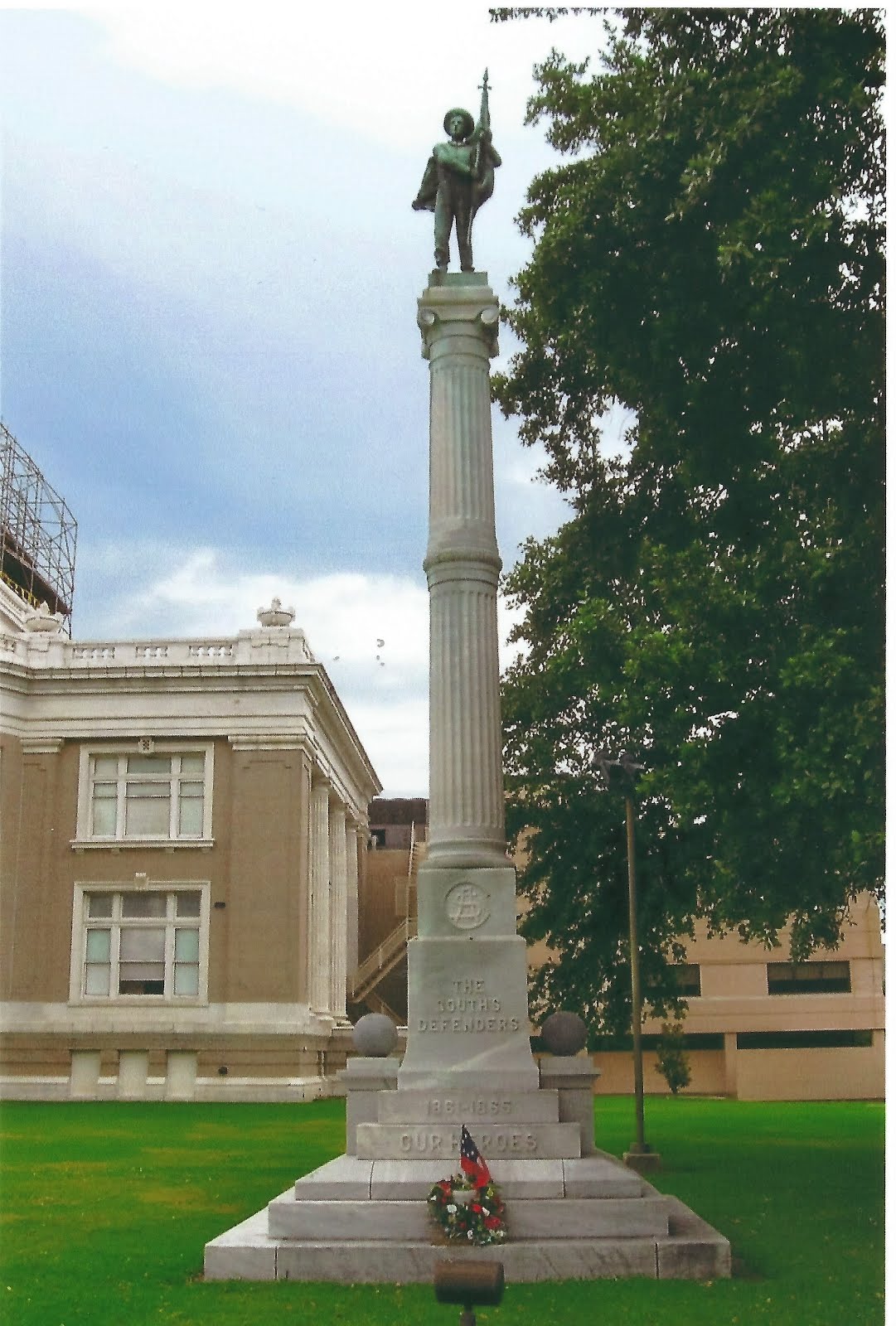
Confederate memorial obelisk, Finn's Point
National Cemetery, New Jersey (National Cemetery
 Administration Department of Veteran Affairs.)
     Seton's last letter, dated Feb. 9, 1864, was a short one in which he described a small skirmish on the Rapidan River. More serious fighting was to come at the Battle of the Wilderness on May 6, and at Spottsylvania Courthouse, May 12, 1864. At Spottyslvania Courthouse his entire division was overrun and many were captured, including the Lake Charles soldier. He was confined in a P.O.W. camp at Fort Delaware on Pea Patch Island in the Delaware River. P.O.W. camps were notorious for their high death rates due to disease. Fort Delaware was one of the worst. First Lieutenant Edward Auguste Seton died there on Feb. 19, 1865 of typhoid fever. His remains now lie in a soldier's grave at Finn's Point National Cemetery on the New Jersey shore, just across the river from Fort Delaware.
     Seton's name is engraved on an 85-foot tall obelisk, along with 2,435 other Confederates prisoners who died at Fort Delaware.
Monday, October 18, 2010

150-Years-Ago: South Carolina Getting Ready for Secession

[Excerpt from UT Tyler Digital Archives]
A you Southerner wearing a secession
cockade. (9th plate ambrotype M.D. Jones
collection).

DAILY ADVOCATE [BATON ROUGE, LA], October 22, 1860, p. 2, c. 5


South Carolina is Arming.—We are glad to see the people of our State everywhere preparing for the crisis which is at hand. As an offset to the "Wide-Awakes" of the North, "Minute Men" are organizing in all the principal districts of South Carolina. Their object is to form an armed body of men, and to join in with our fellow citizens, now forming in this and our sister States as "Minute Men," whose duty is to arm, equip and drill, and be ready for any emergency that may arise in the present perilous position of the Southern States. In Kershaw, Abbeville and Richland Districts the organization is already complete and powerful, embracing the flower of the youth, and led on by the most influential citizens. The badge adopted is a blue rosette, two and a half inches in diameter, with a military button in the centre, to be worn upon the side of the hat. Let the important work go bravely on, and let every son of Carolina prepare to mount the blue cockade.

Saturday, October 16, 2010

Yankee in Gray -- A Great Classic

"Yankee in Gray"
By Mike Jones
I've been into reading classic histories on  the War For Southern Independence lately, and just finished another one, "Yankee in Gray" by Henry E. Handerson (The Press of Western Reserve University, Cleveland, Ohio). Handerson was a member of the Stafford Guards, Company B, 9th Louisiana  Infantry Regiment, one of the outstanding Pelican State units in the Army of Northern Virginia. Handerson started the war as a private, became a lieutenant and adjutant of the regiment, and then was promoted to captain and served on the staff of Brig. Gen. Stafford.

Despite being a native of Ohio, Handerson had spent  a longtime in the South and was working as a tutor to  a plantation family in Rapides Parish when the war started. He admits in his memoir that he had supported the Bell-Everett Constitutional  Union Party ticket in the 1860 election, and that he hadn't given  a lot of thought to the right of secession before the secession crisis after the election. However he was inclined to support his friends in the South for the establishment of a new, free and indepedendent Southern Republic. Handerson was as loyal and devoted as any other Confederate and served honorably throughout the whole 4 years of the conflict. He suffered mightily for the south during the war, suffering a serious wound and captivity in the last year. Handerson was one of the "Immortal 600," Confederate prisoners of war who were deliberately placed under the fire of Confederate artillery. However he survived it all to go on to become a distinguished medical doctor after the ward.


Pvt. Henry E. Handerson in
his early war uniform
 of Co. B, 9th Louisiana
Infantry Regiment.
(The Western Reserve
 University Press)
 The late, great, historian Bell I Wiley, wrote this of Handerson's memoir, "He was an unusually keen observer and wrote with exceptional frankness and honesty. Especially valuable and interesting  are his discerning remarks about Southern society in the late antebellum period, his comments on various military leaders, such as 'Rob' Wheat, Richard Taylor, and 'Stonewall' Jackson, his vivid depictions of battle and his surprisingly objective description of prison life. This unique account by an unusual soldier should have great appeal to anyone interested in the Civil War."