Wednesday, February 16, 2011

150-Years-Ago -- A NEW FLAG FOR LOUISIANSA

The Richmond Dispatch
February 16, 1861

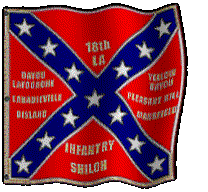
The new Louisiana Republic Flag flew for the first time Feb. 12, 1861.
(M. Jones collection)
Louisiana intelligence.

New Orleans, Feb. 12.

The new flag of Louisiana, ordered by the Convention, was unfurled to-day from the dome of the City Hall. The military were out in strong force on Lafayette Square, and formed a line opposite the City Hall. The flag was raised by Mayor Munro, amidst the huzzas of the multitude. The greatest enthusiasm was exhibited. The troops were reviewed by the Convention, and complimented on their efficiency and imposing appearance.

Judge Robertson, Commissioner from Virginia, was received in the Convention to-day.

The flag of Louisiana consists of thirteen stripes, in blue, red and white, with a yellow star on a red field. It is considered very handsome.

Monday, February 14, 2011

150-Years-Ago -- Henry Clay and Abraham Lincoln

The Richmond Dispatch
February 14, 1861

Sen. Henry Clay of Kentucky
(Library of Congress)
   In acknowledging a present of a bronze medal of Henry Clay, which some one lately sent to the Black Republican President elect, Mr. Lincoln speaks of the "extreme gratification I feel in possessing so beautiful a moment to of him whom, during my whole political life. I have loved and revered as a teacher and a leader."

   His teacher! His leader! Henry Clay the teacher of Mr. Lincoln! What lesson of Henry Clay has he learned? Wherein does he follow his leader's footsteps?
   If we were called upon to search the United States for two men who were father apart than any other two in character and public policy, we could not find such antipodes as Henry Clay and Abraham Lincoln. The solitary polar sea glittering in its framework of everlasting ice, and the mighty and genial tropie gulf, alive with the white sails of commerce and gemmed with the richest islands of the globe, are not farther apart and more dissimilar. Abraham Lincoln, the starched up, grim visaged, billions, dyspeptic Puritan, and Clay, the bright, joyous, generous, candid, noble gentleman! But in their political life, they have even less in unison than in personal character. Abraham Lincoln is the representative of sectional principles and a sectional party. The Convention which nominated him deliberately struck the word "National" out of its platform. It refused to be known by any such designation, and in that it was at least honest. It received no support in the slave States, and could claim none; and it presented Lincoln, not on his own merits but as the best available embodiment and representative of the sectional spirit. With a country rent in twain by his party, and the whole land overwhelmed with financial convulsions and distress, he has refused to speak one word which could end the war of sections and pour oil upon the troubled waters. And this is the man who has the effrontery to speak of Henry Clay as his teacher and his leader! If there was anything in the world by which Henry Clay was peculiarly and pre-eminently distinguished, it was his American spirit, embracing in its ample arms every section, every State, every little neighborhood of the American Union, and knitting one and all to his own patriotic soul with "hooks of steel." On every occasion of sectional antagonism, he stepped forward to heal the breach, and was willing himself to spring into the open chasm and perish there, if he could, by so doing, save his country. At such periods, when section was arrayed against section, when civil war was imminent, when the best and boldest held their breath in terror and amazement, the whole country looked to Henry Clay as its Pacificator, and so, on three different occasions, he proved himself, dying at last amid his struggles to preserve the Union and overcome the fell demon of sectionalism. Yet Lincoln, the first begotten of this sectional demon, has the audacity to declare himself a follower and disciple of Henry Clay! If so, he is such a follower as Benedict Arnold was of Washington, and such a disciple as was the traitor Judas.

Saturday, February 12, 2011

150-Years-Ago -- The Last of the Union in Louisiana

The Charleston Mercury
Feb. 19, 1861

[From the New Orleans Delta.]

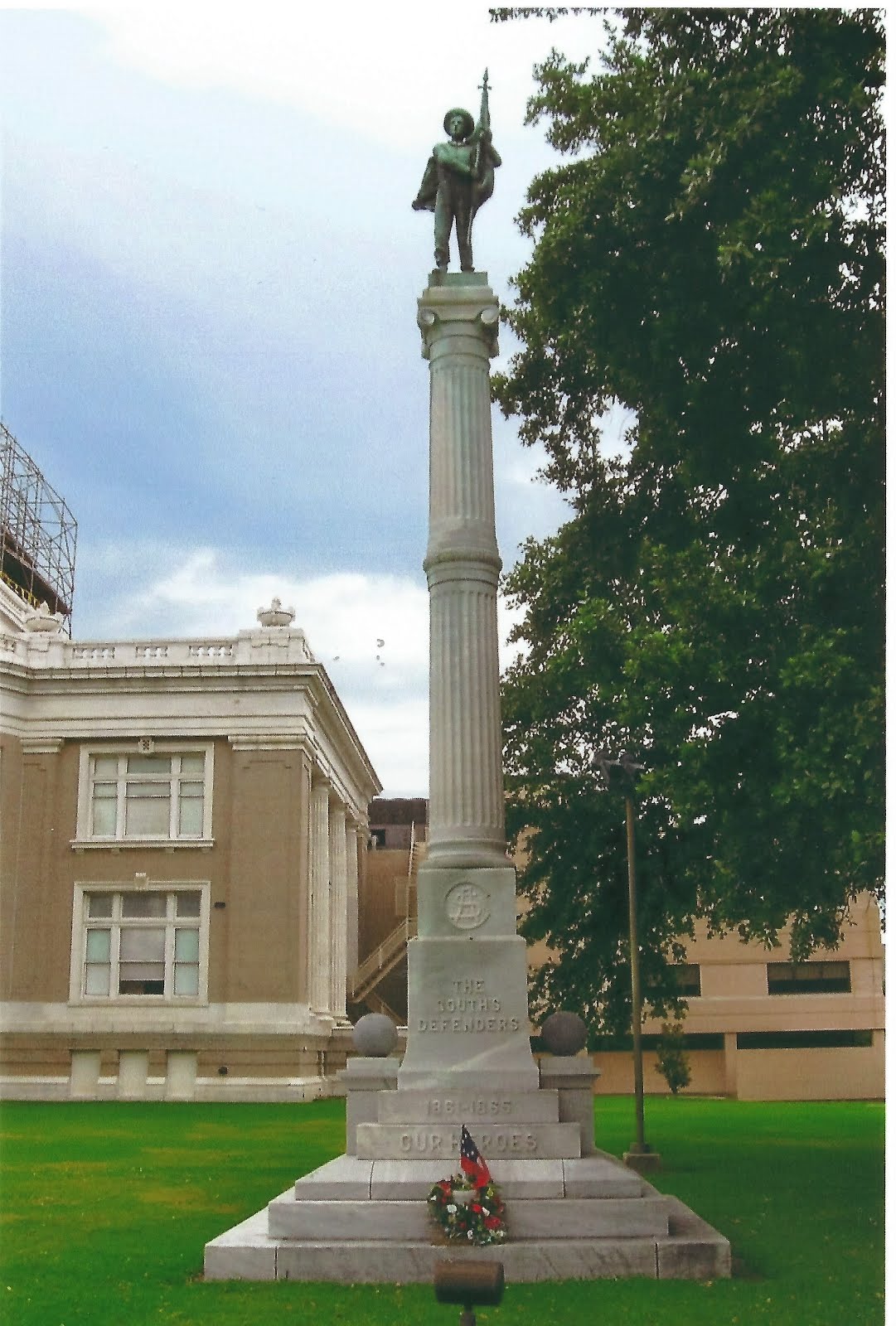
The South's Defender
The Statue of Southern Liberty!
(Photo by Mike Jones)
   Louisiana has discarded the old order, and has wedded herself to the new. Louisiana has changed her political alumnae, and inscribed her name on the roll of an era which shall date from the 26th of January, 1861. Louisiana has joined the Southern exodus; she has passed dry-shod through the chasm; she has placed a gulf of storm and water, cloud and darkness, thunder and lightning, between herself and Egypt and servitude. Let Pharaoh and his hosts follow at their peril.
   Louisiana, the great exporting State of North America; Louisiana, the State of the great Commercial Metropolis of the South; Louisiana, which sits at the seaward portal of the Mississippi Valley and its majestic Rivers; Louisiana, which, of all the slave holding States, has the strongest material reasons for pursuing a conservative policy; Louisiana has publicly, formally, and by authentic and sovereign act, repudiated a Union which was without friendship, and a despotism which could not offer even the poor boon of a tranquil servitude, and, turning away from an unsatisfying past, has gone forth, bravely and hopefully, to reap the harvests of the coming years.
   This act of Louisiana closes the lid on the coffin of the old Federal Union. Abraham Lincoln will be fortunate if he can make himself its legal administrator; he can never be representative as a living reality. The day of the temporizers and compromisers is over. The men of the past must give way to the men of the future. The statesmanship that was devoted to be perpetuation of decay must yield to the statesmanship which aims to bring out of corruption incorruption, and to cause a new and more vigorous life to blossom from the very body of death. It is a high and sacred office, and should be discharged with sacramental fervor and religious devotion. It looks to nothing less than a national palangenesis.
   Thus for the patriot and philanthropist, the friend of liberty and the friend of peace, have cause to rejoice at the means which have been used to achieve Southern independence. They have been the progress of a revolution at once orderly and irresistible, at once bloodless and effectual. Never before in the history of civilization have an insulted and injured people thus vindicated their rights without warlike collision, without carnage, and without dangerous social convulsions. Let us hope that this spectacle will be presented to the end. Let it not be the fault of the South, at least, if the drama of the revolution shall yet be marked with sword and desolated fields and burning cities. But let it always be remembered that to be armed at all points is the surest guarantee against war; that, in assertion of our rights, to speak words as hard as cannon balls, and which mean cannon balls, as the surest way of saving our liberty as well as our ammunition. Semper paratus, semper tutus.

Thursday, February 10, 2011

150-Years-Ago -- Davis and Stephens Elected President and Vice President


Jefferson Davis, elected first president
of the Confederate States of America.
 The New Orleans Daily True Delta
Alexander H. Stephens elected vice president
of the Confederate States of America.
February 10, 1861

   Montgomery, Feb. 9 -- The congress of seceded states, last night, unanimosly agreed to the constitution for a provisional government.
   A strong and vigorous government will go into immediate operation, with full powers and ample funds.
   No propositions for compromise or re-construction of the old federal Union will be intertained.
   The Congress will remain in secession to make all the necessary laws.
   Latest from Montgomery.
   Hon. Jefferson Davis, of Mississippi, has just been unanimously elected president of the Confederate States of North America. Hon. A.H.Stephens of Georgia, was elected vice-president by a similar vote.
______________


   The Contemplated Attack on Fort Sumter.
   Washington, Feb. 8 - The impression in well-informed circles is, that the question of an attack on Fort Sumter will be deferred to the southern congress; meanwhile, the South Carolina authorities will intercept reinforcements, supplies and mail matter for Maj. Anderson.
                                                                   The Peace Congress.
   Nearly all the commissoners, including those from Massachusetts and New York, have arrived.

Saturday, February 5, 2011

150-Years-Ago -- The National Crisis

The Richmond Dispatch
February 5, 1861

Fifth Company, Washington Artillery of
New Orleans, 1861.
(Copy print, M. Jones collection)

The Mississippi and Mobile Bay to be Blockaded — from Pensacola — the South Carolina Ultimatum--Union meeting at Charlestown, mass.--Kentucky, & etc., & etc.
     The Mississippi and Mobile Bay to be Blockaded.
     The New Orleans Picayune, of the 29th ult., says that the following is an extract from a private letter, from an authentic source at Vera Cruz, by the shipsteamship Tennessee:
     "It is said here, that Mr. Pickett, U. S. Consul, recently arrived on the Tennessee, has brought orders for Com. Prendergast, to blockade the mouths of the Mississippi and Mobile Bay, and protect Pensacola. It is certain that the St. Louis, the Powhatan, and the Sabine, are about to leave for your port. A meeting of the officers of these vessels has in consequence been held, at which there was much excitement. Many of the officers. Southern born, have since resigned, saying they are sons of the South, and cannot draw the sword against them. The feeling in Vera Cruz is entirely with the South."
      A large number of officers are reported to have already resigned, or expressed their intention of so doing when their States shall have seceded, but the Picayune withholds their names till officially advised. In the meantime, the Powhatan, St. Louis and Sabine may be daily expected off Pensacola, where the Macedonian has preceded them.
From Pensacola.
     A correspondent of the Mobile Advertiser writes as follows by the last steamer:
     We are at present at Warrington, with an army of one thousand six hundred or more, doing nothing. The Mississippi and Alabama boys are "spoiling" for a tight, but no prospects in advance of us for it. We can take Fort Pickens any time, but a political question behind this at present delays the assault.
      A correspondent of the Tribune writes by the same steamer:
      Mrs. Slimmer was in the Navy-Yard yesterday and kindly treated by all. Her voice is for war. She told Lieut. Slimmer he could not surrender. So much for apron-strings and petticoats.
      I saw an Alabama lady on her way down to Pensacola, following her husband, who, she said, she would stand or fall with, and be he living or dead, she would not falter to dress his wounds.
     A Pensacola letter, dated 25th Jan., states as follows:
     "Brown, of the Auburn Guards, was killed to-day by Betts, of the Tuskegee Light Infantry. All justify Betts. The offence was an insult to Mrs. Betts."
     Another dispatch states that Brown lived about an hour, during which he protested that he was not the man who insulted Mrs. Betts. He was killed with a bowie-knife, having first fired at Betts with a revolver, on the latter's making the attack.
The South Carolina Ultimatum.
      The final demand of South Carolina for the surrender of Fort Sumter, it is understood, has been responded to negatively by the President, with the assurance that the fort would not be reinforced, unless demanded by Major Anderson. The impression exists in this city that this reply of the President will be laid before the Congress which is now in session at Montgomery, and that the future military operations in the harbor of Charleston and at Pensacola will be given in charge of the Provisional Government, to be established for the Southern Confederacy. It may, therefore, be expected that Commissioners appointed by the Congress will be sent to Washington, making the demand in the name of the six seceding States for the surrender of all the forts and public property in their respective States. This, if so, will occasion further delay, and give time for the action and interposition of the Peace Congress of the Border States between the belligerents.--Wash. Cor Balto. Amer.
Union meeting at Charlestown, mass.
     Boston,Feb. 2.--A great Union meeting was held at Charlestown to-night. The speakers included Hon. Edward Everett, Messrs. Salsonstall, James Danna, and Richard Frottingham, Jr.
Resolutions were adopted as follows:
     Resolved, That this meeting concurs most heartily in the sentiment expressed by Hon. Wm. H. Seward, viz: "That the question of slavery is not now to be taken into account. We are to save the Union first, and will then save all that is worth saving."
     Resolved, That we earnestly hope that the proposition of Hon. Mr. Crittenden be adopted as the basis of a settlement of the impending perils of the United States, as the only practicable plan that all sections can finally and honorably adopt, which is all that human wisdom has been able to offer our distracted country.
     Resolved, That the proceedings of this meeting be forwarded to Senator Crittenden, with the request to present them to the Senate as the voice of the Union men of Bunker Hill.
     A call has been issued for a mass Union meeting of the people of Massachusetts, in Faneuil Hall, on next Tuesdaynight.
     The House, in secret session to-day, considered the bill appropriating $100,000 to the emergency fund. It was passed, under suspension of the rules.
Kentucky.
     On Friday, the Kentucky Senate, by a very decisive vote, passed a resolution declaring it inexpedient at this time to take any action towards calling a State Convention. The Senate has also made an appeal to the South to stop the revolution, and to Congress to call a National Convention, and proposes adjourning over to the 24th April to await a response to these appeals.
Another Resignation.
     Mr. Henry Myers, who has been for some years in the United States Navy as Purser, we learn, has resigned his post. Mr. Myers is a native of Savannah, and has made this sacrifice for the honor of the State of Georgia.
Friday, February 4, 2011

150-Year-Ago -- FORMATION OF CONFEDERATE STATES OF AMERICA BEGINS & LIST OF FOUNDING FATHERS

The Charleston Mercury
February 4, 1861

The Southern Congress.
    To-day meets a body  charged with the duty of constructing a Confederate Government for those States which have seceded from the Union of the late United States. It is a grave mission. Since the framing of the United States Constitution and Government, no work of such magnitude and importance has been imposed upon any statesmen in this country. The counsels now Inaugurated are fraught with the destinies of the Southern people.

The Members.
     The following is a full list of gentlemen appointed to represent their respective States in the Southern Congress:
Robert B. Rhett, South Carolina delegate.
(Library of Congress)
SOUTH CAROLINA.
R.B. Rhett.
James Chesnut, Jr.
W.P. Miles.
T.J. Withers.
R.W.Barnwell.
C.G.Memminger.
L.M.Keitt.
W.W. Boyce.
FLORIDA.
Jackson Mortaon
J. Patten Anderson.
James Powers.
MISSISSIPPI.
W.P. Harris.
Walter Brooke.
W.S. Barry.
W.S. Wilson.
A.M. Clayton.
James T. Harris.
Howell Cobb, Georgia delegate.
(Library of  Congress)
J.A.P. Campbell.
ALABAMA.
R.W. Walker.
R.H. Smith.
C.J. McRae.
J.G. Shorter.
W.P. Chilton.
S.F. Hale.
D.P. Lewis.
T. Fearn.
J.L.M. Curry
 GEORGIA.
Robert Toombs.
Howell Cobb.
F.S.Bartow.
M.J. Crawford.
Duncan Kenner, Loiuisiana delegate.
(Ascension Parish Library)
E.A. Nisbet.
B.H.Hill.
A.R. Wright.
T.R.R. Cobb.
A.H. Kenan.
Alex. H. Stephens.
LOUISIANA.
J. Perkins, jr.
A. Duclouet.
C.M. Conrad.
Duncan F. Kenner.
E. Sparrow.
Henry Marshall.
NORTH CAROLINA (commissioners.)
Ex.-Governor Swain.
J.L. Bridges.
M.W.Ransom.


Tuesday, February 1, 2011

150-Years-Ago -- TEXAS GONE OUT!


Gov. Sam Houston refused to take the
oath of office to the Confederacy after
Texas seceded from the Union
(Library of Congress)
 By Mike Jones
   Texas became the seventh Southern state to assume its sovereign independent status when delegates to the Texas state secession convention passed an ordinance of secession from the United States on February 1, 1861. The passing margin of the vote was 166 to 8. The convention delegates cited the federal government's misuse of power against the Southern people. Texas resumed its status an independent republic, which it had been between 1836 to 1845 when it first joined what was then a voluntary union of sovereign independent united states. The people of Texas ratified the convention's action on February 23, 1861 and the ordinance became effective as of March 2, 1861, which was the 25th anniversary of the Texas Declaration of Independence from Mexico.
   Texas then became the seventh state to join the newly formed Confederate States of America. Governor Sam Houston refused to recognize the authority of the convention, but accepted the decision of the voters to approve secession. However he declined to take the oath of allegiance to the Confederacy and he was removed from office by the convention. Lt. Gov. Edward Clark succeeded Houston and did take the oath. Ironically Houston's son, Sam Houston Jr., served in the Confederate army as a member of the 2nd Texas Infantry. Houston Jr. served faithfully in the army and was severely wounded at the Battle of Shiloh.
Brig. Gen. Ben McCulloch
(Library of Congress)
   The Committee of Public Safety completed the new Texas revolution by securing the surrender of federal troops and property in Texas. Commissioners negotiated with Gen. David E. Twiggs, commander of U.S. troops in the state, for the surrender without success. Former Texas Ranger Ben McCulloch assembled a force of Texans, many who were members of the Knights of the Golden Circle, in San Antonio and took Twiggs into custody on February 16, 1861. Twiggs, a native of Georgia with southern sympathies, agreed to surrender his troops and federal property to the state. The U.S. soldiers were allowed to retain their sidearms and exit the state with honor.
   Twiggs soon was dismissed from the U.S. Army and became a Confederate general in command of the troops forming at New Orleans. Twiggs died July  15, 1862 at age 72. McCulloch went on to become a Confederate general and was killed in action at the Battle of Elk Horn Tavern, Arkansas on March 7, 1862. Sam Houston died in 1863 at his home in Huntsville, Texas.
Two Confederate soldiers, with the one at
right holding a Ben McCulloch colt revolver.
(Library of Congress)