Saturday, January 19, 2013

HAPPY BIRTHDAY GENERAL LEE!


[Below is an excerpt about General Robert E. Lee from The Story of a Soldier’s Life by Field-Marshal Viscount Wolseley. This is a tribute to General Lee on the occasion of his 206th birthday anniversary, January  19, 2013.]

General Robert E. Lee
Robert E. Lee described as 'ablest general' - 'greatest man' by Lord Wolseley

                As soon as I could do so I proceeded to General Lee’s Headquarters, about six miles out of town, on the road to  Harper’s Ferry. Every incident in that visit to him is indelibly stamped on my memory. I have taken no special trouble to remember all he said to me then and during subsequent conversations, and yet it is still fresh in my recollection.  But it should be so, for he was the ablest general, and to me, seemed the greatest man I ever conversed with; and yet I have had the privilege of meeting Vom Moltke and Prince Bismark, and at least upon occasion had a very long and intensely interesting conversation with the latter. General Lee was one of the few men who ever seriously impressed and awed me with their natural, their inherent greatness. Forty years have come and gone since our meeting, yet the majesty of his manly bearing, the genial winning grace, the sweetness of his smile and the impressive dignity  of his old-fashioned style of address, come back to me amongst my most cherished recollections. His greatness made me humble, and I never felt my own individual insignificance more keenly than I did in his presence. He was the about fifty years of age, with hair and beard nearly white. Tall, extremely handsome and strongly built, very soldier-like in bearing, he looked a thoroughbred gentleman. Care had, however, already wrinkled his brow, and there came at moments a look of sadness into his clear, honest, and speaking dark brown eyes that indicated much his overwhelming national  responsibility had already told upon him. As he listened to you attentively, he seemed to look into your heart and to search your brain. He spoke of the future with confidence, though one could clearly see he was of no very sanguine temperament. He deplored the bitterness introduced into the struggle, and also the treatment of the Southern folk who fell into hostile hands. But there was no rancor in his tone when he referred to the Northern Government. Not even when he described how they had designedly destroyed his home at Arlington Heights, the property on the Potomac he had inherited from General Washington. He had merely “gone with his State” – Virginia – the pervading principle that had influenced most of the soldiers I spoke with during my visit to the South. His was indeed a beautiful character, and of him it might truthfully be written: “in righteousness he did judge and make war.”

Gen. Lord Wolseley
Who was Viscount Wolseley?
      Garnet Joseph Wolseley, the First Viscount of Wolseley, was one of the great British generals of the last half of the 19th Century. He was known as a tireless advocate of modernization of the British Army and was the "go-to" man whenever there was trouble in some far-flung area of the British Empire.
      He was  the son of a British Army officer born June 4, 1833 in Dublin, Ireland. Wolseley was educated in Dublin and commissioned into the British Army in  1852 in the King's Own Borderers, but transferred to the 80th Regiment of Foot. He served in the Second Burmese War, wounded at the Battle of Donabyu; the Crimean War in Russia;  the Indian Mutiny; the Anglo-French Expedition to China in 1860; the Fenian Invasion of Canada; the Ashanti Campaign in Africa; the Egyptian Army revo0lt; attempted to relieve Gordon at Khartoum; and the Boer War, 1899-1902.
      Wolseley was promoted to Field Marshal in 1894 and to Commander in Chief of the British Army, 1895-1901. He retired in 1903 and died March 26, 1913 in Mertone, France.
      In October, 1862, while stationed in Canada, took a leave of absence to  visit the Confederate Army. He had interviews with both General Robert E. Lee and Lieutenant General Thomas J. "Stonewall" Jackson. Wolseley left behind his impressions in his auto-biography and in periodical articles.


Thursday, January 17, 2013

150-Years-Ago -- The Battle of Prairie Grove, Arkansas 7 Dec. 1862


[Battle Summary, National Park Service]


Maj. Gen. Thomas C.
Hindman
 (Library of Congress)
          Maj. Gen. Thomas C. Hindman sought to destroy Brig. Gen. Francis Herron’s and Brig. Gen. James Blunt’s divisions before they joined forces. Hindman placed his large force between the two Union divisions, turning on Herron first and routing his cavalry. As Hindman pursued the cavalry, he met Herron’s infantry which pushed him back. The Rebels then established their line of battle on a wooded high ridge northeast of Prairie Grove Church. Herron brought his artillery across the Illinois River and initiated an artillery duel. The Union troops assaulted twice and were repulsed. The Confederates counterattacked, were halted by Union canister, and then moved forward again. Just when it looked as if the Rebel attack would roll up Herron’s troops, Blunt’s men assailed the Confederate left flank. As night came, neither side had won, but Hindman retreated to Van Buren. Hindman’s retreat established Federal control of northwest Arkansas.

150-years-ago VAN DORN'S RAID AT HOLLY SPRINGS, MISS. 20 Dec. 1862


The Richmond Daily Dispatch
Jan. 15, 1863
Van-Don's brilliant Cavalry raid
interesting particulars.
Gen. Earl Van Dorn
(Library of Congress)
          The recent cavalry raid of Gen. [Earl] Van-Dorn in the West was one of the most brilliant feats of the war, not falling short of any that have been made by the renowned Stuart or ubiquitous Morgan. A correspondent of the Mobile Register gives the following interesting particulars of his brilliant achievements in the vicinity of Holly Springs, Miss:
          Van-Dorn took a by-way and meandering route through the swamp, and came within eight miles of Holly Springs in the evening, where he bivouacked his force until two hours before day, when he moved cautiously into town, leaving the Texas brigade upon the heights outside as a reserve. As our forces dashed in from all sides, the entrance proved a complete surprise, the breaking streaks of daylight showing the Yankee tents with their yet undisturbed slumberers. A charge was ordered upon them, and the torch applied to the canvas which covered them. To paraphrase "Belgium's" picture--

"Ah, then and there was hurrying to and fro,
And, running in hot haste
And checks all pals and blanched with woe,
Exhibiting Yankees cowardice"

          The rapidity with which the tents of the enemy were vacated was marvelous; and impelled by burning torches and rapid discharges of side arms, the Yankees took no time to prepare their toilets, but rushed out into the cool atmosphere of a December morning clothed very similarly to Joseph when the lady Potiphar attempted to detain him. The scene was wild, exciting, tumultuous. Yankees running, tents burning, torches flaming, Confederates shouting, guns popping, sabres clanking, Abolitionists begging for mercy, "rebels" shouting exultingly, women en dishabille clapping their hands, frantic with joy, crying "kill them, kill them"--a heterogeneous mass of excited, frantic, frightened human beings, presented an indescribable picture, more adapted for the pencil of Hogarth than the pen of a newspaper correspondent.
            The surprised camp surrendered 1,800 men and 150 commissioned officers, who were immediately paroled. And then commenced the work of destruction. The extensive buildings of the Mississippi Central depot, the station house, the engine houses, and immense store houses, were filled with supplies of clothing and commissary stores. Outside of the depot the barrels of flour, estimated half a mile in length, one hundred and fifty feet through, and fifteen feet high. Turpentine was thrown over this, and the whole amount destroyed — up town, the court house and the public buildings, livery stables, and all capacious establishments, were filled, ceiling high with medical and ordnance stores. These were all fired, and the explosion of one of the buildings, in which was stored one hundred barrels of powder, knocked down nearly all the houses on the south side of the square.
       Surely such a scene of devastation was never before presented to the eye of man. Glance at the gigantic estimates: 1,809,000 fixed cartridges and other ordnance stores, valued at $1,500,000, including 5,000 rifles and 2,000 revolvers, 100,000 suits of clothing and other quartermaster stores, valued at $500,000; 5,000 barrels of flour and other commissary stores, valued at $500,000.
$1,600,000 worth of medical stores, for which invoices to that amount were exhibited, and 1,000 bales of cotton and $600,000 worth of sutlers' stores!
          While the capture of the camp, paroling of the prisoners, and destroying of the stores was going on, the Texas Rangers, comprising the 9th, 6th, and 3d legions, became engaged with the Michigan cavalry, and drove them pell-mell through town and run them off north, with a considerable lose to the Abolitionists, and a loss of thirty in killed and wounded on our part.
          The ladies rushed out from the houses, wild with joy, crying out: "There's some at the Fair Grounds. Chase them, kill them, for God's sake!" One lady said: "The Yankee Commandant of the Post is in my house; come and catch him;" and a search was instigated, but without success, when the noble woman insisted that he was there, concealed; and finally, after much ado, the gallant (save the mark!) Colonel Murphy, the intrepid Yankee Commandant of Holly Springs, was pulled out from under his bed, and presented himself in his nocturnal habiliments to his captors.
          The Provost Marshal was also taken, and, addressing General Van Dorn, said: "Well, General, you've got us fairly this time. I knowed it. I was in bed with my wife when I heard the firing, and I at once said: "Well, wife, it's no use closing our eyes, or hiding under the cover; we've gone up."
          Our attention was given to Grant's headquarters, which he had left twenty-four hours before. All his papers, charts, maps, etc., were captured, together with his splendid carriage, which was burned. Among his papers was found a pass, to pass the bearer over all railroads and steamboats in the United States, at Government expenses; to pass all pickets and guards, and other papers, at once interesting and valuable. Mrs. Grant was also captured, but no indignity was offered to her.
Nearly every store on the public square was filled with sutler stores, and after our men had helped themselves the balance of the goods were burned.
           When our forces first reached the depot, there was a train about leaving. The engineer jumped off and run away, and one of our men took his place, shut the throttle valve, and stopped the train. Sixty cars and two locomotives were then tired and destroyed.
          After the complete destruction of all public property about the place, and after each man had supplied himself with a suitable quantity of clothing and boots, at six o'clock in the morning the march was renewed, and Davis's mill was the next place attacked. Here the enemy were entrenched, and sheltered themselves in a block house and fort formed of cotton bales. The cavalry were commanded to charge, and attempted to do so; but the swamp and intricate lagoons breaking off in front of the enemy's position would not permit it. The Yankees opened fire with some effect from their fort, and were supported by a 9-pound rifled gun, mounted on an iron- clad railroad car, forming a railroad battery.
            The Texans were again ordered to charge, and Major Dillon, of Van Dorn's staff, whose gallantry during the expedition was particularly conspicuous attempted to lead them to the attack; but the men refused to follow, believing the way impassable and the position too strong for cavalry demonstration alone. Col. McCullough, of the Missouri cavalry, was ordered to get in the rear of the railroad battery, cut the track to prevent its escape, and capture it. I believe he succeeded in cutting the road, but our forces were compelled to withdraw, and the steam battery was not taken. The force then pushed on to Middleburg and Bolivar, and attacked both places, but found them too strongly defended and garrisoned to succeed in taking either of the points.
            When the command turned back after its unsuccessful attack upon Bolivar the enemy sent a force of 10,000, comprising the three branches of the service, out after Van Dorn, and made great efforts to flank and cut off its force; but this dashing officer was too wary for them, and succeeded in returning with 400 head of captured horses and mules, laden with spoils taken from the enemy.
The people of Tennessee are represented as having been almost frantic with joy at the appearance of our forces once more upon their borders. They fed our soldiers with a bountiful hand, and wept for joy. "Thank God, you have come at last!" one and all exclaimed.--Their hospitality was not a little surprising to our soldiers, who have been so uniformly swindled and extorted from in Mississippi.--The people of Tennessee had been induced to believe that Gen. Grant's headquarters were at Jackson, Miss., and that our whole army had been captured. Judge, then, of their surprise, when they were visited by Van-Dorn's command.
           The entire number of prisoners captured and paroled during the raid is 2,100 privates and 175 commissioned officers.

Monday, January 14, 2013

150-Years-Ago NEWS REPORTS ON GALVESTON VICTORY

U.S.S. Westfield being blown up by its commander, Commodore
William B. Renshaw, killed accidentally in the explosion,
Jan. 1, 1863 at Galveston. (U.S. Naval Historical Center)
The Richmond Daily Dispatch
January 10, 1863

Latest from New Orleans.
Brilliant naval Exploit.
the "Harriet Lane" captured!
another shipsteamer
Blown up with all on Board.
Mobile, Jan'y 8.
     A special dispatch, dated Jackson to-day, says the New Orleans Delta, of the 6th, received at Ponchtonia, contains the following:
     About 2 o'clock on New Year's morning, four rebel gunboats came down Buffalo Bayou into Galveston Bay, and ran alongside the shipsteamer Harriet Lane, one on each side. The Texan sharp-shooters then commenced an assault on her, and soon succeeded in killing all the gunners and Capt. Wagnewyth, her commander. The assailants then boarded her, and after a desperate struggle, captured the vessel.
     The rebel gunboats were lined and fortified with cotton bales, after the manner of the boats in New Orleans known as the Montgomery fleet.
      The Westfield, under Commander Renshaw, determined not to be taken, and, after a consultation, officers and men all agreeing, they blew her up, with all on board, including the commander. Only eight escaped.
      The balance of the Yankee fleet, and one transport, escaped. Two coal boats at the wharf, with two companies of the 42d Massachusetts Regiment, were captured.
       A Federal vessel was pinched to reconnoitre around the harbor to watch the Harriet Lane and prevent the Confederates sending her to sea.

Official account of the Affair.
      The following official dispatch from Major-Gen. Magruder was received at the War Department yesterday. It came via Natchez:
Maj. Leon Smith, Texas Marine Dept.
(Six Decades in Texas)
Headq'rs Galveston, Texas.
      This morning, the 1st January, at 3 o'clock, I attacked the enemy's fleet and garrison at this place, and captured the latter and the shipsteamer
      Harriet Lane, and two barges, and a schooner of the former. The rest, some four or five, escaped ignominiously under cover of a flag of truce. I have about six hundred prisoners and a large quantity of valuable stores arms, etc. The Harriet Lane is very little injured. She was carried by boarding from two high-pressure cotton steamers, manned by Texas cavalry and artillery. The line troops were gallantly commanded by Colonel Green, of Sibley's brigade, and the ships and artillery by Maj Leon Smith, to whose imitable energy and heroic daring the country is indebted for the successful execution of a plan which I had considered for the destruction of the enemy's fleet--Col. Bagby, of Sibley's brigade, also commanded the volunteers from his regiment for the naval expedition, in which every officer and every man won for himself imperishable renown.
(Signed) J. Bankhead Magruder,

Major General.

Thursday, January 10, 2013

150-Years-Ago - Sinking of the USS Hatteras by the CSS Alabama

Admiral Raphael Semmes
(Service Afloat)

[Editor’s note: Excerpted from  Memoirs of Service Afloat During the War Between the States by Admiral Raphael Semmes, Baltimore, Md., 1869]
In the interval between our leaving the West Indies, and arriving off Galveston, this city had been retaken by General Magruder, assisted by a gallant seaman of the merchant service, Captain Leon Smith. Smith, with a couple of small river steamers, protected by cotton bags, and having a number of sharp-shooters on board, assaulted and captured, or drove to sea the enemy’s entire fleet, consisting of several heavily armed steamships.
What was best to be done in this changed condition of affairs? I certainly had not come all the way into the Gulf of Mexico, to fight five ships of war, the least of which was probably my equal. And yet, how could I very well run away, in the face of the promises I had given my crew? for I had told them at the Arcas islands, that they were, if the fates proved propitious, to have some sport off Galveston. Whilst I was pondering the difficulty, the enemy himself, happily, came to my relief; for pretty soon the look-out again called from aloft, and said, “One of the steamers, sir, is coming out in chase of us.” The Alabama had given chase pretty often, but this was the first time she had been chased. It was just the thing I wanted, however, for I at once conceived the design of drawing this single ship of the enemy far enough away from the remainder of her fleet, to enable me to decide a battle with her before her consorts could come to her relief.
At length, when I judged that I had drawn the stranger out about twenty miles from his fleet, I furled my sails, beat to quarters, prepared my ship for action, and wheeled to meet him. The two ships now approached each other, very rapidly. As we came within speaking distance, we simultaneously stopped our engines, the ships being about one hundred yards apart. The enemy was the first to hail. “What ship is that?” cried he. “This is her Britannic Majesty’s steamer Petrel,” we replied. We now hailed in turn, and demanded to know who he was. The reply not coming to us very distinctly, we repeated our question, when we heard the words,“This is the United States ship ——” the name of the ship being lost to us. But we had heard enough. All we wanted to know was, that the stranger was a United States ship, and therefore our enemy. A pause now ensued—a rather awkward pause, as the reader may suppose. Presently, the stranger hailed again, and said, “If you please, I will send a boat on board of you.” His object was, of course, to verify or discredit the answer we had given him, that we were one of her Britannic Majesty’s cruisers. We replied, “Certainly, we shall be happy to receive your boat;” and we heard a boatswain’s mate call away a boat, and could hear the creaking of the tackles, as she was lowered into the water.
The USS Hatteras, right, beginning to sink following its classic sea battle
with the CSS Alabama off Galveston, January 11, 1863.
(US Naval Historical Center)
Things were now come to a crisis, and it being useless to delay our engagement with the enemy any longer, I turned to my first lieutenant, and said, “I suppose you are all ready for action?” “We are,” he replied; “the men are eager to begin, and are only waiting for the word.” I then said to him, “Tell the enemy who we are, for we must not strike him in disguise, and when you have done so, give him the broadside.” Kell now sang out, in his powerful, clarion voice, through his trumpet, “This is the Confederate States steamer Alabama!” and turning to the crew, who were all standing at their guns—the gunners with their sights on the enemy, and lock-strings in hand—gave the order, fire! Away went the broadside in an instant, our little ship feeling, perceptibly, the recoil of her guns. The night was clear. There was no moon, but sufficient star-light to enable the two ships to see each other quite distinctly, at the distance of half a mile, or more, and a state of the atmosphere highly favorable to the conduct of sound. The wind, besides, was blowing in the direction of the enemy’s fleet. As a matter of course, our guns awakened the echoes of the coast, far and near, announcing very distinctly to the Federal Admiral—Bell, a Southern man, who had gone over to the enemy—that the ship which he had sent out to chase the strange sail, had a fight on her hands. He immediately, as we afterward learned, got under way, with theBrooklyn, his flag-ship, and two others of his steamers, and came out to the rescue.
Our broadside was returned instantly; the enemy, like ourselves, having been on his guard, with his men standing at their guns. The two ships, when the action commenced, had swerved in such a way, that they were now heading in the same direction—the Alabama fighting her starboard-broadside, and her antagonist her port-broadside. Each ship, as she delivered her broadside, put herself under steam, and the action became a running fight, in parallel lines, or nearly so, the ships now nearing, and now separating a little from each other. My men handled their pieces with great spirit and commendable coolness, and the action was sharp and exciting while it lasted; which, however, was not very long, for in just thirteen minutes after firing the first gun, the enemy hoisted a light, and fired an off-gun, as a signal that he had been beaten. We at once withheld our fire, and such a cheer went up from the brazen throats of my fellows, as must have astonished even a Texan, if he had heard it. We now steamed up quite close to the beaten steamer, and asked her captain, formally, if he had surrendered. He replied that he had. I then inquired if he was in want of assistance, to which he responded promptly that he was, that his ship was sinking rapidly, and that he needed all our boats. There appeared to be much confusion on board the enemy’s ship; officers and crew seemed to be apprehensive that we would permit them to drown, and several voices cried aloud to us for assistance, at the same time. When the captain of the beaten ship came on board to surrender his sword to me, I learned that I had been engaged with the United States steamer Hatteras, Captain [H.C.] Blake.
There was very little said by the enemy, about this engagement, between the Alabama and the Hatteras, as was usual with him when he met with a disaster; and what was said was all false. My own ship was represented to be a monster of speed and strength, and the Hatteras, on the other hand, to be a tug, or river steamer, or some such craft, with two or three small guns at the most. The facts are as follows: The Hatteras was a larger ship than the Alabama, by one hundred tons. Her armament, as reported to us by her own people, was as follows: Four 32-pounders; two Parrot 30-pounder rifles; one 20-pounder rifle; and one 12-pounder howitzer—making a total of eight guns. The armament of the Alabama was as follows: Six 32-pounders; one 8-inch shell gun; one Blakeley rifle of 100 pounds—total, eight guns. There was, besides, a little toy-rifle—a 9-pounder—on the quarter-deck of the Alabama, which had been captured from a merchant-ship, and which, I believe, was fired once during the action. The crew of the Hatteras was 108 strong; that of the Alabama110. There was thus, as the reader sees, a considerable disparity between the two ships, in the weight of their pivot-guns, and the Alabama ought to have won the fight; and she did win it, in thirteen minutes—taking care, too, though she sank her enemy at night, to see that none of his men were drowned—a fact which I shall have occasion to contrast, by-and-by, with another sinking. The only casualty we had on board the Alabama was one man wounded. The damages to our hull were so slight, that there was not a shot-hole which it was necessary to plug, to enable us to continue our cruise; nor was there a rope to be spliced. Blake behaved like a man of courage, and made the best fight he could, ill supported as he was by the “volunteer” officers by whom he was surrounded, but he fell into disgrace with the Demos, and had but little opportunity shown him during the remainder of the war, to retrieve his disaster.
[Editor's note: The casualties on both sides were amazingly light. The  Hatteras had two men killed and five wounded. As Admiral Semmes noted, only one man was slightly wounded on the Alabama.]

Saturday, January 5, 2013

A PHOTO SURVEY OF THE BATTLE OF GALVESTON

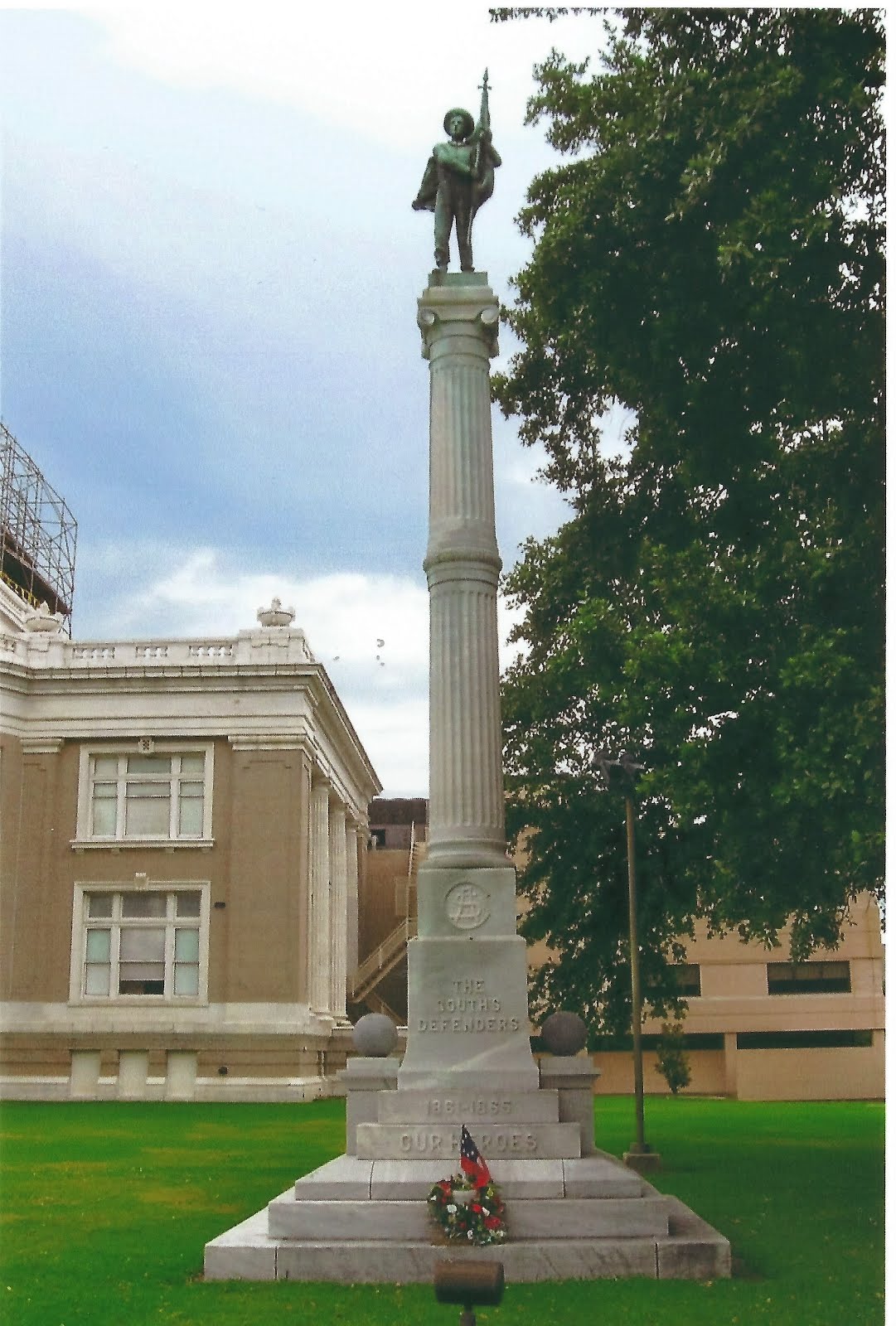
The recently refurbished 1911 Confederate Monument
in front of the Galveston Courthouse. It was rededicated
in June 2012.

 
Here are some photographs of historic sites in Galveston related to the Battle of Gavleston by Mike Jones.


Another view of the Confederate Monument.


The Hendley Building, seen here, played a prominent role
in the battle. The first shot of the battle was fired from near
here at 20th and Strand by General Magruder.
Scars of the battle are still
visible on the building.

A view of Galveston Harbor and the approximate
location of Kuhn's Wharf, which no longer exists.
It is not far from the Hendley Building at 20th and
Strand. The main part of the Battle of Galveston
was fought in this area.


The 1861 Custom House at Post Office Street, now the
headquarters of the Galveston Historical Foundation at
520 20th Street, suffered damage in the battle. It is
beautifully restored.


Monday, December 31, 2012

150-Years-Ago -- THE BATTLE OF GALVESTON

By Mike  Jones
     The Battle of Galveston, Texas, January 1, 1863, was a resounding Confederate victory after a string of stunning losses on the Louisiana and Texas gulf coasts in 1862. New Orleans was lost in April 1862 and Galveston October 4, 1862. A series of successful raids along the coast also demoralized the Confederate populace even more. But President Jefferson Davis had sent a man to Texas who would dramatically turn things around -- Major General John Bankhead Magruder.
Maj. Gen. J.B. Magruder
(Cdv, author's collection)
      Magruder was a fighter. He was also very innovative, crafty and aggressive. A native Virginian, West Point graduate, and veteran of the Seminole and Mexican Wars, Magruder arrived in Texas in November, 1862 and immediately went about developing a plan to take back Galveston. He knew he didn't have much time. A U.S. Navy  flotilla had taken the city without resistance October 4, but occupation troops had not yet arrived, so it had a very tentative hold on the city. When the Federal Army arrived in force, it would be practically impossible to dislodge them or prevent an invasion of the Texas mainland. The  target for the Federals was Houston, which was an important railroad hub for the state, much like Atlanta was for Georgia. Whoever controlled Houston, effectively controlled Texas.
      The bulk of the Confederate Army of the Trans-Mississippi was then tied up in Louisiana dealing with the Federal build up at New Orleans. Magruder had to  cobble together the meager troops available to him to take back the important port city of Galveston. He was able to assemble some Sibley's Texas cavalry which had returned from its failed New Mexico Campaign, some of the coastal defense forces, mainly 1st Texas Heavy Artillery Regiment, Pyron's Texas Cavalry Regiment and portions of the Griffin's 21st Texas Infantry  Battalion and the 20th Texas Infantry Regiment. He also had two riverboat steamers, the Neptune and Bayou City, fitted out with a few artillery pieces and cotton bales were stacked around the decks, thus transforming them into "cottonclad" gunboats. The two vessels were manned by portions of the 5th Texas Cavalry and the 7th Texas Cavalry to serve as boarding troops, thus transforming the cavalrymen into "horse marines. He also had 14 light artillery pieces and 6 pieces of heavy artillery for his innovative land-sea attack. Altogether there were about 1,500 Confederates for the operation. The Confederate cottonclads were under the command of Major Leon Smith of the Texas Marine Department and the Confederate land forces under Brig. Gen. William Scurry. Magruder was the overall commander.
Cottonclads Neptune and Bayou City on their way to Galveston to attack the
Federal fleet. ( From Six Decades in Texas)
       Magruder's plan was to launch a surprise attack early in the morning of New Year's Day, 1863. The land troops would get in place in the Galveston city, then  the cottonclads would attack the Federal fleet in the harbor when they heard the land attack beginning. About 500 Confederates would storm the Federals lodged on Kuhn's Wharf.
       The Federal fleet had been reinforced on Christmas Day by several companies, about 260 men, of the 42nd Massachusetts Infantry under Colonel Isaac Burrell. They set up a defensive position on Kuhn's Wharf, under the protection of the navy  gunboats. Burrell could send out patrols in the daytime, but had to withdraw into his defenses on the wharf at night. The gunboat fleet in the harbor at that time consisted of the U.S.S. Harriet Lane, U.S.S. Clifton, U.S.S. Westfield, U.S.S.Oawasco, and U.S.S. Corysephus. Commodore W.B. Renshaw on his flagship, the Westfield, was in overall command. Although outnumbered in manpower, the Federals had a decided advantage in firepower with the heavy guns on the gunboats.
      Magruder's plan went awry from the beginning. The cottonclads arrived too early after midnight and were spotted by the gunboats. Smith had the Confederate ships withdraw and wait on the land forces to get into place. It took Magruder longer than expected to get across the two mile long railroad bridge and into place in the city. It was about  4 p.m. when all the units were in their assigned places. Magruder then fired the first shot of the battle from a field place at the end of 20th Street near the Hendley building, which still stands in Galveston today. By that time both the Federal troops on the wharf and the gunboats in the harbor were ready and waiting. The cottonclads had withdrawn too far away to immediately attack the Federal ships, the small Confederate guns and six heavy pieces had to duel it out  with the heavily armed gunboats. Confederate infantry and cavalry kept the Massachusetts infantry pinned down on the wharf during the artillery duel.
      The Confederate artillery was clearly getting the worst of the duel and about 5 a.m. the storming party, led by Colonel Joseph Cook of the 1st Texas Heavy  Artillery, led the assault. The  Yankee infantry had pulled up planks of the wharf in two places so they attackers couldn't sweep across it. The Massachusetts men had suffered no casualties during the artillery duel. So, the 42nd Massachusetts was ready to open up with a deadly fire on the storming party. The Confederates splashed into the water with scaling ladders, while some men went onto the wharf and fired from the first break in the walkway. The scaling ladders proved to be too short, and the firepower of the enemy infantry and heavy firepower of the fleet was too much for the Confederate infantry. The assault was a failure and the attackers retreated. With daylight approaching, Magruder had the entire Confederate land force take shelter behind the buildings of the city, such as the Custom's House, still there today.
The U.S.S. Harriet Lane, center, being attacked by the C.S.S. Bayou City
and C.S.S. Neptune at the Battle of Galveston.
(U.S. Naval Historical Institute)
      Just when it seemed the Union was winning, the Confederate cottonclads arrived and the Neptune and Bayou City immediately went for the Harriet Lane, the closest and most powerful of the gunboats. The Bayou City attacked first, trying to ram and board the Union vessel, but just grazed it and damaged its wheelhouse. It had to turn around for another try. Captain Wier, commanding the heavy artillery piece on the Bayou City, was killed when the gun exploded. The Neptune succeeded in ramming the Harriet Lane, but it also suffered the most damage and received a blast from the gunboat's heavy guns and was beginning to sink. The Neptune pulled away and partially sank near the shore in 8 feet of water. The sharpshooters on board were able to keep up their fire from the steamers upper deck. The Bayou City came around and also turned the battle around by successfully ramming the Harriet Lane. Smith led the boarding party onto the Federal ship and successfully took it over. The Harriet Lane's commander, Captain Jonathan Wainwright was killed, as was his executive officer, Lt. Cmdr. Edward Lea. The rest of the crew surrendered. The two were buried with military and masonic honors in Galveston's Episcopal Cemetery. Lea's father, Lt. Col. A. M. Lea, on Magruder's staff, was at his son's side when he died.
      Meanwhile, the Westfield had grounded and never got into the fight. Renshaw thought he was being attacked by ironclads and so ordered the fleet out to sea. Captain Lubbock of the Bayou City bluffed the Federals into a three hour cease fire and demanded surrender. Before the Confederates could get to Renshaw, the fleet commander tried to blow his ship up to prevent its capture, but was himself blown up with it when the demolition charge went off to soon. The rest of the fleet skulked out under the truce flag. The Confederates had won and recaptured Galveston. With the fleet gone, the 42nd Massachusetts surrendered.
     The Southerners lost 26 men killed and 117 wounded. The Federals lost about 370 men captured, including 150 battle casualties, killed and wounded.  The Harriet Lane was  captured intact, the Westfield was destroyed and some auxiliary ships captured. It was a great victory for Magruder and the Confederates. The triumph was the first and only time the Confederacy would recover one of its captured ports and hold it until the end of the war.