Monday, April 8, 2013

150-years-ago -- An English Picture of Confederate Headquarters.

Robert E. Lee

The  Richmond Daily Dispatch
April 27, 1863
          In visiting the headquarters of the Confederate Generals, but particularly those of General Lee, any one accustomed to see European armies in the field cannot help to be struck with the great absence of all the pomp and circumstance of war in and around their encampments. Lee's headquarters consisted of about seven or eight pole tents pitched with their backs to a stake fence, upon a place of ground so rocky that it was unpleasant to ride over it, its only recommendation being a little stream of good water which flowed close by the General's tent. In front of the tents were some three four wheeled wagons drawn up without any regularity, and a number of horses roamed loose about the field. The savants, who were of course slaves, and the mounted soldiers, called "couriers" who always accompany each General of Division in the field, were unprovided with tents and slept in or under the wagons. Wagons tents, and some of the horses, were marked U. S., showing that part of that huge debt in the North has gone to furnishing even the Confederate Generals with camp equipments. No guard or sentries were to be seen in the vicinity; no crowd of aids-de-camp loitering about, making themselves agreeable to visitors, and endeavoring to save their Generals from receiving those who have no particular business.
          A large farm house stands close by, which, in any other army, would have been the General's residence pro tens, but, as no liberties are allowed to be taken with personal property in Lee's army, he is particular in setting a good example himself. His staff are crowded together two or three in a tent; none are allowed to carry more baggage than a small box each, and his own kit 14 but very little larger. Every one who approaches him does so with marked respect although there is none of that bowing and flourishing of forage caps which occurs in the presence of European Generals; and, while all honor him and place implicit faith in his courage and ability those with whom he is most intimate feel for him the affection of sons to a father. Old General Scott was correct in saying that when Lee joined the Southern cause it was worth as much as the accession of 20,000 men to the "rebels." Since then every injury that it was possible to inflict the Northerners have heaped upon him. His house on the Pamunkey river was burnt to the ground and the slaves carried away — many of them by force — while his residence on the Arlington Heights was not only gutted of its furniture, but even the very relics of George Washington were stolen from it and paraded in triumph in the saloons of New York and Boston. Notwithstanding all these personal losses, however, when speaking of the Yankees, he neither evinced any bitterness of feeling, nor gave utterance to a single violent expression, but alluded to many of his former friends and companions among them in the kindest terms. He spoke as a man proud of the victories won by his country and confident of ultimate success, under the blessings of the Almighty, whom he glow fled for past successes, and whose aid he invoked for all future operations. He regretted that his limited supply of tents and available accommodation would prevent him from putting us up, but he kindly placed at our disposal horses or a two house wagon, if we preferred it, to drive about in.
          Upon leaving him we drove to Rucker Hill, six miles nearer Martinsburg, at which place "Stonewall" Jackson, now of world-wide celebrity, had his headquarters. With him we spent a most pleasant hour, and were agreeably surprised to find him very affable, having been led to expect that he was silent and almost morose. Dressed in his gray uniform, he looks the hero that he is; and his thin, compressed lips and calm glance, which meats yours unflinchingly, give evidence of that firmness and declining of character for which he is no famous. He has a broad open forehead from which the hair is wed brushed back; a shapely nose straight and rather long; thin, colorize cheeks with only a very small allowance of whiskers; a cleanly shaven upper lip and chin; and a pair of fine greyish-blue eyes rather sunken, with ever hanging brown which intensify the keenness of his gaze, but without imparting any fierceness to it. Such are the general characteristics of his face, and I have only to add that a smile seems always lurking about his mouth when he speaks, and that though his voice partakes slightly of that harshness which Europeans unjustly attributes to all Americans, there is much unmistakable cordiality in his manner; and to us he talked most affectionately of England and of his brief but enjoyable adjourn there. The religious pedant seems strongly developed to him and though his conversation is perfectly free from all Puritanical cant, it is evident that he is a person who never loses sight of the fact that there is omnipresent duty ever presiding over the minutest occurrence of life as well as over the most important. As one of his soldiers said to me in talking of him "he is a glorious fellow!" and after him I felt that I had at last solved the mystery of "'Stonewall Brigade," and discovered why it was that it had accomplished such almost miraculous feats. With such a leader men would go anywhere and face any amount of difficulties; and for myself, I believe that, inspired by the presence of such a man, I should be perfectly insensible to fatigue, and reckon upon success as a moral certainty.
        While General Lee is regarded in the light of infallible Love, a man to be reverenced, Jackson is loved and adored with all that childlike and trustful affection which the ancients are said to have lavished upon the particular deity presiding over their affairs. The feeling of the soldiers for General Lee resembles that which Wellington's troops entertained for him — namely, a fixed and unshaken faith in all he did, and a calm confidence of victory when serving under him, but Jackson, like Napoleon is idolized with that intense fervor which, consisting of mingled personal attachment and devoted loyalty, causes them to meet death for his sake and bless him when dying.

Saturday, March 30, 2013

150-Years-Ago -- FORREST'S RAID ON BRENTWOOD, TENNESSEE


[Excerpted from N. B. Forrest report, War of the Rebellion: Official Records of the Union and Confederate Armies, Vol. 25, Series I, Page 187]

Lt. Gen. Nathan Bedford Forrest
(Library of Congress)
Report of Brig. Gen.Nathan B. Forrest, C. S. Army, commanding First Division, First Cavalry Corps, April 1, 1863.

                Major: I respectfully submit the following report of expedition to Brentwood:
                On the 24th ultimo I ordered Colonel [J.W. Starnes], commanding Second Brigade, to proceed with his command in the direction of Brentwood, leaving Franklin on  the left and crossing Harpeth River at Half Acre Mill, 5  miles east of Franklin, and to pass through fields and by-roads thence to Brentwood, ordering him to throw out a squadron on the pike and railroad between Brentwood and Franklin, cutting the telegraph wires, and tearing up the track of the railroad, sending two regiments forward to attack the stockade, and posting the balance of the Third [Fourth] Tennessee Regiment so as to cut off any retreat of the enemy toward Nashville and Triune. He was ordered to bring on the attack at daylight on the 25th, at which time I was to join him with General Armstrong’s brigade, with the Tenth Tennessee Cavalry, temporarily attached to his brigade, which marched on Brentwood via Hilsborough and the Hillsborough pike. I failed to reach Brentwood with General Armstrong’s command at the appointed hour, owing to delay in getting the artillery across Harpeth River. I arrived there, however, at 7 o’clock in the morning, sending one squadron of the Tenth Regiment down the Hillsborough pike to protect my rear, and another to the left and rear of Brenthwood to prevent any retreat of the enemy toward Nashville, and give me timely information of any re-enforcements from Nashville. With the other six companies of the Tenth Tennessee and my escort, I moved to the right of the road running from Hillsborough pike to Brentwood, ordering General Armstrong, with his brigade and a section of Freeman’s artillery, to move to  the left of that, and attack the Federals at Brentwood.
Lt. Hiram L. Hendley, Co. 4, 9th Tenn. Cav. Bn.
(Liljenquist Family Collection, Library of Congress)
                After disposing of my troops as stated, I moved rapidly on with my escort to the Franklin pike, capturing a courier and a dispatch to the commander of the Federal forces at Franklin, asking for help. I found the enemy had thrown out his skirmishers on the pike and on the surrounding hills. A flag of truce was sent in, demanding an immediate and unconditional surrender. The colonel commanding replied that we must come and take him. By this time the other six companies of the Tenth Tennessee, commanded by Major [William E.] De Moss, had arrived at the pike. He was ordered to dismount his men and attack in front, while messengers were sent to General Armstrong to move up and open upon them with his artillery in the left and rear. Major De Moss promptly attacked them. As soon as this was done, with my escort I moved rapidly to the right of the pike, and, gaining a high position, found the enemy were preparing to make their escape toward Nashville. My escort was ordered to advance to the pike and engage them. By  this time the firing in front between the enemy and Major De Moss became general. The enemy hoisted a white flag and surrendered, with all their arms, wagons, baggage, and equipments. 
                . . . The enemy lost about 15 killed and 30 wounded and 800 prisoners. We captured and brought away 3 ambulances and harness, 9 six-horse wagons and harness, 2 two-horse wagons and harness, 60 mules, and 6 horses, which were placed in charge of Major [N. C.] Jones, assistant quartermaster First Brigade, who was ordered to turn them over to quartermaster at Columbia. Many of the men in the  command who were unarmed got guns on the field, and many who had inferior guns, muskets, shot-guns, &c., exchanged them on the field, placing 9or, at any rate, so ordered) their old guns in wagons in lieu of them. . . .

N. B. Forrest, Brigadier-General

 [Editor's note: 
Confederate units involved were: First Brigade -  4th Mississippi; Second Brigade: 9th [19th] Tennessee, 10th Tennesse, 11th Tennessee, Swingley’s squadron. Total Confederate casualties were 9 men killed, 16 wounded and 39 captured.
Union Commander of the Brentwood garrison was Lt. Col. Edward Bloodgood, 22nd Wisconsin Infantry. Other Union units involved were the 19th Michigan Infantry and the 2nd Michigan Cavalry.]

Tuesday, March 26, 2013

Port Hudson Commemorates Siege Sesquicentennial

A replica of the original Port Hudson garrison flag waves proudly in the
breeze at the 150th Anniversary events of the 1863 siege at Port Hudson
State Historic Site, north of Baton Rouge, Louisiana. (Photo by Mike Jones)

By Mike Jones
         
            PORT HUDSON, La. -- Port Hudson State Historic Site, about 16 miles north of Baton Rouge, Louisiana off U. S. Hwy. 61, observed the Sesquicentennial of the Siege of Port Hudson March 23 and 24, 2013. The facility, part of the state parks system, covers about 600 acres which includes the northern portion of the original battlefield.
           The first Union attack on Port Hudson occurred on the night of March 14-15, 1863 when Admiral David G. Farragut tried to pass the guns of the Mississippi River Confederate bastion. At the same time Major General Nathaniel P. Banks led the Union Army of the Gulf up to the outskirts of the land side of the fortress.
          Only two Union ships managed to get by the guns of Port Hudson and the U. S. S. Mississippi was sunk and the others beaten back. Banks' land forces skirmished with the  Confederates, and then withdrew.
          The Siege of Port Hudson, which took place at the same  time as the Siege of Vicksburg, was from May  23, July 9, 1863. The Port Hudson  garrison, commanded by Major General Franklin Gardner, surrendered when it was learned that Vicksburg had surrendered July 4. Port Hudson was the longest true siege in U. S. Military History.
         To commemorate the event, the state historic site presented a gunboat demonstration at a pond behind the park visitor center and museum, cavalry and artillery demonstrations. There was also music by James Hogg and the Zachary High School. Other activities included a Civil War dance class and medical demonstration.
          There were battle reenactments on both days in which hundreds of living history reenactors took part. A reconstructed section of authentic looking breastworks added to the realism to the mock battle. The reenactment scenarios included the Battle of Plains Store, which historically occurred May 21, 1863, and the Battle of Slaughter's Field, which occurred May 27, 1863.
         At the Battle of Plains store  Union forces approaching Port Hudson under the command of Union General C. C. Augur were met by Mile's Louisiana Legion and Boone's Battery. The Confederates, outnumbered, retreated back to Port Hudson after a sharp clash. The Battle of Slaughter's Field was part of a Union effort to storm the ramparts of the fortress, which was beaten back by the Confederates. The field was littered with the Union dead and wounded.
          At the end of the Sunday battle reenactments, the surrender of the Confederate forces was reenacted.
          Click here to go to the Port Hudson State Historic Site.
         Here are some photographs taken at the event, all by Mike Jones:


Friday, March 22, 2013

150-years-ago -- FEDERALS MOVE ON PORT HUDSON


Bombardment of Port Hudson, March 14, 1863.
(Library of Congress)

Official Records of the Union and Confederate Navies in the War of the Rebellion, Vol. 19, Pages 704-705.

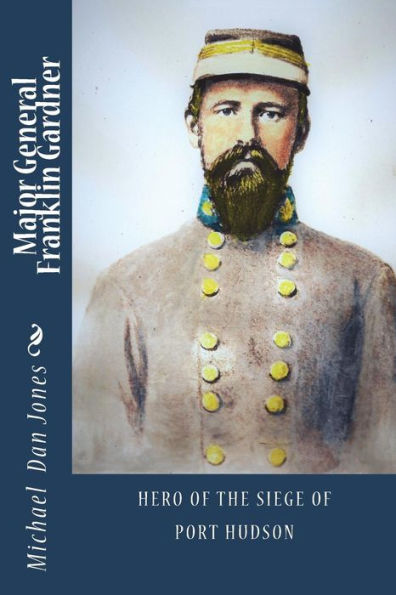
Major General Franklin Gardner
(Library of Congress)
Report of Major-General Gardner, C. S. Army, commanding at Port Hudson [Louisiana]
Headquarters
Port Hudson, La., March 18, 1868
          Colonel: I have the honor to make the following report of the engagement at the post during the night of the 14th instant with the enemy's fleet:
          During the day of the 14th the enemy advanced with his entire force, two divisions by the Bayou Sara road and one by the direct road to Clinton, and moved his fleet up the river to within sight but out of range. At 2 o'clock p.m. he commenced bombardment slowly from his mortar boats at long range, and gradually increasing the range until he threw his shells within the lower part of the breastworks. This was continued until 6, without producing any other result than continued cheers from the men as his shells exploded. During the day Rust's pickets (his brigade being in advance of the breastworks) skirmished successfully with the enemy advance. At 11 o'clock at night the fleet moved up, intending to pass seven vessels by, but were discovered immediately on starting by the signal corps on the opposite side of the river, who sent up signal rockets, and Rust's light batteries at Troth's opened on them.
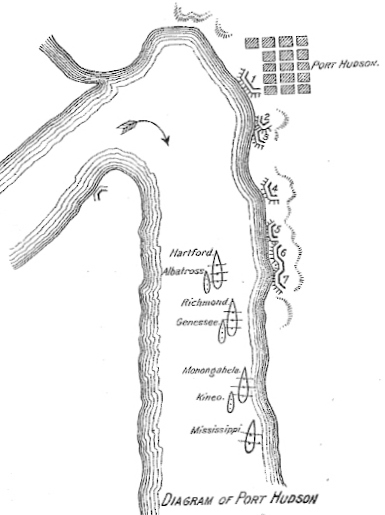
        The enemy immediately commenced bombarding from  his mortar boats and firing from  all his vessels as he came in range. They advanced in the following order, as has been ascertained from prisoners: Steamship Hartford (flagship), with Kineo [Albatross] (not Monongahela, as was reported) lashed on far side; steamship Richmond, gunboat, Genesee, gunboat Monongahela, steamship Mississippi, gunboat, Sachem, another not known, ironclad Essex (remaining at long range), and six mortar boats towed above the point. While passing up all opened their broadsides as rapidly as possible. Rust's two field batteries at Troth's Landing first received this tremendous firing, but strange to say without any harm, although the batteries kept up this unequal contest until the last. Next was Mile's 20-pounder Parrott gun, which was beautifully served; and then followed the heavy guns, first of De Gournay's battalion and next the First Tennessee Artillery under De Gournay's command; next the battery served by four  companies of Colonel Steedman's First Alabama Regiment, the remaining companies of their regiment being posted on the bluff as sharpshooters, but unfortunately the enemy did not come in near this bank until after passing them.
       The five steamboats which had brought provisions from Red River were unloading until the morning of the battle and got underway in time of escape. The enemy's fleet advanced boldly, but were handsomely received by our batteries. The Hartford, with the gunboat lashed to her, only succeeded in passing a little before 12; all the rest of the fleet were driven back and evidently much damaged. The Mississippi was burned immediately opposite, and the Richmond driven back after she had reached the Point.
      I regret to state that Captain Youngblood and perhaps four others have been captured on the other side of the river.
      I am, sir, very respectfully, your obedient servant,
Frank. Gardner,
Major-General.

Lieutenant-Colonel J. R. Waddy,
Assistant Adjutant-General.
Diagram of the Port Hudson attack, March 14, 1863
(Official Records. . . Navies, Vol. 19, 669)

Saturday, March 16, 2013

150-years-ago -- VICKSBURG, JUST PRIOR TO THE SIEGE

Pvt. Henry Augustus Moore, Co. F, 15th
Miss. Inf. His regiment served in the
Vicksburg campaign as part of Johnston's
relief forces. (Liljenquist Family Collection,
Library of  Congress)
American Citizen
Canton, Mississippi
March 27, 1863

           Impelled thereto by business engagements, we last week made a short visit to Vicksburg, taking in our route Calhoun, Madison, Tagaloo, Shotwell's tank, Jackson, Clinton, Bolton's, Edward's, Bovina, "and all intermediate landings."  From the route we took, as indicated by the above names, it will be reasonably inferred that we traveled "by rail."  such was certainly our intention, but in it we failed.  "The best laid schemes of mice and men gang aft aglee."
            In our peregrinations we saw but little that was interesting or noteworthy, consequently we took no "notes," though we did take "note of time," as TIME—however much "tempus"  may "fugit," was not a fast fugitive to us, but rather hung heavily upon our hands while away from "the young folks at home."  In former times—before grim war's dreadful alarums resounded throughout the land—it was a pleasure and a benefit to any man to take a short respite and recreation from business in a trip to the "Hill City," or the "Crescent City;" but now, in these times of "war and pestilence and famine," the very worst punishment that could be inflicted upon a man would be to compel him to leave home and travel on railroads and take lodgings and meals at the hotels.
            The first feature that presents itself to the mind of the wayfaring man is, the great number of soldiers that are continually "going to and fro, up and down in the earth," crowding all the cars on all the railroads;--the next is, the vast number of soldiers—officers, especially,--that are found at all the railroad depots of any note, and in all the towns along the lines of railroads.  At Jackson we tarried a day.  The city was alive with soldiers, and it seemed to us that every third man we met was an officer, had on shoulder straps, or a "spangle" of some sort to indicate that the wearer was something more than a "common soldier."  The inquiry naturally arises, What are all these officers and soldiers doing out of camps?  Why are they not with their regiments, on duty, in active service?  There were, it seemed to us, a sufficient number of officers and men walking about the streets of Jackson to form a full regiment.  How it is that so many men, able-bodied and healthy, are enabled to shirk their duty and keep out of the service, passeth our comprehension.  While thousands are thus loitering about the cities, towns and railroad stations, all over the Confederacy, of no benefit whatever to the great cause in which we are engaged, the plea is made here in Mississippi by our sapient Governor, that the danger at present is so imminent that not a man can be spared from the field, and that the very salvation of the country depends upon retaining the militia in active service!—many of whom are old men not fit for military duty, but who ought to be at home, superintending their crops and raising bread and meat to supply the demands of the army and the people.  The Confederate authorities should at once call all stragglers to the field, and Governor Pettus should disband the militia without further delay.  He has committed an error in keeping them in the field up to the present time; the longer he persists in that error—to gain a reputation as "a man of firmness and decision of character"—the greater will be the detriment to the agricultural interests of the State, and to his own fair fame.  Disband the "melish," Governor, disband the "melish," and let them raise corn, and you'll raise yourself in the estimation of everybody.

Monday, March 11, 2013

150-years-ago -- Washington Artillery of New Orleans Camp Entertainment


Mobile Register and Advertiser 
March 15, 1863
Washington Artillery of New Orleans in Camp Louisiana.
(In Camp and Battle with the Washington Artillery of New Orleans)

Camp of Washington Artillery
Near Fredericksburg, Va., Feb. 23, 1863
. . . You have heard, I presume, of the second performance of the "Washington Artillery Varieties" Company—it was a complete success, even better than the performance before the battle of Fredericksburg—in fact, the army thinks the Varieties an "institution."  It was attended by scores of ladies from the surrounding country and different points on their railroad (a special train having been run for the accommodation.)  Gen. Longstreet and staff were present.  Gen. Lee was prevented by business from being present, but sent his regrets in an autograph note thanking the managers for their kind invitation, and wishing them success in their efforts to introduce these entertainments into the army.  Representatives from all the divisions of the army were present; one of the men of Jackson's corps walking twenty miles, so great was their desire to be present.  Our theatre being "out of doors" we could of course accommodate the largest kind of audience.  There could be no danger of crowding the house.
                The stage was tastefully decorated with the Battalion colors and the guidons of the four batteries; the battle flag presented to us by Gen. Beauregard was conspicuously displayed; the side scenes were blankets and a tent fly served for a drop curtain, on which was handsomely sketched a representation of our badge, the Cross Cannon and motto, "Try Us!"  The whole scene was illuminated, not with "soft light from alabaster lamps," but with tallow "dips," hung in Chinese lanterns of fantastio shape, (brought from Maryland last summer.)  The United bands of the 12th and 16th Mississippi regiments, under the leadership of Prof. Hartwell, furnished us with music.  The programmes were handsomely printed in Richmond and distributed throughout the army.  The performance opened with "Pocahontas; or, Ye Gentle Savage,"—a "demi-savage, semi-civilized extravaganza"—with music dislocated and re-set through the instrumentality of Sig. Knight.
                Private W. P. N., of 3d Co., sustained the part of Powhattan 1st, King of the Tuscaroras, and one of the original F. F. V's.  Private Bob M. of 3d Co., was capital as Pocahontas, and Corpl. W., of 1st Co., as John Smith, was excellent.—The rest of the characters were well sustained by different members of the Battalion.
                "Toodles" was the after piece—Corpl. H., of 2d Co., as Toodles, and Sergt. B., of same company, as Mrs. T.  Of course throughout the plays the house came down an unknown number of times, and everybody was delighted.  The band, played the "Bonnie Blue Flag" as our audience scattered for their respective camps in the jolliest mood imaginable.
                The bills announce that the "Lady of Lyons" will shortly be repeated, and that the "Serious Family" and "Box and Cox" are in rehearsal.  Everything is now ready for another performance, except the weather.  Who is to play the part of Pauline is now the question.  The knowing ones will not tell.  You remember, on our "opening night," before the battle of Fredericksburg, Sergeant John C. W. took the part, and the next day was put hors du combat by a shell from the Yankees.  He is still absent at the Charlottesville hospital.  John didn't "go in" in his crinoline, however, as the Zouave actors did at Inkermann, as it was borrowed.

Friday, March 1, 2013

150-years-ago -- Morgan Hailed as Great Partisan Leader

The Richmond Daily Dispatch
March 4, 1863
Brig. Gen. John Hunt Morgan
(Library of Congress)

Gen. John Morgan.
          The Whig publishes an extract from a forthcoming work entitled "West Point and Political Generals," in which a brief summary is given of the exploits of this great partisan leader. They border on the marvelous; yet they are strictly authentic. 
          He began with a small body of horse, which he raises himself, and during his career has brought from within the lines of the enemy, and turned over to the Confederate service, nearly 5,000 men. He has generally been at the head of less than 1,000 men — in his famous raid on Kentucky he started with 875 and returned with 1,200. He has within two years, fought more than fifty battles — has killed or wounded more than 6,000 of the enemy — and has made upwards of 14,000 prisoners. 
          His expeditions have always been of the most daring description; yet, he has never, but on two occasions, been forced to fight when he did not wish it. Many of his battles have been of the most desperate character, and he has been uniformly victorious. He has frequently operated hundreds of miles from support, in the midst of overwhelming bodies of the enemy, whose strength was greatly enhanced by the possession of railroads and telegraphs, stretching around him like a web, and almost indefinitely facilitating their power of concentration, while, in the same degree, it complicated the dangers of his situation. The sagacity with which he has always been enabled to pluck triumph from the very few of these multiplied dangers, indicates the great leader, not only of partisan corps, but of regular armies.
          There never has been on the continent of America — probably there never was in the world — any partisan leader whose exploits could sustain a comparison with those of Morgan. Even Marion and Sumpter sink into absolute insignificance when placed beside him. And yet they were undoubtedly great officers, and, as such, entitled to all the admiration with which they are regarded, not only by the people of their own States, but by those of all the Southern States.
          The following is a summary of Morgan's exploits for the six months beginning 4th July, 1862, and ending 5th January, 1863; Between 12,000 and 13,000 prisoners, and 19,000 stand of arms captured; and $9,500,000 worth of stores destroyed; 4,695 men raised within the enemy's lines, and armed and equipped by himself, be having received but 200 saddles from the Government.