Friday, May 3, 2013

150-years-ago -- DAY THREE, Battle of Chancellorsville.


Capt. Murray F. Taylor of Gen. A. P. Hill's
 staff was present at the Battle of
Chancellorsville when Hill and Stonewall
Jackson were  wounded on the night of May 2.
Taylor was injured when his horse fell on his
leg.(Library of Congress)
[National Park Service]
May 3, 1863
Despite his misfortune on May 2, [Joseph] Hooker still held the advantage at Chancellorsville. He received reinforcements during the night and the Third Corps moved back from Catharine Furnace to reoccupy Hazel Grove. Sickles' troops thus divided the Confederates into separate wings controlled by Stuart and Lee. Hooker, if he chose, could defeat each fraction of his out manned enemy in detail.

The Confederate commanders understood the need to connect their divisions, and Stuart prepared an all-out assault against Hazel Grove at dawn. Hooker made it easy for him. As the Southerners approached the far crest of Hazel Grove they witnessed Sickles' men retiring in an orderly fashion. "Fighting Joe" had directed that his troops surrender the key ground and fall back to Fairview, an elevated clearing closer to Chancellorsville.

Stuart immediately exploited the opportunity by placing 31 cannon on Hazel Grove. Combined with artillery located west along the Turnpike, the gunners at Hazel Grove pounded Fairview with a spectacular bombardment. The Federals responded with 34 pieces of their own and soon the Wilderness trembled with a discordant symphony of iron.

The bloodiest fighting of the battle occurred between 6:30 and 9:30 a.m. on May 3. Stuart launched brigade after brigade against entrenched Union lines on both sides of the Turnpike. Troops lost their way in the tangled underbrush and the woods caught fire, confronting the wounded with a horrible fate.

The see-saw fighting began to favor the Southerners as, one by one, Union artillery pieces dropped out of the contest. Hooker failed to resupply his cannoneers with ammunition or shift sufficient infantry reserves to critical areas. A Confederate projectile abetted this mental paralysis when it struck a pillar at Chancellorsville, throwing the Union commander violently to the ground. The impact stunned Hooker, physically removing him from a battle in which he had not materially been engaged for nearly 48 hours. Before relinquishing partial authority to Couch, Hooker instructed the army to assume a prepared position in the rear, protecting the bridgehead across the Rappahannock.

Stuart pressed forward first to Fairview and then against the remaining Union units at Chancellorsville. Lee's wing advanced simultaneously from the south and east. The Bluecoats receded at last and thousands of powder-smeared Confederates poured into the clearing, illuminated by flames from the burning Chancellorsville mansion.

Lee emerged from the smoke and elicited a long, unbroken cheer from the gray multitudes who recognized him as the architect of their improbable victory. A Confederate staff officer, watching the unbridled expression of so much admiration, reverence, and love, thought that, "it must have been from such a scene that men in ancient times rose to the dignity of gods."

The Southern commander wasted little time on reflection. He prepared to pursue Hooker and seal the success achieved since dawn. A courier bearing news from Fredericksburg shattered Lee's plans. Sedgwick had driven Early's contingent from Marye's Heights and now threatened the Confederate rear. This changed everything. Lee assigned Stuart to watch Hooker's host and sent McLaws eastward to deal with the Sixth Corps menace.

Sedgwick, slowed by Wilcox's single Alabama brigade retreating stubbornly from Fredericksburg, came to grips with the Confederates four miles west of town at Salem Church. The Federals swept into the churchyard but a powerful counterattack drove them back and ended the day's combat. The next day Lee shoved Sedgwick across the Rappahannock at Banks Ford and once again focused on the main Union army in the Wilderness.

Hooker, however, had seen enough. Despite the objections of most of his corps commanders, he ordered a withdrawal across the river. The Federals conducted their retreat under cover of darkness and arrived back in Stafford County on May 6. Ironically, this decision may have been Hooker's most serious blunder of the campaign. Lee's impending assault on May 6 might have failed and completely reversed the outcome of the battle.

Confederate leadership during the Chancellorsville Campaign may represent the finest generalship of the Civil War, but the luster of "Lee's greatest victory" tarnishes upon examination of the battle's tangible results. In truth, the Army of the Potomac had not been so thoroughly defeated - some 40,000 Federals had done no fighting whatsoever. Although Hooker suffered more than 17,000 casualties, those losses accounted for only 13% of his total strength. Lee's 13,000 casualties amounted to 22% of his army, men difficult to replace. Of course, Jackson's death on May 10 created a vacancy that could never be filled. Finally, Lee's triumph at Chancellorsville imbued him with the belief that his army was invincible. He convinced the Richmond government to endorse his proposed offensive into Pennsylvania. Within six weeks, the Army of Northern Virginia confidently embarked on a journey northward to keep an appointment with destiny at a place called Gettysburg.

The text for this section was written by A. Wilson Green, former staff historian for Fredericksburg and Spotsylvania National Military Park. It is derived from a National Park Service training booklet.

Thursday, May 2, 2013

150-years-ago -- SECOND DAY-Battle of Chancellorsville


Gen. Robert E. Lee at Chancellorsville, May 2, 1863.
(Library of Congress)

[National Park Service]
Before dawn, [Robert E.] Lee and [Stonewall] Jackson studied a hastily drawn map and decided to undertake one of the biggest gambles in American military history. Jackson's corps, about 30,000 troops, would follow a series of country roads and woods paths to reach the Union right. Lee, with the remaining 14,000 infantry, would occupy a position more than three miles long and divert [Joseph] Hooker's attention during Jackson's dangerous trek. Once in position, "Stonewall" would smash the Federals with his full strength while Lee cooperated as best he could. The Army of Northern Virginia would thus be fractured into three pieces, counting [Jubal] Early's contingent at Fredericksburg, any one of which might be subject to rout or annihilation if the Yankees resumed the offensive.

Jackson led his column past the bivouac early on the morning of May 2. He conferred briefly with Lee, then trotted down the Furnace Road with the fire of battle kindled in his eyes. After about one mile, as the Confederates traversed a small clearing, Union scouts perched in treetops at Hazel Grove spotted the marchers. The Federals lobbed artillery shells at Jackson's men and notified Hooker of the enemy movement.

"Fighting Joe" correctly identified Jackson's maneuver as an effort to reach his right flank. He advised the area commander, Major General Oliver 0. Howard, to be on the lookout for an attack from the west. As the morning progressed, however, the Union chief grew to believe that Lee was actually withdrawing - the course of events Hooker most preferred. Worries about his right disappeared. Instead, he ordered his Third Corps to harass the tail end of Lee's "retreating" army.

Colorful Major General Daniel E. Sickles commanded the Third Corps. He probed cautiously from Hazel Grove toward a local iron manufactory called Catharine Furnace. In mid-afternoon the Federals overwhelmed Jackson's rearguard beyond the furnace along the cut of an unfinished railroad, capturing nearly an entire Georgia regiment. The action at Catharine Furnace, however, eventually attracted some 20,000 Bluecoats onto the scene thus effectively isolating Howard's Eleventh Corps on the right with no nearby support.

Meanwhile the bulk of Jackson's column snaked its way along uncharted trails barely wide enough to accommodate four men abreast. "Stonewall" contributed to Hooker's faith in a Confederate retreat by twice turning away from the Union line - first at Catharine Furnace, then again at the Brock Road. After making the desired impression, Jackson ducked under the Wilderness canopy and continued his march toward Howard's insensible soldiers.

Acting upon a personal reconnaissance recommended by cavalry general Fitzhugh Lee, Jackson kept his column northbound on the Brock Road to the Orange Turnpike where the Confederates would at last be beyond the Union right. The exhausting march, which altogether traversed more, than 12 miles, ended about 3 p.m. when "Old Jack's" warriors began deploying into battle lines astride the Turnpike. Jackson, however, did not authorize an attack for some two hours, providing 11 of his 15 brigades time to take position in the silent forest. The awe-inspiring Confederate front measured nearly two miles across.

Although individual Northern officers and men warned of Jackson's approach, Eleventh Corps headquarters dismissed the reports as frightened exaggerations from alarmists or cowards. Hooker's shortage of cavalry hampered the Federals's ability to penetrate the Wilderness and uncover the Confederate presence with certainty. Only two small regiments and half a New York battery faced west in the direction of Jackson's corps.

Suddenly, a bugle rang out in the afternoon shadows. Bugles everywhere echoed the notes up and down the line. As waves of sweat-soaked soldiers rolled forward, the high defiance of the Rebel Yell pierced the gloomy woods. Jackson's Corps erupted from the trees and sent the astonished Unionists reeling. "Along the road it was pandemonium," recalled a Massachusetts soldier, "and on the side of the road it was chaos."

Most of Howard's men fought bravely, drawing three additional battle lines across Jackson's path. But the overmatched Federals occupied an untenable position. The screaming gray legions overwhelmed each Union stand and eventually drove the Eleventh Corps completely from the field.

Sunset and the inevitable intermingling of "Stonewall's" brigades compelled Jackson to call a reluctant halt to the advance about 7:15. He summoned Major General A.P. Hill's division to the front and, typically, determined to renew his attack despite the darkness. Jackson hoped to maneuver between Hooker and his escape routes across the rivers and then, with Lee's help, grind the Army of the Potomac into oblivion.

      While Hill brought his brigades forward, Jackson rode ahead of his men to reconnoiter. When he attempted to return, a North Carolina regiment mistook his small party for Union cavalry. Two volleys burst forth in the blackness and Jackson tottered in his saddle, suffering from three wounds. Shortly thereafter a Federal shell struck Hill, incapacitating him, and direction of the corps devolved upon Stuart. The cavalryman wisely canceled "Stonewall's" plans for a night attack.

(National Park Service)

Wednesday, May 1, 2013

150-years-ago --- DAY ONE, THE BATTLE OF CHANCELLORSVILLE

[National Park Service]
May 1, 1863

Lt. Gen. T. J. "Stonewall Jackson"
The Federals had encountered virtually no opposition to this point. Moreover, they could now press eastward, break clear of the Wilderness, and uncover Banks Ford downstream, thus significantly shortening the distance between their two wings.[Maj. Gen. Joseph] Hooker, however, decided to halt at Chancellorsville and await the arrival of additional Union troops. This fateful decision disheartened the Federal officers on the scene who recognized the urgency of maintaining the momentum they had thus far sustained.

"Stonewall" Jackson, gladly seizing the initiative that Hooker needlessly surrendered, left the Fredericksburg lines at 3:00 a.m., on May I and arrived at Zoan Church five hours later. There he found two divisions of Confederate infantry, Major General Richard H. Anderson's and Major General Lafayette McLaws', fortifying a prominent ridge covering the Turnpike and Plank Road. Although his corps had not yet appeared, Jackson ordered Anderson and McLaws to drop their shovels, pick up their rifles, and advance to the attack.

Jackson's audacity dictated the shape of the Battle of Chancellorsville. When Hooker at last authorized an eastward movement late in the morning of May 1, his troops on the Turnpike and Plank Road ran flush against "Stonewall's", outgunned but aggressive brigades. Union front-line commanders had not expected this kind of resistance. They sent anxious messages to Hooker, who quickly ordered his generals to fall back to the Wilderness and assume a defensive posture. The Federal columns on the River Road marched almost to Bank's Ford without seeing a Rebel. They returned to Chancellorsville fuming, fully realizing the opportunity that had slipped through their fingers. 

Late in the day, as the blue infantry threw up entrenchments encircling Hooker's Chancellorsville headquarters, Major General Darius N. Couch approached his superior. As the army's senior corps commander, Couch had advocated an offensive strategy and shared his comrades' disappointment with "Fighting Joe's" judgment. "It is all right, Couch," Hooker reassured him, "I have got Lee just where I want him; he must fight me on my own ground."

Couch could barely believe his ears. "To hear from his own lip that the advantages gained by the successful marches of his lieutenants were to culminate in fighting a defensive battle in that nest of thickets was too much, and I retired from his presence with the belief that my commanding general was a whipped man."

Hooker's confidence had faded to caution, but whether he was "whipped" depended upon Lee and Jackson. Those two officers reined up along the Plank Road at its intersection with a byway call the Furnace Road on the evening of May 1. Transforming discarded Federal cracker boxes into camp stools, the generals examined their options.

Confederate scouts verified the Federals' strong positions extending from the Rappahannock River, around Chancellorsville, to the high, open ground at Hazel Grove. This was the bad news. The Southern army could not afford a costly frontal attack against prepared fortifications.

Then, about midnight, Lee's cavalry chief, "Jeb" Stuart, galloped up to the little campfire. The flamboyant Virginian carried thrilling intelligence. The Union right flank was "in the air" -- that is, resting on no natural or artificial obstacle! From that moment on, the generals thought of nothing but how to gain access to Hooker's vulnerable flank. Jackson consulted with staff officers familiar with the area, dispatched his topographical engineer to explore the roads to the west, and tried to snatch a few hours rest at the chilly bivouac.


Sunday, April 28, 2013

150-years-ago -- CHANCELLORSVILLE CAMPAIGN


(U.S. Army Center of Military History)
Chancellorsville, 27 April - 6 May 1863. In the East, during this period, Federal operations were directed by Maj. Gen. Joseph Hooker, who replaced Burnside as commander of the Army of the Potomac on 25 January. Hooker effected some reorganization and by late April was ready to assume the offensive with about 134,000 men. Hooker's objective was to destroy Lee's army, about 60,000 strong, which was still holding Fredericksburg. To accomplish this he planned a double envelopment which could place strong Union forces on each of Lee's flanks. The Chancellorsville Campaign began, as planned, with the movement of five corps under Hooker up the Rappahannock and across the river to Chancellorsville, while two corps under Maj. Gen. John Sedgwick crossed below Fredericksburg. Meanwhile Union cavalry made a diversionary raid in Lee's rear. Lee quickly became aware of Hooker 's intentions, and on 1 May boldly launched an attack toward Chancellorsville, leaving on a small force to defend Fredericksburg. In a brilliant display of generalship, Lee outflanked Hooker's force and kept it on the defensive. He also repulsed Sedgwick, who had taken Fredericksburg on 3 May and had advanced west, only to be driven northward across the Rappahannock on 5 May. Lee then turned his full attention to Chancellorsville, but Hooker withdrew his forces across the Rappahannock on 6 May before the Confederates could launch an assault. Federal casualties were 1,575 killed, 9,594 wounded, and 5,676 missing; Confederate casualties were 1,665 killed, 9,081 wounded, and 2,018 missing. Among the Confederate losses was Stonewall Jackson, who was mortally wounded on 2 May.

Encouraged by the victory at Chancellorsville, Confederate authorities decided to attempt another invasion of the North. In early June Lee began moving his units up the Shenandoah and Cumberland Valleys into Pennsylvania, where he was forced by the exigencies of scanty supply to disperse his army over a broad area. Hooker had become aware of Lee's intentions by mid-June, and had promptly started north with his army, crossing the Potomac near Leesburg on 25-26 June. When Lee learned of this he ordered his army to concentrate at once between Cashtown and Gettysburg.

(Battle and Leaders of the Civil War)

Tuesday, April 23, 2013

150-years-ago -- Confederate Flag and Seal

The Richmond Daily Dispatch
April 24, 1863

Second National Confederate Flag
(Naval History & Heritage Command )

          The Senate committee, it is understood, has completed their designs of the flag and seal for the Confederacy. The flag is a white field with the well known battle flag of the Army of the Potomac, (Gen. Johnston's flag) in a square of blue at the upper corner, near the staff, and a blue horizontal bar across the centre. 
          Willing to accept almost anything in preference to the present despised parody upon the Yankee flag, we should yet prefer the battle flag itself to the modification of it proposed by the committee. At the beginning of the war, owing to the close resemblance between the Confederate and Federal flags, each party often accused the other of the fraud of holding its eugenicist's flag for the purpose of deception.

Gen. Joseph E. Johnston
         Both parties were mistaken, and each was possibly deluded by the mistake into some unfortunate movement. Gen. Johnston was so thoroughly convinced of the danger of going into battle with a flag too much like that of the enemy that he caused to be adopted in the field the well known battle flag — illustrious for the many victories was beneath its folds. 
          It is simple, neat, and very distinct from a long distance. It answers the purpose of a flag very well, is easily made, and is not obnoxious to any serious objection. We are sure the conflicting counsels of a body of men not deeply skilled in heraldry, will not produce anything too appropriate, and likely to engross to much the public approval and love as the Potomac battle flag. 
         A great many battles must be fought, and a great many victories must be won under another to make it so famous. The change made by the committee is no improvement of it. We trust that at least the blue bar across the committee's flag may be stricken out by Congress. 
         Let us be done with the bar at all events. It would be grateful to the nation, we are sure, if all parties would compromise on the glorious battle flag. It is already consecrated by our best blood, and many of the most brilliant victories in the annuals of war. 
         It should, therefore, be cherished with affection. How can we discard it? With what feeling can we lay it away in the archives as a moment of the nation's glory? Can we hide it away from the eyes of the people! Do what we will with it, it is hardly probable that the army will give it up.
         Congressmen may suggest variations upon it, or may distaste a new banner to the veterans of so many bloody fields; but they will not abandon the flag they have fought and conquered under, and which they have learned to love as the emblem of their triumphs. It must indeed be something better than any yet devised that could reduce them from this invincible battle flag.
        The seal represents the equestrian statue of Washington, after that on the Capitol Square, with appropriate bordering and back ground, and the motto, "Deo duc vincimus" which in English, freely rendered, is, "God being with us, we will conquer." The people care less about the seal than the flag; and we suppose there will be no objection to this. It will certainly be satisfactory in so far as it contains the figure of Washington.
        The Congress has been too long in the making of the flag, certainly. It is to be hoped they will now settle both questions of flag and seal, and end debate about them.
Great Seal of the Confederate States of America
(Georgia Division, Sons of Confederate Veterans)

Thursday, April 18, 2013

150-years-ago -- BATTLE OF IRISH BEND, LOUISIANA


Battle of Irish Bend
(Harper's Weekly, May 16, 1863)

National Park Service Summary

          While the other two Union XIX Army Corps divisions comprising the expedition into West Louisiana moved across Berwick Bay towards Fort Bisland, Brig. Gen. Cuvier Grover’s division went up the Atchafalaya River into Grand Lake, intending to intercept a Confederate retreat from Fort Bisland or turn the enemy’s position. On the morning of April 13, the division landed in the vicinity of Franklin and scattered Rebel troops attempting to stop them from disembarking. That night, Grover ordered the division to cross Bayou Teche and prepare for an attack towards Franklin at dawn. In the meantime, Confederate Maj. Gen. Richard Taylor had sent some men to meet Grover’s threat. On the morning of the 14th, Taylor and his men were at Nerson's Woods, around a mile and a half above Franklin. As Grover’s lead brigade marched out a few miles, it encountered Rebels on its right and began skirmishing with them. The fighting became intense; the Rebels attacked, forcing the Yankees to fall back. The gunboat Diana arrived and anchored the Confederate right flank. The Confederates were outnumbered, however, and, as Grover began making dispositions for an attack, they retreated leaving the field to the Union. This victory, along with the one at Fort Bisland, two days earlier, assured the success of the expedition into West Louisiana.

Sunday, April 14, 2013

150-years-ago -- THE BATTLE OF FORT BISLAND, LOUISIANA


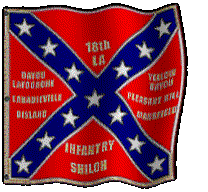
[Excerpted from "General Mouton's Regiment, the 18th Louisiana Infantry" by Michael Dan Jones, CreateSpace.com, ]

April 13, 1863


Brig. Gen. Alfred Mouton
           The cannon fire began at exactly seven minutes past 11 o'clock that morning and at 2 o'clock that afternoon enemy gunboats were seen steaming past them on Grand Lake. The intermittent firing continued until 4 o'clock when a furious artillery duel was commenced by the two contending forces. "Cornay, with the St. Mary's Artillery, maddened at the sight of the enemy standing upon his own homestead with their batteries planted upon the playground of his children, sent forth shell after shell, filling the air with their peculiar and indescribable music," [Maj. Silas)  Grisamore said.
            General  [Alfred] Mouton set up his command post on the left in the redoubt where he could get the best view of the enemy's movements. Mouton, along with Colonel Bush and his aides braved the missiles of death that went zipping by them  as the battle progressed. "Gen. Mouton was standing patiently, scrutinizing with his glass every movement in the front," Grisamore recalled. General [Richard] Taylor was viewing the battle on the  Confederate right. "Weitzel and Emory came in sight of our lines before nightfall, threw forward skirmishers, opened guns at long range, and bivouacked; and  our scouts reported the movement on the  lake," Taylor said.
          On  the Confederate left, [Union Col. Oliver] Gooding prepared his brigade for a major assault against Mouton's line at about 2:30 o'clock that afternoon. He was reinforced by two more regiments and the 1st Maine Battery. He advanced the 38th Massachusetts Infantry as skirmishers and deployed the 53rd Massachusetts as the backup line of skirmishers. His main battle line consisted of the 31st Massachusetts, at the right and rear of the right section of the 1st Maine Battery, the 175th New York Infantry to the left rear of the left section of  the battery,  and the 156th New York Infantry on the extreme right in the woods. He also had a detachment of the Louisiana Cavalry (Union) in the rear as a reserve. Gooding then ordered the advance at 3:15 p.m. and hit the Confederates with everything he had. Facing them were the Yellow Jacket Battalion, Crescent Regiment and the 18th Louisiana on the  Confederate left, with [Col. Arthur] Bagby's Texans in the advance post in the woods. The firing was brisk from both sides, first from the 38th Massachusetts and when its ammunition was expended, then the 53rd Massachusetts came up at 5 o'clock and kept up the firing.

Click here.
        At about that same time Gooding ordered the 31st Massachusetts to support the 156th New York in the woods on the Federal right, and the Confederate left began to crumble. Mouton then sent the entire left wing of the 18th Louisiana, along with a detachment of Waller's battalion from the west bank, to reinforce Bagby for what became intense combat in the woods. "The enemy threatening to storm our works, our men fixed bayonets and resolutely prepared to meet and dispute with them to the death the possession of the intrenchments [sic]. They, however, although they could easily have borne us down by superiority of numbers, dared not expose themselves to a hand-to-hand conflict.," Mouton said. By contrast, Gooding said, "The Thirty-first Massachusetts. . . charged and carried a breastwork of the enemy in the wood in front of our right, killing many of the enemy and capturing 86 prisoners, among the latter two lieutenants of the Seventh Texas Cavalry and one of the Eighteenth Louisiana Infantry." The breastworks he was talking  about was the advance line of Bagby in the woods. The lieutenant of the 18th Louisiana captured was either 2nd Lieutenant Lavince Becnel or 1st Lieutenant Louis Becnel.
          On the Confederate right, on the west side of the bayou, Taylor said the fighting was also furious there also, and to bolster the  morale of the troops, some of whom were raw recruits, he mounted the breastwork and walked up and down smoking a cigarette. The heaviest fire was concentrated on the Diana, which became disabled. The gunboat had to be withdrawn for repairs. Taylor kept in contact with Mouton through his staff officers. After the firing ceased for the day, at 9 o'clock that night, he was informed by Colonel Reily that the enemy had landed at Hutchin's Point in full force but had not yet reached Franklin. He said he knew then that he would have to evacuate Bisland. He ordered Mouton to begin preparing for the evacuation of the east bank and Green's regiment would act as the rear guard.