












Friday, May 17, 2019

Sunday, April 21, 2019
Dick Dowling and the Jefferson Davis Guard: Irish Patriots, Confederate Heroes.

Dick Dowling and the Jefferson Davis Guard by Michael Dan Jones is now available in e-book format, exclusively on Amazon.com; as well as in the print version available on Amazon.com as well as other online booksellers.
Company F (Jefferson Davis Guard) was an atypical Confederate unit. Against all odds, 43 mostly Irish immigrants from Houston and Galveston, making up the company, stopped a massive Yankee invasion fleet on September 8, 1863 at the Battle of Sabine Pass, Texas.
Houston, Galveston and Beaumont were all saved from the fate of Atlanta, Vicksburg and other Southern cities that were destroyed by the Northern invaders. The unit was led by a colorful young Irish saloon keep from Houston, First Lieutenant Richard William "Dick" Dowling who won a lasting place in Texas history.
This is the story of the valiant band of unlikely heroes who beat the odds and lived to celebrate their famous victory.
The book contains a full roster of the company, pictures, illustrations and maps.
Saturday, April 6, 2019
"The Tiger Rifles: The Making of a Louisiana Legend" Now Available as E-Book

The history of one of America's most amazing fighting units, the Tiger Rifles, Company B, 1st Special Battalion (Wheat's) Louisiana Volunteers, by Michael Dan Jones, is now an e-book available exclusively at Amazon.com. Of course the print edition is also available on Amazon.com as well as other online booksellers.
The Tiger Rifles were one of the most storied, and notorious, Confederate companies in the War for Southern Independence. Their unique Zouave-style uniforms brought them attention from their fellow Confederates, the Federals, newspapers and artists. The attention continues to this day among historical reenactors, historians and artists.
Their company commander, Captain Alexander White, was a man of action and violence that made him among the most notable characters on the Mississippi River prior to the war. He fully lived up to the reputation during their war. The author probes and explores the mystery behind the man that his name was an alias and that he was actually the son of a former Kentucky governor who killed a man during a card game and became a fugitive.
Jones does some historical sleuthing and comes up with some interesting possibilities to unravel the mystery and identify one very likely candidate for his real name.
Another reason for the Tiger Rifles fame is their battalion commander, Major Chatham Roberdeau Wheat, who became famous in the 1850s and early '60s as a swashbuckling filibuster and soldier of fortune.
The enlisted men themselves were mostly made of Irish immigrants who had become Mississippi River steamboatmen, dockworkers and were among the most colorful, toughest, rowdiest men in the nation at that time. They made outstanding light infantry and skirmishers during the war and fought in some of the most famous early war battles, but their high jinks in camp also brought them notoriety. Their battles included First Manassas (Bull Run), Front Royal, Middletown, Strasburg, Port Republic, the Seven Days Battles, including the Battle of Gaines' Mill and the Battle of Malvern Hill. But the Tigers had become so depleted in numbers by August 9, 1862, the whole battalion was disbanded and the men discharged or distributed to other Louisiana units. Many, however, continued fighting for Southern Independence all over the Confederacy.
Their legend became so great even during the war, that all Louisianians in the Army of Northern Virginia became known as Louisiana Tigers. The nickname lives on to this day with the Louisiana State University Tigers athletic teams, as well as historical reenactment units and the Louisiana Division of the Sons of Confederate Veterans.
Wednesday, April 3, 2019
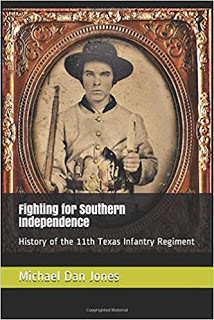
Fighting for Southern Independence: History of the 11th Texas Infantry Regiment by Michael Dan Jones

This is the story of a regiment of Southern patriots fighting in defense of their homes and families in the War for Southern Independence. Most of them were ordinary East Texas farmers who performed great feats of physical endurance, fought in some of the bloodiest battles of the war and became one of the premier fighting regiments of the legendary Walker's Texas Division of the Confederate Army. These Texans helped turn back major Federal Army invasions in Louisiana at the Battle of Bayou Bourbeau, the Battle of Mansfield, the Battle of Pleasant Hill and the Battle of Jenkin's Ferry, thus saving their home state of Texas from the kind of death and destruction visited on so many other Southern states. There is an annotated roster of over 1,500 names and records of men who served in the regiment.
[Independently published, 277 pages, photos, illustrations, maps, roster, bibliography, and index. It is available on Amazon.com by clicking here. It is also available from other online booksellers.]
Sunday, January 13, 2019

SCV Responds to Taxpayer Funded Smithsonian Slander
Compatriots,
The anti-South cultural bigots are at it again! This time
they are using our tax dollars to fund their neo-Marxist propaganda. The
Smithsonian Magazine in a 6,500-word article entitled ‘The Costs of the
Confederacy,’ slandered our ancestors and heritage. The article began by
stating “American taxpayers have spent $40 million on Confederate Monuments and
groups that distort U. S. history and perpetuate racist ideology.”
In 2017 the Smithsonian Institute received $863,000,000.00
from the American taxpayers—a large segment of those taxpayers are Southerners,
the very people who were the targets of the Smithsonian’s slander. In the
fiscal year 2018 the Smithsonian requested that their Federal funding be
increased to over $963,000,000.00. Gentlemen, we must not sit idly by and allow
their slander of the South to go unchallenged!
As Commander-in-Chief of the SCV, I have sent the
Smithsonian Magazine an official request for “equal time” to give the readers
of their magazine “the rest of the story” about our honorable heritage. I think
we all understand that unless we as individual members apply pressure, these minions
of anti-South cultural bigotry will not publish our response. There is a way we
can put real pressure on the Smithsonian. Federal funding for their institute
has to go through Congress. I am asking each member of the SCV to write, phone,
and e-mail their U. S. Representative, their Senators, and cc a copy of your
letters to the Smithsonian Magazine. They will not like “doing business” with
us, but to keep their funding they may very well relent and publish our
response.
For your convenience we have posted a copy of a letter to be
sent to your Representatives and Senators. You may download and use the letter,
use it as a guide for your own, or just write your own letter from scratch.
Please remember, we are the heirs of real Southern gentlemen; be courteous and
polite. All we seek is fair-play and evenhanded journalism. Don’t forget to
send the Smithsonian a copy of your letters. They MUST know that we are
actively engaged in promoting and defending our ancestors good name and we
vote!
Our response is not an attempt to answer every false and
slanderous allegation made in the Smithsonian article. Our response is a
written vindication of the Cause for which our Confederate ancestors fought.
An instruction sheet including the Smithsonian magazine’s
address along with a copy of our article responding to their slander can be
found at our web site: MakeDixieGreatAgain.org.
Without your active support, we can do nothing—forward to
the sound of the guns!
Respectfully,
Paul C. Gramling Jr.
Commander-in-Chief, Sons of Confederate Veterans
Paul C. Gramling Jr.
Commander-in-Chief, Sons of Confederate Veterans
Operation Smithsonian Rebuttal
Tell everyone to join us in this defense of Dixie!
Minimum Requirements: Instructions and Sample Letter
For a full understanding, read all the documents.
To read the controversial article in the Smithsonian Magazine, go to www.smithsonianmag.com.
Tell everyone to join us in this defense of Dixie!
Minimum Requirements: Instructions and Sample Letter
For a full understanding, read all the documents.
To read the controversial article in the Smithsonian Magazine, go to www.smithsonianmag.com.
Instructions to Camps, Members and Friends
Sample Letter You Send to Congress in Word (must download)
Sample Letter You Send to Congress as Adobe PDF
Operational Overview from Commander in Chief, S.C.V.
Letter to Smithsonian from Commander in Chief, S.C.V.
Our Article Defending the Confederacy and Dixie
Sample Letter You Send to Congress in Word (must download)
Sample Letter You Send to Congress as Adobe PDF
Operational Overview from Commander in Chief, S.C.V.
Letter to Smithsonian from Commander in Chief, S.C.V.
Our Article Defending the Confederacy and Dixie
Sunday, January 6, 2019


Friday, August 17, 2018
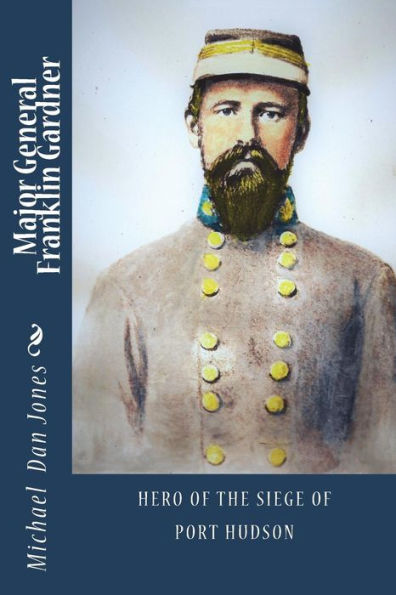
NEW BIOGRAPHY OF MAJOR GENERAL FRANKLIN GARDNER
NEW
BIOGRAPHY ON
MAJOR
GENERAL FRANKLIN GARDNER
A new biography has been published on
the life of Major General Franklin Gardner who commanded Confederate forces in
the epic Siege of Port Hudson, Louisiana in 1863. The book, "Major General Franklin Gardner: Hero of the Siege of
Port Hudson," by Michael Dan Jones, is believed to be the first book
length biography on this important Confederate general. The author covers
Gardner's entire life, from his birth in New York City and growing up in
Washington D.C. to his time as a student at the West Point, his family life,
his spectacular record in the Mexican-American War, the War for Southern
Independence and his final post-war years in Louisiana.
The book, "Major General Franklin Gardner: Hero of the Siege of
Port Hudson," by Michael Dan Jones, is believed to be the first book
length biography on this important Confederate general. The author covers
Gardner's entire life, from his birth in New York City and growing up in
Washington D.C. to his time as a student at the West Point, his family life,
his spectacular record in the Mexican-American War, the War for Southern
Independence and his final post-war years in Louisiana.
Jones also covers new ground in that he
has corrected the historic record about Gardner's controversial departure from
the U.S. Army in April 1861. He was accused of not having resigned before he
left his last military post, which resulted in some previous historians
accusing Gardner of being a deserter from the U.S. Army. Jones, however, found
his actual resignation letter, as well as contemporary newspaper notices, which
conclusively prove that Gardner did, in fact, resign before he left his last
post.
Gardner was a brilliant military leader who proved his courage in combat
during the Mexican-American War of 1846-1848. He proved his leadership ability in numerous battles for the opening
of the war in 1846 at Fort Brown, Texas to the final dramatic victory at Mexico
City in 1847. He received two brevet promotions for his gallantry in battle and
personal praise from the commander of the American forces, General Winfield Scott.
In December 1862, Gardner was promoted to
major general and put in command of the District of Mississippi and East
Louisiana with headquarters at Port Hudson, La.
There,
he conducted one of the most gallant and effective defenses of a Confederate
fortification in the war. It was the longest siege in American military
history. The author covers the siege and its aftermath, during which Gardner
was a prisoner of war, in detail.
Gardner had married in 1850 the daughter
of former Louisiana senator and governor Alexandre Mouton, and after the war
lived the rest of his life in the state. Jones has found that Gardner had a
much more prominent and varied life in the postwar years, including jobs as a
draftsman, newspaper reporter and a parish surveyor for Lafayette Parish.
The book is published by CreateSpace.com
in Charleston, S.C. and has 218 pages, photos, maps, index and bibliography. It
is $15.95 and is available on Amazon.com, Barnesandnobles.com, Booksamillion.com
and other online booksellers
Subscribe to:
Posts (Atom)