Tuesday, September 30, 2025

Today in History (general history) On This Day in Confederate History/ Confederate General Birthdays, September 29.

 Click ðŸ‘‰ Today in History (general history) Sept. 29.

On This Day in Confederate History, Sept. 29.

1863: The Battle of Stirling's Plantation/Fordoche Bridge is an overwhelming Confederate victory in Louisiana. The Federal forces in the battle were the 19th Iowa and 26th Indiana infantry regiments, the 6th Missouri Cavalry Battalion, the 2nd Illinois Cavalry, a company of mounted infantry of the section of the 1st Missouri Light Artillery, about 1,000 men in a provisional brigade under Lt. Col. J.B. Leake. The Confederate units in the battle were Speight's Texas Infantry Brigade (20th, 22nd, 31st, & 34th Tex. DM Cav.,& 15th Tex. Inf.) , the 11th (Spaight's) Battalion Texas Volunteers, Mouton's Louisiana Infantry Brigade (18th, Cres. Reg't, & 28th La. Inf.), Green's Texas Cavalry Brigade (4th, 5th, & 7th Tex. Cav.) and Maj. Oliver J. Semmes' First Confederate Battery. They had about 3,000 men in all under Brig. Gen. Tom Green. But only about 1,000 Confederates were engaged in the actual fight. The Federals were there to protect Federal shipping on the Atchafalaya River, seven miles below Morganza, La. Although the Federals denied it, the bluecoats were caught by surprise with Semmes' battery opening the ball which was quickly followed by the Confederate infantry charging and the Confederate Cavalry outflanking the Federal position. But the Federals put up a stout defense which was finally broken by the Southerners. Federal casualties totaled 515, including 16 killed, 45 wounded, and 454 captured, including Colonel Leake. The Confederate casualties totaled 121, including 26 killed, 85 wounded and 10 men missing. General Green reported, "The heavy loss sustained by Speight's brigade shows the desperate nature of the conflict, and it is not out of place to mention here, even where all distinguished themselves, the gallant bearing and activity of Lieutenant [John B.] Jones, assistant adjutant general of Speight's brigade."

Brig. Gen. Tom Green
Led the Attack at Stirling's Plantation
(Colorization by M.D. Jones)


CLICK👉
The Battle of Stirling's Plantation and Bayou Bourbeau:
The Fall 1863 Campaign in Louisiana & Texas

The battles of Stirling's Plantation and Bayou Bourbeau in South Louisiana, and the Rio Grande Expedition in Texas, in the Fall of 1863, were a major Federal attempt to loot thousands of bales of cotton for Northern speculators, and to subjugate western Louisiana and Texas. The campaign left behind a swath of death and destruction that would lead to the even more destructive Red River Campaign of 1864.

1864: The Battle of Chaffin's Farm and New Market Heights at Forts Harrison, Johnson, and Gilmer began on this day at Petersburg, Va. The Federals were under Maj. Gen. Benjamin F. "Beast" Butler with 26,000 men and the Confederates were under General Robert E. Lee and Lt. Gen. Richard S. Ewell with 14,500 men. The New Market Heights were defended by Lee's Grenadier Guard--Hood's Texas Brigade, about 1,800 strong, under Brig. Gen. John Gregg. Their position was attacked by 13,000 Federals and the Texans inflicted some 850 casualties on the attackers while suffering only about 50 of their own. The Federal attack at Fort Harrison succeeded in occupying the fort but they became disorganized. However, the Confederates rallied and contained the enemy's breakthrough. General Lee personally brought up 10,000 reinforcements for the next day's phase of the battle.

General Robert E. Lee
(CDV, M.D. Jones Collection)

Confederate General Birthdays, Sept. 29.

Brigadier General Bradley Tyler Johnson was born on this day in 1829 in Frederick, Maryland. Johnson organized and equipped a company at his expense of the 1st Maryland Infantry, CSA. he was elevated to command of the regiment with the rank of colonel. At the Battle of Front Royal, the 1st Maryland Confederate fought the 1st Maryland Federal and successfully stopped the Yankee 1st Maryland attacks. His other battles included First Winchester, Cross Keys, and the Peninsular Campaign, among others. After the war, he practiced law in Richmond, Va., and in Baltimore, Md. Johnson died Oct. 3, 1903, and is buried in Loudon Park Cemetery in Baltimore.

Sunday, September 28, 2025

Today in History (general history)/ On This Day in Confederate History/ Confederate General Birthdays, September 28.

 Click ðŸ‘‰Today in History (general history) Sept. 28. 

On This Day in Confederate History, Sept. 28.

1863: President Jefferson Davis appointed James Byron Gordon, Thomas Lafayette Rosser, and Pierce Manning Butler Young as brigadier generals. All three were excellent cavalry generals. The cavalry was a vital part of the army at that time. General Lee in the Gettysburg campaign was greatly hampered by not having Stuart's Cavalry with him for most of the Gettysburg Campaign, keeping him informed of Federal movements in a timely way. But Lt. Col.  E.V.  White's 35th Battalion, Virginia Cavalry (White's Comanches) was one of the first cavalry units to join Lee in Gettysburg and drove off some Pennsylvania Militia on June 26. At Vicksburg in 1863. General Pemberton was greatly hampered by not having adequate, timely cavalry intelligence on Grant's. General Johnston repeatedly denied Forrest's Cavalry. The same can be said of the Federal Army early in the war, before proper cavalry doctrine was implemented.

35th Battalion Virginia Cavalry
(aka "White's Comanches")
White's Batt'n. screened Ewell's Corps'
advance into Md. &  Pa. and staged
a series of raid's on the Federal supply line.

Pvt. Philip Carper
35th Va. Cav. Bn.
(Library of Congress)

1864: The Siege of Petersburg, Va., absent major assaults, continues with daily casualties being produced by sharpshooting on both sides and exchanges of artillery. Gen. Robert E. Lee is kept busy opposing Lt. Gen. U.S. Grant's siege tactics.

    While the fighting continued at Petersburg, widespread skirmishing took place across the states of Georgia, Mississippi, Missouri, Tennessee, and Virginia. In Georgia, there was skirmishing near Decatur five miles out on Decatur Road. In Mississippi, a skirmish was reported between Confederates and Federals at Brownsville. There was also skirmishing with Confederate Major General Sterling Price at Caledonia and Centralia, in the state of Missouri. In Tennessee, Confederates skirmishes with Maj. Gen. Stephen G. "Butcher" Burbridge's at Federals near Rheatown, Tenn. Also, in Virginia, Lt. Gen. Jubal Early's Confederates skirmish in the Shenandoah Valley the Maj. Gen. Philip Sheridan's Federals at Port Republic and Rockfish Gap.

Confederate General's Birthday, Sept. 28.

Brigadier General John Gregg was born on this day in 1828 in Lawrence County, Alabama. Gregg was educated at LaGrange College, Alabama, and later studied law and moved to Texas in 1852, where he practiced. He settled in Freestone County, married an Alabama girl, and founded a newspaper. A supporter of secession and a delegate at the Texas secession convention. He entered the Confederate Army in 1861, organized the 7th Texas Infantry, and served as its colonel. He was promoted to brigadier general on Aug. 15, 1862, and fought his brigade in the Vicksburg Campaign at the Battle of Raymond and the Battle of Jackson. With the Army of Tennessee, Gregg's Brigade fought at the Battle of Chickamauga, where he was severely wounded. After recovery, he was given command of Hood's Texas Brigade and led it at the Battle of the Wilderness, Va., in 1864, where he was again wounded. Back in action, during the Siege of Petersburg, Va., he suffered a fatal gunshot wound to the neck on Oct. 7, 1864, while leading a counterattack in the Battle of Darbytown and New Market Roads. General Gregg is buried in the Odd Fellows Cemetery in Aberdeen, Mississippi.

Brig. Gen. John Gregg

Saturday, September 27, 2025

Today in History (general history)/ On This Day in Confederate History/ Confederate General Birthdays, September 27.

 Click ðŸ‘‰ Today in History (general history) Sept. 27. 

On This Day in Confederate History, Sept. 27.

1862: Raid on Taylor's Bayou Ridge: Two cutters from the USS Henry James, one packed with 17 Federal sailors armed with rifles and cutlasses and a 12-pounder rifled boat howitzer, and a smaller one with eight seamen attempted to destroy the bridge over Taylor's Bayou, 12 miles upstream from Sabine Pass, Texas. They then attempted to fire the bridge. The Federal commander claimed they destroyed it, but Confederate commander Lt. Col. Ashley W. Spaight, 11th Battalion Texas Volunteers, reported there was only slight damage to the bridge and that was quickly repaired. His battalion was nicknamed "Swamp Angels," because it was raised in the swampy part of Southeast Texas and was known for the good discipline and conduct of its men. In 1864, the 11th battalion was consolidated with the 20th Battalion Texas Infantry to form the 21st Texas Infantry Regiment. Spaight was then promoted to colonel in command of the new regiment and placed in charge of headquarters in Houston, Texas.


Col. Ashley W. Spaight 
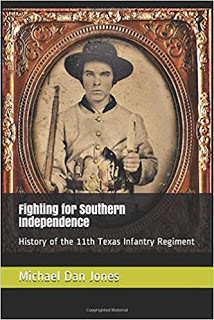
A history of the 11th Battalion (Spaight's) Texas Volunteers in the War for Southern Independence. The unit fought on the Texas Gulf Coast and in Louisiana to fend off Northern invaders of their homeland. They fought in the First Battle of Sabine Pass, Texas, a sea battle of Galveston, Texas, the Battle of Stirling's Plantation, the Battle of Bayou Bourbeau, and the Battle of Calcasieu Pass, all in Louisiana. The book also contains a roster of men who served in the battalion, pictures, maps, a bibliography, and an index.

1864: The Battle of Fort Davidson near Pilot Knob, Missouri, took place during Maj. Gen. Sterling Price's cavalry raid on this day. The commander of the fort, Brigadier General Thomas Ewing Jr., had 1,456 men, and Price had some 5,700 men engaged. The Confederates attacked from different points, but the attacks were piecemeal and driven back by the heavily defended fort. But Ewing evacuated the fort that night and blew it up. Federal casualties numbered 213, and Confederate casualties were said to be costly.

Confederate General Birthdays, Sept. 27.

Admiral Raphael Semmes was born on this day in 1809 in Charles County, Maryland. He had a long career in the U.S. Navy, including the Mexican American War, and held the rank of commander when he resigned in 1861 to join the Confederate Navy. He is most famous for commanding the Confederate cruiser CSS Alabama. He was the most successful commerce raider with a total of 65 prizes. Besides holding the rank of rear admiral in the C.S. Navy, he was also promoted to the temporary rank of brigadier general in the C.S. Army near the end of the war and led the Naval Brigade which surrendered to Sherman with the Army of Tennessee and was paroled. Following the war, Semmes was charged with treason by the U.S. government, but the charges were dropped. He then worked as a professor at the Louisiana State Seminary, editor of the Memphis Bulletin, and wrote one of the greatest memoirs, Memoirs of Service Afloat During the War Between the States. He moved to Mobile, Alabama, and died there on August 30, 1877, and was buried in the Old Catholic Cemetery.

Admiral Raphael Semmes, CSN
(U.S. Naval Institute)

Admiral Raphael Semmes on the deck of Alabama.

Brigadier General Lawrence Sullivan Ross was born on this day in 1838 in Bentonsport, Iowa. He was raised in the Republic of Texas, served in the Texas Rangers, and was in a number of engagements with Indians prior to the war. During the war, he rose from private to brigadier general of cavalry and was in some 135 engagements. Among his battles were Corinth, Thompson Station, and the Franklin-Nashville Campaign. After the war, he served as the 19th governor of Texas and president of what is now Texas A&M University. He died on January 3, 1898, in Brazos County, Texas, and was buried in Oakwood Cemetery in Waco, Texas.

Brig. Gen. Lawrence "Sul" Ross

Friday, September 26, 2025

Today in History (general history)/ On This Day in Confederate History/ Confederate General Birthdays, September 26.

 Click ðŸ‘‰Today in History (general history) Sept. 26. 

On This Day in Confederate History, Sept. 26.

1864: President Jefferson Davis made an inspection trip to the Army of Tennessee after the recent loss of Atlanta, Georgia to evaluate the situation for himself. The relationship between his two top generals, General John Bell Hood and Lt. Gen. William Hardee, had reached the breaking point and Davis tried to find a solution for the good of the army and nation. After meeting separately with both Hood and Hardee, he decided to move Hardee to the command of South Carolina. He also moved General P.G.T. Beauregard to coordinate the entire western region, which gave him technical command over Hood in  Georgia and Tennessee, and of Lt. Gen. Richard Taylor in Alabama, Mississippi, and Eastern Louisiana. But in reality, he would be in command of one or the other only if he was physically present with either one. So Beauregard's position became advisory in nature with no actual control. Hardee was moved to Savannah, Ga. The situation in the western Confederacy would steadily deteriorate, especially with Hood and his Tennessee campaign.

President Jefferson Davis' trip to straighten out
the problems with the Army of Tennessee failed
to save the army and the Western Confederacy
from pending disasters.

Also at this time, Lt.Gen. Nathan Bedford Forrest's raid into Tennessee to cut Sherman's supply line was nearing Pulaski, Tennessee. And in Missouri, Maj. Gen. Sterling Price's raid into Missouri was advancing on Pilot Knob, Missouri.

Confederate General Birthdays, Sept. 26,

None

Thursday, September 25, 2025

Today in History (general history)/ On This Day in Confederate History/ Confederate General Birthdays, September 24.

Click ðŸ‘‰Today in History (general history) Sept. 25.

On This Day in Confederate History, Sept. 25.

1862: In the aftermath of the First Battle of Sabine Pass, Texas, Lieutenant Colonel Ashley W. Spaight, in command of the 11th Battalion Texas Volunteers, was busy rearranging the positions of his battalion on September 25. Colonel X.B. DeBray, sub-military district commander, assembled reinforcements. Captain Marsh's Company A, cavalry, of Spaight's Battalion, was finally seeing some action against the enemy and was sent to the area around Sabine Pass as scouts to keep a close eye on what the enemy movements were. Company B of Spaight's Battalion (Capt. K.D. Keith's heavy artillery) was sent to Fort Grigsby, further up Sabine Pass in case the enemy strikes there also. The three infantry companies of the battalion were dispatched to other spots, Company C to reassemble at Smith's Bluff; Company D was sent to Orange to guard that important river port, and Company E was sent to guard the bridge at Taylor's Bayou. Spaight's other cavalry company, Company F, was sent to scout in the area of  Fort Grigsby. Debray was bringing the 20th Texas Infantry Regiment and the 21st Battalion Texas Infantry.

Believed to be Sgt. Thomas Jefferson Smith,
Co. C, Spaight's Battalion. (Find A Grave)

A history of the 11th Battalion (Spaight's) Texas Volunteers in the War for Southern Independence. The unit fought on the Texas Gulf Coast and in Louisiana to fend off Northern invaders of their homeland. They fought in the First Battle of Sabine Pass, Texas, a sea battle of Galveston, Texas, the Battle of Stirling's Plantation, the Battle of Bayou Bourbeau, and the Battle of Calcasieu Pass, all in Louisiana. The book also contains a roster of men who served in the battalion, pictures, maps, a bibliography, and an index.

1863: The Memphis Appeal on this day ran the casualties of the 5th Company Washington Artillery of New Orleans at the Battle of Chickamauga, Ga. on Sept. 19 and 20: "Sept. 19--Killed: Lieutenant S.M. Blair, Privates John Anderson, C.P. Bailey, M. Duggan, E. Reichard, L. Daigle, Jos.Belson. Wounded: Martin Mathis, through thigh slightly; Felix Arroyo, bruised slightly; C.R. Percy, slightly in right-left; John Walsh, slightly. Sept. 20--Killed: Fred Morrel, L. Brocard, (volunteer for the fight) James Bayle, Benjamin Stakeman. Wounded: W.A. Wood, leg amputated, doing well; Myle Greenwood, foot, doing well; J. Weber, slightly; George Pugh, slightly; C. Weingard, bruised slightly; W.G. Crawford, slightly; John Frazar, slightly through the forearm.

Pvt. Emile F. Reichert, Co. 5, Washington Artillery of  New
Orleans, La. was killed in action on Sept. 19, 1863 at Chickamauga.
 

A group  picture of the 5th Company Washington Artillery

Confederate General Birthdays, Sept. 25.
 
None.

Wednesday, September 24, 2025

Today in History (general history)/ On This Day in Confederate History/ Confederate General Birthdays, September 24.

Click ðŸ‘‰Today in History (general history) Sept. 24. 

On This Day in Confederate History, Sept. 24.

1861: James Ewell Brown Stuart was appointed a brigadier general on this day. Stuart was Robert E. Lee's premier cavalryman in the Army of Northern Virginia, and Lee relied heavily on Stuart's expertise in all aspects of the cavalry. In those days, the cavalry was the eyes and ears of the armies and were guards of the flanks of the army during battle and in making movements. Stuart was flamboyant and was one of the legendary characters of the war.

Maj. Gen. J.E.B. Stuart

1862: The First Battle of Sabine Pass, Texas occurred on this day and the next in 1862. The battle was between the Federal West Gulf Blockading Squadron, two schooners, and one steamer, under the command of Lt. Frederick Crocker of the USS Kensington, versus the 11th Battalion (Spaight)'s Texas Volunteers, which included infantry, artillery, and cavalry, Daley's Texas Cavalry Battalion, and artillery Company B of Spaight's Battalion.  Major Josephus S. Irvine was in overall command of the Confederates. The draft of the Kensington's draft was too great to get over the bar at the entrance of the pass, so the schooner USS Rachel Seaman and the mortar schooner USS Henry Janes carried out the attack. The Confederates were in Fort Sabine, which is a totally different fort for the more famous Second Battle of Sabine Pass a year later which was Fort Griffin further up the pass. The Confederates were vastly undermanned because there was a yellow fever epidemic and most of the men had been given a furlough. The four heavy artillery guns were manned by Co. B, Spaight's Battalion, 18 men under Capt. K.D. Keith, and 10 cavalrymen of Co. A Spaight's Battalion. The fort was also vastly outgunned by the Federal blockaders. The Confederates rejected a surrender demand. The schooners then stood out of range for the Confederate guns and pummeled the Confederates at a long distance for five hours. At 2 o'clock A.M. Maj. Irvine determined resistance in the undermanned and outgunned little fort was futile and had the guns spiked, saved most of the ordnance and other public property, and withdrew. The next morning, the town was surrendered but because of the yellow fever epidemic, the Federals were too afraid to land and occupy it but did land a party to finish destroying the fort. They did bombard some parts of the helpless village and continued to terrorize the civilian population. No one was killed or wounded on either side but two Confederates were left behind because they were too ill with yellow fever to be moved.

Major Josephus S. Irvine, Spaight's Battalion
He was in overall command during the battle.
Mag. Ivine was a veteran of the Texas Revolution
and fought in the Siege of Bexar (San Antonio) in
1835, and the Battle of San Jacinto in 1836.
Confederate reenactors fired this artillery piece at
a reenactment of the Second Battle of Sabine Pass
on the actual battlefield. (Photo by M.D. Jones)
A history of the 11th Battalion (Spaight's) Texas Volunteers in the War for Southern Independence. The unit fought on the Texas Gulf Coast and in Louisiana to fend off Northern invaders of their homeland. They fought in the First Battle of Sabine Pass, Texas, a sea battle of Galveston, Texas, the Battle of Stirling's Plantation, the Battle of Bayou Bourbeau, and the Battle of Calcasieu Pass, all in Louisiana. The book also contains a roster of men who served in the battalion, pictures, maps, a bibliography, and an index.

1864: On the second day of Confederate Major General Nathan Bedford Forrest's action at the Battle of Fort Henderson, Alabama, part of Forrest's raid on Sherman's supply line, the Confederates bombarded the enemy installation for hours. Forrest then met with the Federal commander, Col. Wallace Campbell, who agreed to surrender. Some Federals of the 18th Michigan and 102nd Ohio tried to relieve the fort but were turned back by a Confederate counterattack. Forrest's cavalry moved on, destroying other parts of the Nashville and Decatur Railroad and supplying Sherman's army.

Confederate General History, Sept. 24.

None. 

Monday, May 19, 2025

Today in History (general history)/ On This Day in Confederate History/ Confederate General Birthdays, July 19.

Click ðŸ‘‰Today in History (general history) July 19.

On This Day in Confederate History, July 19.

1861: Gen. Joseph E. Johnston's 18,000-man Army of the Shenandoah begins arriving at Manassas Junction, Va., to bolster Gen. P.G.T. Beauregard's 22,000-man Confederate Army of the Shenandoah, which is threatened by Brig. Gen. Irvin McDowell's 35,000-man Yankee Army of Northeastern Virginia. Johnston approves of Beauregard's plan to strike the Federals on the Federal left flank. Meanwhile, McDowell is planning to attack the Confederate left flank.

The 1st Bn. (Wheat's) La. Vol. gained fame at the 1st Battle of Manassas, VA. This sketch of a drummer of Co. B (Tiger Rifles) was made by William Ludwell Sheppard,  for the Century Magazine's Battle and  Leaders series. The artist was a Confederate veteran (Richmond Howitzers) and spent much of his time during the war sketching other soldiers, possibly even this Zouave member of Co. B. The Tigers were in Evans' Brigade at First Manassas.
 
William Ludwell Sheppard
postwar. (Find A Grave)
 

1863: Brigadier General John Hunt Morgan's Confederate Cavalry meets with disaster at the Battle of Buffington Island, Ohio. Morgan's cavalry, numbering 1,930 men, was trying to cross the river into West Virginia at that point when it was attacked and nearly 3,000 Federals under Brigadier General Edward H. Hobson. Morgan's men first found the fort abandoned at that point, but three Federal gunboats prevented them from crossing. They were then nearly surrounded by the Federals. Morgan and about 700 men escaped, while over 750 under Colonel Basil W. Duke were captured. The Confederates suffered 52 killed, 100 wounded, plus those captured. Federals lost 25 men killed and 30 wounded.

1864: Reaction to the replacement of General Joseph E. Johnston with General John Bell Hood is met with great anger by the soldiers of the Confederate Army of Tennessee in the Atlanta Campaign. But the men were kept busy building breastworks at the fortifications at Atlanta, Georgia. Other than the morale problem over the chance of commanders, the Confederate army is in good shape to meet Maj. Gen. W.T. Sherman's three Federal armies, the Army of the Cumberland, the Army of the Tennessee, and the Army of the Ohio.

2nd Lt. Thomas S. McLane, Co. A, 41st Ga. Inf.
Army of  Tennessee. Lt. McLane retired to
the Invalid Corps on Aug. 29, 1864.
(Liljenquist Collection, Library of Congress)

Confederate General Birthdays, July 19.

Brig. Gen. Roger Atkinson Pryor was born in 1828 in Dinwiddie County, Virginia. He was a pre-war journalist, politician, and member of the U.S. House of Representatives from Virginia. He was also a fiery orator and proponent of secession. After leaving the U.S. House in 1861, he first served in the Confederate Congress before joining the Confederate Army as the colonel of the 3rd Virginia Infantry Regiment. He was then promoted to brigadier general and led his brigade in the Peninsula Campaign, the Seven Days Battles, Second Manassas, and Sharpsburg. He commanded a division at Sharpsburg but performed poorly. Pryor resigned his commission in 1863. Still wanting to serve his nation's cause, he enlisted as a private in August 1863 in the 3rd Virginia Cavalry. He was captured by the Yankees on Nov. 28, 1864, and was suspected of spying, but was released on parole under the authority of Lincoln and remained voluntarily in Petersburg when the city was evacuated in 1865. Following the war, Pryor moved with his family to New York, where he practiced law, advocated against Reconstruction, was active in the Democratic Party, and was appointed to the New York Supreme Court. Pryor was also active in the Sons of the American Revolution and his wife the Daughters of the American Revolution, which she helped found. Pryor died on March 14, 1919, in New York City and was buried in Princeton Cemetery in Princeton, New Jersey.

Brig. Gen. Roger A. Pryor