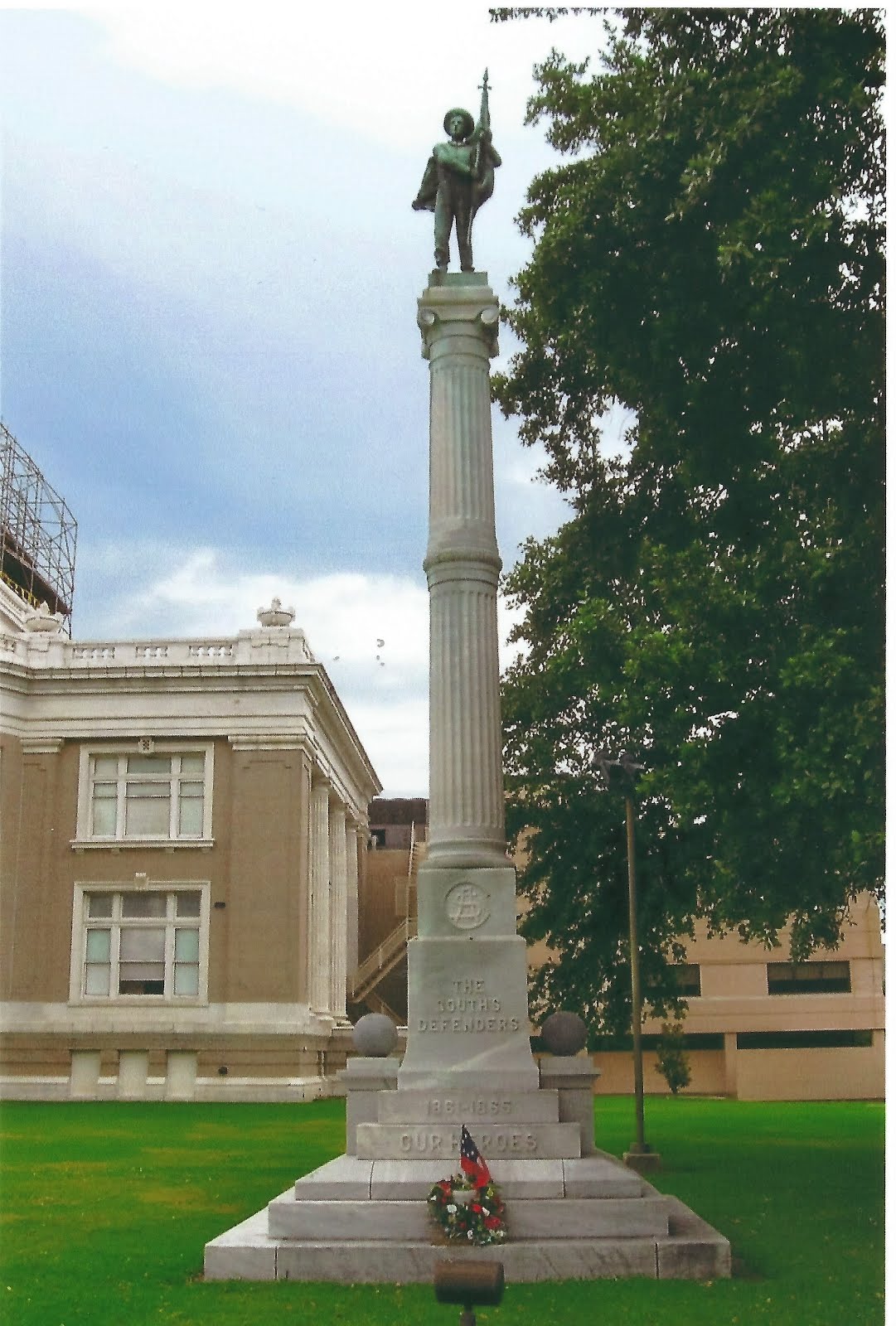
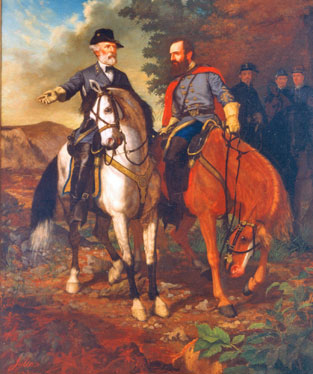
January is a very special month for those of us of Confederate Heritage. It is the month that our two greatest military heroes were born, Robert E. Lee and Thomas J. "Stonewall" Jackson. Not only do we pay tribute to those two Southern greats, but all of our Confederate ancestors and the great and good principles for which they fought. In spite of what our politically correct culture tells us about the causes of the War For Southern Independence, we know the truth is that they were fighting to rescue us, their descendants, from overpowering, centralized government, that makes a mockery of the founding principles of the United States -- which were limited, constitutional government where the real political power was in the state and local governments where the people have the most control. This "Principle of Confederacy" was what the Founding Fathers gave us in 1776 with the Declaration of Independence and in 1789 with the U.S. Constitution. In fact, if you read the writings of the Founders, you'll see that they frequently refer to the U.S. as a Confederacy. They knew the dangers of highly centralized government, which eventually descends into some form of totalitarian dictatorship. The Confederate Constitution of 1861 preserved those founding principles of 1776 and 1789. That's why Lee, Jackson, Davis and our Confederate ancestors were willing to risk their lives, their fortunes and their sacred honor. And let us not forget the noble women of the South when we are celebrating Lee and Jackson. Without the self-sacrificing support of Confederate women, the men would not have lasted very long in the field. Just as the men suffered in camp, on the march and in battle, so did the women who kept home and family together during those very trying times.
Tuesday, December 29, 2009
CONFEDERATE HEROES MONTH
January is a very special month for those of us of Confederate Heritage. It is the month that our two greatest military heroes were born, Robert E. Lee and Thomas J. "Stonewall" Jackson. Not only do we pay tribute to those two Southern greats, but all of our Confederate ancestors and the great and good principles for which they fought. In spite of what our politically correct culture tells us about the causes of the War For Southern Independence, we know the truth is that they were fighting to rescue us, their descendants, from overpowering, centralized government, that makes a mockery of the founding principles of the United States -- which were limited, constitutional government where the real political power was in the state and local governments where the people have the most control. This "Principle of Confederacy" was what the Founding Fathers gave us in 1776 with the Declaration of Independence and in 1789 with the U.S. Constitution. In fact, if you read the writings of the Founders, you'll see that they frequently refer to the U.S. as a Confederacy. They knew the dangers of highly centralized government, which eventually descends into some form of totalitarian dictatorship. The Confederate Constitution of 1861 preserved those founding principles of 1776 and 1789. That's why Lee, Jackson, Davis and our Confederate ancestors were willing to risk their lives, their fortunes and their sacred honor. And let us not forget the noble women of the South when we are celebrating Lee and Jackson. Without the self-sacrificing support of Confederate women, the men would not have lasted very long in the field. Just as the men suffered in camp, on the march and in battle, so did the women who kept home and family together during those very trying times.
Sunday, December 13, 2009
THE CONFEDERATE SOUTH IS PRO-LIFE
It is a shame that Louisiana, a pro-life Confederate state, is forced to allow this diabolical practice. It is also a shame that it is represented in the U.S. Senate by a pro-abortion senator, Mary Landrieu, Democrat. Here is the response from the Louisiana Right To Life organization to Landrieu's latest pro-abortion vote in the federal senate on the so-called health care bill:
December 10, 2009
LA Right to Life Releases Newspaper Ads Reminding
Senator Landrieu: Abortion is NOT Health Care
Louisiana Right to Life Urges Senator Landrieu to oppose “cloture” on H.R. 3590.
Baton Rouge, LA ‐‐ In conjunction with Louisiana Family Forum Action and the Acadiana Right to Life Committee, Louisiana Right to Life has published half‐page ads in three prominent
Louisiana newspapers. The ads call attention to Senator Mary Landrieu’s recent vote in favor of abortion funding and urge Senator Landrieu to oppose the vote on “cloture” on H.R. 3590.
The half‐page ad will run in The Advocate on Thursday and the Times Picayune and Lafayette’s The Advertiser on Friday. Benjamin Clapper, Executive Director of the Louisiana Right to Life
Federation, made the following comment after the releasing the ads:
“Senator Landrieu has asserted in the defense of her vote against the Nelson Amendment that pro‐lifers manufactured the issue of abortion in order to ”scuttle” health care reform. However,
this ad reminds Senator Landrieu, and Louisiana, that we believe abortion is not health care, and without the Nelson Amendment, the Senate health care bill will authorize government
funding of abortion.”
“We hope Senator Landrieu stands for Louisiana values by opposing ”cloture” on H.R. 3590,” Clapper concluded.
Louisiana Right to Life Federation (LARTL), established in 1970, works through education and legislation to restore the right to life in Louisiana by opposing abortion, euthanasia, and other life destroying actions.
Enclosed: Ad Run Thursday in Advocate in the Main News Section
Additional Resources Available Online at www.ProLifeLouisiana.org/Healthcare:
Point by Point Rebuttal to Senator Landrieu’s December 8th Press Release
Louisiana Right to Life December 8 Press Release on Defeat of Nelson Amendment
God bless and protect the unborn, and God bless our Confederate South!
Mike Jones
Monday, November 23, 2009
WAR ON SOUTHERN CIVILIANS

The Lincoln administration's deliberate war on innocent Southern civilians would, if it happened today in any foreign nation, no doubt be considered a war crime. Gone With The Wind by Margaret Mitchell details the cruel way the O'Hara family was treated by a single forager, and then Gen. William T.Sherman's main army while burning and robbings his way from "Atlanta to the Sea." After reading Gone With The Wind, I wanted to read a straight history on the campaign for comparison, and found War Like the Thunder Bolt by Russell S. Bonds (Westholme, Yardley, Pa. 2009) to be an excellent read.
In his book, Bond gives a very good historical account of both the Atlanta campaign, as well as the burnings of Atlanta and the mistreatment of civilians. The campaign stretched from the summer of 1864 to that fall, leaving the whole region devastated, the city, as well as other towns, in ashes and many civilians destitute and in a starving condition. Battles of Peachtree Creek, Atlanta, Ezra Church and Jonesboro are all detailed, as well as the dramatic assumption of command of the Confederate Army of Tennessee by Gen. John Bell Hood.
We also read profiles of the many colorful personalities involved, including Confederates Hood, Joseph E. Johnston, Patrick Cleburne; Yankees Sherman, George Thomas, Benjamin Harrison, and civilians like 10-year-old Carrie Berry, who withstood the siege and occupation and recorded it in her diary. The mistreatment of civilians was every bit as portrayed by Mitchell in Gone With the Wind.
War Like the Thunderbolt, The Burning and Battle of Atlanta by Russell S. Bonds, Westholme Publishing Inc., Yardley, Pa.; 522 pages; maps, photographs; bibliogrpahy; endnotes; index; $29.95 index.
Thursday, November 19, 2009
The Sum of Good Government

Thomas Jefferson's "Doctrine of States Rights" was the political foundation of the government of the Confederate States of America. Here are some Jefferson quotes that summarize "Good Government."
"The care of human life and happiness and not their destruction is the first and only legitimate object of good government." --Thomas Jefferson to Maryland Republicans, 1809. ME 16:359
"The only orthodox object of the institution of government is to secure the greatest degree of happiness possible to the general mass of those associated under it." --Thomas Jefferson to M. van der Kemp, 1812. ME 13:135
"The first object of human association [is] the full improvement of their condition." --Thomas Jefferson: Declaration and Protest of Virginia, 1825. ME 17:444
"The happiness and prosperity of our citizens... is the only legitimate object of government and the first duty of governors." --Thomas Jefferson to Thaddeus Kosciusko, 1811. ME 13:41
"The energies of the nation... shall be reserved for improvement of the condition of man, not wasted in his destruction." --Thomas Jefferson: Reply to Address, 1801. ME 10:248
"Here... will be preserved a model of government, securing to man his rights and the fruits of his labor, by an organization constantly subject to his own will." --Thomas Jefferson to William Plumer, 1815. ME 14:237
"The freedom and happiness of man... [are] the sole objects of all legitimate government." --Thomas Jefferson to Thaddeus Kosciusko, 1810. ME 12:369
"The equal rights of man, and the happiness of every individual, are now acknowledged to be the only legitimate objects of government." --Thomas Jefferson to A. Coray, 1823. ME 15:482
"To preserve the peace of our fellow citizens, promote their prosperity and happiness, reunite opinion, cultivate a spirit of candor, moderation, charity and forbearance toward one another, are objects calling for the efforts and sacrifices of every good man and patriot. Our religion enjoins it; our happiness demands it; and no sacrifice is requisite but of passions hostile to both." --Thomas Jefferson: to Rhode Island Assembly, 1801. ME 10:262
"All religions are equally independent here, our laws knowing no distinction of country, of classes among individuals and with nations, our [creed] is justice and reciprocity." --Thomas Jefferson to the Emperor of Morocco, 1803. ME 19:136
Monday, November 16, 2009
Why Did the South Lose?
If the South was right, and we know that it was. If the Southern Cause was true, and we know that it was. If the Southern army was far more Christian than the Union army, and we know that it was. If the Confederate president and leadership were vastly more honorable and Godly than those of the Union, and we know that they were. And, if God is on the side of what is right, true, Christian, and Godly, and we know that He is. Then, why did the South lose?
There is one, and only one, possible answer, and to me it seems obvious. It's not over! Oh, the shooting war may have ended long ago, but the battle rages on. The struggle for what is right, true, and Godly has not ended. Our Southern heritage and the principles of our founding fathers are still under attack. And we, like those brave Confederates who faced the barbaric Union invaders, are still being forced to defend what is true and Godly against deceitful and demonic oppressors.
Consider the nation of Israel. In A.D. 70, and again in A.D. 135, the Romans completely destroyed Jerusalem, renamed it, and denied the Jews any hope of ever seeing their homeland again. But, nearly nineteen centuries later, long after the Roman Empire had fallen, Israel rose from the ashes and is once again a strong and powerful nation. It's never over until God says it's over.
Consider also our Lord. He was executed as a criminal with criminals. His followers were in fear and despair. They had believed Him. Trusted Him. And now, He was dead. The Romans who crucified Him, thought it was over. The Jewish leaders who sought His death, thought it was over. Even His disciples and friends, thought it was over. But, it wasn't over. Three days later Jesus arose from a cold grave turning death into victory, and despair into joy.
The Bible tells us, "What shall we then say to these things? If God be for us, who can be against us?" The South's Cause of truth, freedom, justice, and Christian Godliness is not lost. It's just not over. And I know it's not over because we haven't won yet. We may not know God's plan, or exactly what He is going to do. But this we can know: It may take nineteen hundred years or just a few days, but God's side always wins.
Bro. Len Patterson, Th.D.
Chaplain, Army of Trans Mississippi
Sons of Confederate Veterans
Sunday, October 25, 2009
GONE WITH THE WIND: Book Review

I have been a fan of the movie Gone With The Wind since the first time I saw it in the 1960s in Houston, Texas. It tells the story of the War For Southern Independence from a distinctly Southern point of view, and is a classic that is considered the all time ticket seller in movie history. As much as I love the movie, until recently I had never read the book upon which the movie was based, Margaret Mitchell's epic adventure first published by Scribner in 1936. The author won the Pulitzer Prize the next year and it has sold over 30 million copies since then. Even today it reportedly sells about 200,000 copies a year.
As good as the movie is, in my opinion, the book is even better. You get a lot more historical background in the book, more characters, a fuller explanation of the character's motivations than in the movie, and more detailed descriptions of the time and places depicted. The book is well written. Margaret Mitchell was obviously a master story-teller with the written word. A native of Atlanta, Ga. born in 1900, Mitchell knew one of her Confederate veteran gandfathers and heard numerous stories from other veterans and female members of her family that lived through the war. She had an excellent grasp on the history of the Atlanta campaign, around which of the book revolves. She died an untimely and tragic death in 1949 when struck by a car while crossing the street in Atlanta.
Mitchell tells the story from a woman's view point, which is both the civilian side of the war and reconstruction. I've always been most interested in the battles, generals, soldiers, etc., and haven't really read much about the war from a civilian view point. I learned a lot about the civilians and how they interacted with the armies by reading Gone With The Wind. The book tells that side of the war and reconstruction much better than does the movie. The agonizing hardships suffered by women, children and the elderly is heart-wrenching. It also shows just how dedicated the majority of the population of the South were to the cause of Southern Independence, and the lengths to which they were prepared to sacrifice for it. The soldiers of the South held Southern women in high esteem because they knew how much they had sacrificed, as well as the men in uniform.
I also appreciate what the book and movie do to make sure the traditional Southern view of the war are kept alive in popular culture, generation after generation. Political correctness has become so vile, poisonous and deceptive, lies about the South and the Confederacy are now accepted by many people as the truth, because they've heard only one side of the story -- and that is the biased Northern side.
But most of all this was just a very enjoyable book about engaging characters, exciting action and a dramatic story from one of nation's most important periods of history.
GONE WITH THE WIND by Margaret Mitchell; 1936, Scribner (Simon & Shuster) New York, N.Y.; 1048 pages; $28 hardback.
Sunday, October 11, 2009
A Trip to the Confederate Memorial Hall

I went on a field trip yesterday, 10 October, with fellow members of Captain James W. Bryan Camp 1390, SCV, and friends, to Confederate Memorial Hall and Museum and the National World War II in New Orleans. These two museums are studies in contrast. The Confederate Museum is very traditional, in fact the oldest museum in Louisiana, and the World War II museum is very modern. While different, they both are world-class museums that do an outstanding job of telling the story of the respective wars they interpret.
The Confederate Museum was built in 1891 specifically to be a museum and meeting hall for the city's Confederate veterans. Most of the exhibits on display were donated by the veterans themselves, family members or collectors. The building itself is a historical artifact. It is of magnificent romanesque style architecture with a widow's peak tower detail. It is rightfully on the National Register of Historic Places and is without a doubt one of the most historic buildings in New Orleans. Inside are showcases, paneling and other historical and architectural details that are gems of style and tradition. There is stunning stained glass window of Father Abram J. Ryan, "Poet-Priest of the Confederacy."
The exhibits on display make up one of the world's greatest collections of Confederate military memorabilia. They have the uniforms of generals P.G.T. Beauregard, Franklin Gardner, Daniel W. Adams, and Albert G. Blanchard. There are over 100 original Confederate battleflags and a number of restore flags are on display. There are many family artifacts from the President Jefferson Davis family, including a crown of thorns woven for Davis during his captitivity, by Pope Pius IX. There are numerous, rare, ambrotypes of tintypes of Confederates soldiers, rifles, pistols and swords. There are many paintings and sculptures of famous Confederate generals, some by world renown artists. Besides the uniforms of on display of Confederate generals, there are also many that were worn by ordinary Confederate soldiers. The scope, content and quality of the artifacts are simply breath-taking.
Just across the street and around the corner is the National World War II Museum, which was first open June 6, 2000, as the National D-Day Museum. It is now rapidly expanding on 4 November will open a new building that will have a 4-D theatre, four star restaurant and additional exhibits. On the ground floor, the museum has on display World War II vehicles and a reconstruction of a World War II Higgins boat, the boat that Eisenhower said won World War II for the Allies and which was manufactured in New Orelans. There are also a half-track, Sherman tank, an American Jeep and a German staff car. Hanging from the ceiling are German, American and United States aircraft from World War II.
The visitor follows a path that takes him through exhibits on the beginning and causes of the war, the D-Day landings in Normandy, France and other campaigns in Europe and the Pacific. Exhibits include uniforms of all the main armies engaged, weapons, personal artifacts such as letters, watchess, etc., and of the technogical advances that helped win the war, such as the code-breaking machines. One of the most impressive displays was an actual Medal of Honor that was posthumously awarded to a sailor in the war.
What makes the museum so modern is the vast collection of audio-visual displays, including many documentary newsreels, personal reminiscences of veterans, and electronic map displays. Also there are huge blow-ups of famous photographs from various theaters of the war. These work well for a museum about World War II, which was the first major war in history that could be filmed, complete with sounds and the spoken word by participants near the time the events happened.
Louisiana has a lot of history and these two museums puts the state in the world-class category of importance.
