Thursday, May 31, 2012

150-Years-Ago 8th Louisiana Infantry Casulaties

An unidentified Louisiana private.
(Library of Congress/Liljenquist Family Collection
of Civil War Photographs)

The  Richmond Daily  Dispatch
May 31, 1862

Winchester, Va., May 26th, 1862.
           The Yankees having possession of Baton Rouge, La., the place wherein the Creole Guards (now company A, 8th regiment Louisiana volunteers,) were raised, I find it impossible to inform their relatives of the company's loss in the battle, fought yesterday, May 25th, 1862, save through the indirect medium of the press.
          Therefore, I beg of you to announce, by the insertion of this communication, that private Jos, A. Cannon was killed while bravely charging the enemy in the front ranks of his company, and privates Leon P. Gusman, Jas. M Martin, and Thos. Herrington were wounded, the first severely, though not dangerously, in the left thigh; the second quite severely in the left side, and the third slightly in the right foot.
          Should Louisiana editors noticing this only give it a re-publication, no doubt but that, in the long run, our friends and relatives will become informed of our exact loss, and thus be relieved of great anxiety.
Respectfully, yours,
A. L. Gusman,
Capt. Co. A, 8th Reg.La. Vols.

[Blog Editor's Notes: According to Booth's Records of Louisiana Confederate soldiers, Private Joseph A. Cannon was killed in action  on  May 25, 1862 at the Battle of  Winchester, Virginia, in which Brig.Gen.Richard Taylor's Louisiana Brigade smashed through Yankee lines. Cannon was born in Louisiana, a farmer from Baton Rouge, Louisiana, single and 23 years old at time of  enlistment, June 19, 1861. Private Leon P. Gusman was  wounded in the same battle and left in Winchester where he was captured by the Yankees and later paroled. He was killed in  action  July 2, 1863 at the Battle of Gettysburg, Pa. He was a native of Louisiana, from Baton Rouge, single and  19-years-old  at the time of his enlistment June 19, 1861 at Camp Moore. Private Thomas Herrington was wounded in the same battle, left wounded, captured and later paroled. He was again wounded at the Second Battle of Manassas August 30, 1862. His right arm was disabled by the wound and for the rest of the war he was on detailed service at Camp Jackson, Richmond, Va. He was captured May May 29, 1865 in Augusta, Ga. and paroled. Herrington was born in Ireland, a laborer in Baton Rouge, single and 26-years-old  at the time of his enlistment on June 19, 1861 at Camp Moore.  Private James M. Martin was wounded and  captured in the same battle. He died at the U.S.A. post hospital in Winchester, Va. on June 6, 1862. Martin was a native of Louisiana, resident of Livingston Parish, a farmer, and married.  Captain A. L. Gusman was the original first lieutenant of  Company A (Creole Guards) of  Baton Rouge. He was promoted to captain on March 19, 1862. He was acting major of the regiment when he  was captured Nov. 7, 1863 at Rappahannock River, Virginia. Confined at Johnson's Island, Ohio, he refused to take the oath of allegiance to the  United States twice, June 13 and June 14, 1865. He was received at Fort Lafayette, N.Y. Aug. 31, 1865. The last record was that he was in confinement of Oct. 26, 1865. He was born in Louisiana, a resident of Baton Rouge, a lawyer, 24-years-old at time  of enlistment June 19, 1861 at Camp Moore, and single.
According  to information on Find-A-Grave web site, Antoine L. Gusman was born Feb. 22, 1836 and died March 9, 1914 and is buried in St. Joseph Cemetery. On the 1880 Census in Baton Rouge his wife's name is listed as Clotilde, a native of France, and they had a number of children.  

Friday, May 25, 2012

150-Years-Ago --- THE BATTLE OF FRONT ROYAL, VIRGINIA

Wheat's Louisiana Tigers helped rout the Federal
forces at Front Royal, Virginia on May 23, 1862
150-years-ago. Seen here is reenactor Luke Jones
portraying one of Wheat's Tigers.
(Photo by Mike Jones)
[Editor's note: Excerpt from the The Tiger Rifles: The Making of a Louisiana Legend Michael Dan Jones. The battle took place May 23, 1862 and was part of Stonewall Jackson's Shenandoah Valley Campaign of 1862.]

The attack began soon after Belle Boyd’s dramatic appearance, about 1:45 p.m., with the Marylanders and Louisianans swooping down the hill and scooping up the advance pickets. Jackson, Ewell, and their staffs were close behind. Campbell Brown, aide-de-camp on Ewell’s staff, gave this impression of Wheat’s Battalion: “I shall never forget the style in which Wheat’s Battalion passed us, as we stood on the road. He was riding full gallop, yelling at the top of his voice – his big sergeant major running at top speed just after him, calling to the men to come on -- & they strung out according to their speed or ‘stomach for the fight,’ following after – all running – all yelling – all looking like fight. Their peculiar Zouave dress, light striped, baggy pants, bronzed and desperate faces wild excitement made up a glorious picture. Wheat himself looked as handsome in a fight as any man I ever saw. . . . That day, the enemy having hurried across the bridge tried to fire it. Wheat’s position, on the right of Johnson, brought him nearer their line of retreat & consequently he was the first man at the bridge. He put spurs to his horse, galloped through the already kindled flame in the face of enemy fire, & saved the bridge – so I was told by him and others at the time and afterwards & never heard it denied.”

When the Confederates got into the town, the battle developed into a rare urban battle with fighting house to house. The civilians in town also recorded their impressions. Lucy Buck wrote in her diary, “There was heard the quick, sharp report of a rifle, and another and another in rapid succession. Going to the door we saw Yankees scampering over the meadow below our house and were at a loss how to account for such evident excitement on their part until presently Miss B. White rushed in with purple face and disheveled hair crying – ‘Oh my God! The Southern Army is upon them – the hill above is black with our boys.’ ”[1]

     Col. Johnson halted his Marylanders on the edge of town so they could catch their breath. They then began the process of taking a building that was being used as a hospital. “. . . Major Wheat shot by like a rocket, his red hat gleaming, revolver in hand, and in first, throwing his shots right and left. The hospital was taken,” Johnson wrote. The Federals fired from the hospital windows and wounded six Marylanders. As they pushed through the town, Johnson could see the enemy had a line of battle on the side of a hill on the road to Winchester. The bluecoat skirmishers came rapidly down the hill and into a wheat field. The Confederates met them with the Marylanders on the right side of the road and Wheat’s Tigers on the left. “The enemy opened on us sharply with shell from two pieces, and though shooting remarkably well, did no execution. During the rest of the afternoon, after a short struggle, their skirmishers were driven back, and Captain Nicholas was ordered to take a white house to the left of the road, which would give us flank fire on their line. . . . Nicholas got nearly to his position, but was obliged to give ground on account of Wheat’s battalion falling back and exposing his flank,” Johnson wrote. [2]

Johnson was referring to the Federals who had reformed in a strong line on Richardson’s Hill,  and with two rifled artillery pieces prevented the Confederates from directly charging their infantry position. Due to the strung out condition of the Confederate army, the attackers were unable to bring up their own rifled pieces in time to provide effective counter-battery fire. Taylor sent the 8th Louisiana Infantry across the North Fork bridge, which the Federals had tried to burn, and the 6th Louisiana to the left to outflank the desperate northerners. Realizing he had been outflanked, Colonel Kenly withdrew to save his command. Johnson and Wheat then led their men in a run on the abandoned position and a Maryland private captured the enemy’s colors. The Confederate cavalry, Lt. Col. Flournoy’s 6th Virginia, caught up with the Federals at Cedarville and the Virginians badly cut them up with their sabers before the bluecoats surrendered. Kenly was wounded and captured.  In his official report, Taylor wrote of the Tigers at the opening of the engagement, “Here Major Wheat’s battalion, of five companies, was immediately ordered forward into the town, to assist the Maryland regiment in dislodging the enemy, the Sixth Louisiana Regiment following as a reserve.” After the town was cleared, “Major Wheat performed his part in gallant style, charging through the town, and drawing up his command on the bank of the Shenandoah in a position sheltered from enemy’s shells . . . .” Wheat’s Battalion lost one man killed and six wounded in the Battle of Front Royal. Another sidebar to the story of Wheat’s Tigers at Front Royal is their capture of a train chugging in to the town with tons of supplies for the Federal army, during the afternoon lull in the battle.  Since communications had been cut off before the battle, the train engineer had no idea he was entering a combat zone. Wheat, seeing the slow moving train, and always quick to seize an opportunity, swarmed the engine, hopped on, began tooting the horns and taking control of more loot for themselves and the Confederate army. [3]
     Lucy Buck also wrote in her diary of an amusing joke the “N.O. Tigers” played on the “Yankees.” She wrote, ‘The Tigers doffed their uniforms and donned the Yankee blue. Then they got on the cars and steamed off to Markham where the news of the fall of Front Royal had not arrived and the Federal troops of course took them to be some of their own men and coming out of quarters at the invitation of the Tigers a number of them concluded to ‘take a ride a little way.’ The hospitable Rebels not only extended the ride to Front Royal but also gave them lodging and board there.” The next morning Lucy noted that she had some of the Tigers and other Louisiana troops over for breakfast at the Buck home, which was called Bel Air.


[1] William Buck, Sad Earth, Sweet Heaven, The Diary of Lucy Rebecca Buck, (Buck Publishing Co., Front Royal, Va. 1995) 78.
[2] Driver, First and Second Maryland Infantry, 70-75.
[3] Driver, First and Second Maryland Infantry, 70-75. Ecelebarger, Three Days in the Shenandoah, 88, 89. Official Records, Reports of Brig. Gen. Richard Taylor, Vol. 12, Series 1, 800. Robert G. Tanner, Stonewall in the Valley: Thomas J. “Stonewall” Jackson’s Shenandoah Valley Campaign, Spring 1862, (Doubleday & Company, Inc., Garden City, N.Y. 1855) 213.

Wednesday, May 23, 2012

150-Years-Ago -- SCOTT'S LOUISIANA CAVALRY

Unidentified Confederate Cavalryman
(Library of Congress/Liljenquist Family Collection
of  Civil War Photographs)       
The Richmond Daily Dispatch
May 23, 1862
           We have published several notices of the gallant band under the command of Scott, a partisan leader, who bids fair to equal Morgan in the boldness of his movements. The following account, written by the Corinth correspondent of the Mobile Register, is worthy of perusal:
           Our cavalry are now pouring over the Tennessee, and soon Huntsville and Columbia will be in our hands.
          Scott's exploits on the road between Tuscumbia and Athens are the most brilliant on record. Attacking the 19th and 24th Illinois regiments, a battery of artillery, and Zimmerman's cavalry, near Tuscumbia, Captain Fenelton Cannon, of Scott's Louisiana regiment, killed, wounded and captured fifty or sixty. Captain Cannon's force was one hundred men, of which not one was materially hurt.
Pressing forward, Scott crossed the Tennessee and Elk rivers, and with 160 men attacked the 18th Ohio regiment, 700 strong, at Athens, and routed them, killing, wounding and capturing 100, taking their camp, tents, ammunition, wagons, horses, provisions, etc, also 105 muskets.
          Capt. John Williams pursued one detachment to Elkton, and Capt. Cannon burnt the Limestone creek bridge, ten miles from Huntsville — throwing off twenty car loads of coffee, sugar, rice, etc., which he also burnt — killing 20 and taking 7 prisoners.
          Scott's ammunition now gave out — no reinforcement came up, and Mitchell came on him from Huntsville with 8,000 men.
          In the face of this force, Scott re-crossed both Elk and the Tennessee rivers, driving back the 4th Ohio cavalry, 400 strong, who attacked his rear guard, killing their Colonel and 16 men.
This daring feat is worthy of record, from the fact of Scott's crossing into rivers on frail flats, and leaving them in the rear whilst he attacked five times the number of his force.
           The rejoicing of the people of Athens and the vicinity was great. The ladies turned out in great crowds and presented Col. Scott with a Confederate flag.

Monday, May 21, 2012

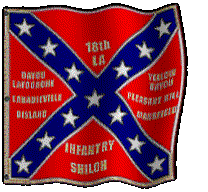
Lafayette Museum/Mouton House has living history, lecture


Members of the Pelican Battery & 18th Louisiana Infantry and
General Mouton Camp, Sons of Confederate Veterans, at the
Bicentennial celebration of  Louisiana Statehood at the Lafayette
Museum, Alexandre Mouton House in Lafayette, La.
(Photo by Mike Jones)

by Mike Jones
          LAFAYETTE, La. -- The Lafayette Museum/Alexandre Mouton House celebrated the Bicentennial of Louisiana Statehood  with a special exhibit, a War Between the States living history and a lecture by imminent scholar and historian Dr. William Arceneaux on the lives of Gov. Alexandre Mouton and his son, Brigadier General Alfred Mouton.
          On Saturday, May 19, the Mouton House hosted the living history put on by the Pelican Battery, Louisiana Artillery, General Mouton Camp of the Sons of Confederate Veterans and the 114th N.Y./18th Louisiana Infantry.
          The reenactment groups set up an encampment and gave demonstrations of infantry drill and artillery drill. The reenactors also gave the public talks on the War for Southern Independence, and the details of military life in the 1860s.
          On display for the month of  May was an exhibit of hand-colored steel engravings depicting scenes from the War Between the States in Louisiana as well as plantation life in 1860s Louisiana.
          On Sunday, May 20, Dr. Arceneaux gave his lecture on the lives of the prominent father and son Moutons and heroes of the Acadian people. Dr. Arceneaux is General Mouton's biographer, "Acadian General-Alfred Mouton and the Civil War," published in 1981, and was the first Louisiana Commissioner of High Education. He earned his B. A. degree from the  University of Louisiana at Lafayette, his M. A. and Ph.D. from Louisiana State University, all in history.
Unveiled at the event was
this beautiful oil painting
of General Mouton by Ken
Henrickson, donated by  Mrs.
Elizabeth Domingue Hayden.
(Courtesy of Lafayette Museum
Alexandre Mouton House's
Spring issue of Past & Present.)
          After reviewing the lives of Gov. Mouton and his son General Mouton, Dr. Arceneaux had a surprise for the gathering reading a letter written by  General Mouton to his cousin just three days before he was killed in action April 8, 1964 at the Battle of Mansfield, La. His cousin, Captain Eraste Mouton of Company A, 26th Louisiana Infantry, who had been captured at the fall of Vicksburg, July 4, 1863, and was then in a parole  camp at Keachi, La., about 16 miles away from Mansfield. General Mouton offered to share his tent and food with this cousin and said, in French, that he would be mad if he didn't accept his invitation. The letter is in the posession of local descendants of Captain Mouton.
        Another surprise was the unveiling of a beautiful oil portrait of General Mouton by Texas artist Ken Hendrickson. The painting was donated to the museum by Mrs.Elizabeth Domingue Hayden of Paris, Texas, a distant relative.
        The museum also expressed it gratitude for its  first funding partnership with the Lafayette Public Library.


Friday, May 18, 2012

150-Years-Ago -- THE BATTLE OF MCDOWELL, VIRGINIA

Lt. Gen. Thomas J. "Stonewall" Jackson began
his famous Shenandoah Valley Campaign of 1862
with the Battle of  McDowell.
 
 
The Richmond Daily Dispatch
May 20, 1862
Camp of Northwestern Anne. May 16, 1862.
           Old Stonewall has kept us continuously on the march ever since the battle of McDowell, so that I have not had a spare moment here; to fore to give you an account of that battle. For the space of ground fought over, it was one of the fiercest and bloodiest it that has occurred during the present war.
           Generals Jackson and Johnson having driven the enemy from Shenandoah mountain in great precipitation, they relied on the main body of their forces at McDowell, where they made a stand. That village is very strongly situated for defence from an attack from the East--there being a very narrow gorge between the mountains. through which the turnpike runs before entering the village.
Generals Jackson and Johnson waited on the top of a high hill called "Washington's Hill," on the left of the turnpike, for the purpose of reconnoitering the position of the enemy.--General Milroy at once saw that this hill commanded his position, and determined that we should not occupy it if he could prevent it.

Gen. Edward Johnson
(Library of  Congress)
             During the reconnaissance Gen. Edw. Johnson's command, consisting of Col. W. C. Scott's brigade, composed of the 55th regiment, commanded by Lieut. -- Col.Board, Col. S. H. Letcher being since; the 44th Georgia, Maj Norvell Cobb, Lieut. Col. A. C. Jones; the 5th regiment by Colonel M. G Harmen; Brice's battery and Miller's battery, and Col.Connor's brigade, composed of the 12th Georgia, commanded by Major Hawkins, Lieut. Col. Smead acting as Adjutant, to General Johnson; the 25th regiment, by Col. George Smith; the 31st regiment, by Col. Johnson Hoffidan, Lieut. Colonel A. H, Jackson, and Maj. Jas. Ontueworth, and the Ese battery, commanded by Capt Raine, were brought on the hill.
            The hill is denuded of tress, but has a few clumps of bushes in some parts of it. Col. Scott formed his line of battle on the crest of the hill, and his men faced west. This was a mere prevention to guard against attack, which he did not expect; but, very unexpectedly, the enemy made a vigorous, attack on Col. Scott's right wing and immediately the battle became fierce and furious. In a short time several regiments of the enemy were sent to the Col.. Scott's right flank, but Col.Connor's brigade was then formed at right angles to Col. Scott's, to resist them. The battle was then general and unremitting. At one time the enemy, by covering themselves by a hill, appeared suddenly in a very short distance of Col. Scott's right wing, and poured into it so deadly a fire as to cause his men to recoil some fifteen or twenty yards. 
           Scott's situation was then perilous in the extreme. He placed himself on his line of battle before his men with not more than a dozen men who had not left, and waving his hat around his head, appealed to his men in the most animating manner to rally to his support. He asked them if Virginians would let a parcel of Yankees make them run on their own soil? By such appeals as this he soon rallied them, and as they returned to the charge, he waved his hat and cheered most vociferously.
           His men then wandered into the enemy, who had by this time got very near to his line, so deadly a fire as to drive them down the hill. During this fire his men shot down the flag bearer, shot the flagstaff in two or three places, and during the temporary flight of the enemy Major Colsy, of the Fifty-eight Regiment, ran out and got the flag which is still in the possession of that regiment. As soon as the enemy were driven down the hill, Colonel Scott proposed three cheers for old Virginia, which were given with a will. 
           The battle was equally fierce with Colonel Connor's Brigade. Indeed, It was fiercest where the left wing of Connor's and the right wing of Scott's united at right angles to each other. The 12th Georgia was nearer the left of Connor's and suffered most. Connor's suffered more than Scott's, because Scott's line of battle was on the west of the hill, and as his front rank would fire he would cause it to fall back a few paces and lie down and load, while Connor's had no such advantage. But for that it is generally believed that a majority of Scott's right wing would have been killed. General Taliaferro's Brigade came up before the battle closed, but I am not advised as to the part it bore in the action. It is highly complimented.
          The battle commenced about 5 o'clock, and did not close until nearly 9 P. M. In this action all the officers and men behaved most gallantly--Gen. Ed. Johnson, as usual, displayed great gallantry, and had his horse killed under him, and was wounded in the ankle.            Col. Harman was wounded in the arm early in the action, and his regiment was then well commanded by Lieut. Col. Skinner and M. Ross. Col. Taliaferro's, of the 23d regiment, had his horse killed; Col.Scott, also, had his horse killed under him by two balls. Indeed, it looks like a miracle that he should have, escaped unhurt. No one in the battle distinguished himself more.
           I visited the field of battle again yesterday, and saw the marks of the enemy's balls, and it is my opinion, and the opinion of nearly all with us , that no one could have stood on any one place during the whole battle, near Col.Scott's right wing, without being hit. The artillery on our side was not in action.
Virginian.

Wednesday, May 9, 2012

150-Years-Ago -- BATTLE OF WILLIAMSBURG, VIRGINIA

Pvt. John White, Virginia drummer boy.
(Library of Congress)


The Richmond Daily  Dispatch
May 9, 1862.

          Early yesterday morning the most extravagant rumors were in circulation with regard to an engagement which was represented to have taken place near Barhamsville, in New Kent county, on Wednesday. One report stated that our arms had been crowned with a most signal and glorious success, and as a consequence of their impertinence and temerity, six thousand of the enemy had fallen into the hands of our victorious forces, together with an almost incalculable number of non and small arms.
          These rumors were general and extensive, that they obtained almost universal credence, and great was the gratification manifested on all aides at the supposed victory. About midday, however, these flattering reports received an official contradiction, and the following paragraph found posted upon the bulletin boards of the different journals of the city:
          "An official letter from General Johnston, ed at Barhamsville, 11 A. M.yesterday,  is that the enemy were landing under the of their gunboats, near West Point. Notion is made of the imminency of an engagement; but, on the contrary, the tenor of the letter indicates that Gen. J. did not expect a conflict with the enemy.
         He states that the repulse of the enemy at Williamsburg seems to have stopped their advance in that direction altogether. The prisoners on Monday were principally of Heintzleman's division, and part of Sumner's.--Nothing said of the extent of casualties on either side."
        Thus it will be seen that all the information heretofore published with reference to the fight at Barhamsville, is entirely without foundation. How it obtained existence, or received public credence, we need not inquire.
       We have some further particulars of the fight of Monday near Williamsburg, which, from the accounts we have, was a most brilliant and successful affair. A large number of the prisoners captured reached this city yesterday afternoon, under a cavalry escort, commanded by Capt. Robert A. Caskie, of the Wise Cavalry. The gallantry displayed by this corps is highly commended, and is said to have struck terror to the enemy.
       Our loss in this fight was very heavy, and we have to mourn the loss of some noble and gallant spirits, and the severe wounding of many others. We published yesterday a list of names which we had received as killed and wounded, and this morning we add a number of others in the 11th and 24th regiments:
      Eleventh Regiment.--Col. Garland, slightly wounded in the hand. Home Guards, Lynchburg — E. A. Akers, wounded twice, not seriously; James Franklin, John Waller, Martin Laskie, Wiley Campbell, Littleton Moor ,S. Noralin, Adam Nowlin, Van Taliaferro, and John Sumpter. Rifle Grays — Killed, J. R. Raize, S. Stewart, J. Slagle, H Elam, and Wm. Florence. Wounded, John Sooley, Thomas Rector, Lieut. Peter Akers, Thomas Chestham, J. O. Thurman, and G. Wightman, Lynchburg Rifles--Wounded, Lieut. Walter Abbott, and — Keaton. Jeff. Davis Guards--Killed, J. Reynolds and-- urks. Wounded — John Bolling and--Larley.
      Twenty-fourth Virginia Regiment.--Col. Terry, of Bedford, shot through the mouth; Lieut. Col. Harriston, shot through the groin; Capt. nings, of Carroll, killed; Capt. Bentley, of Pulaski, wounded; Captain Sybrook, of Patrick, wounded; Captain Headen, of Giles, wounded; Lieut. Mansfield, of Franklin, killed; Lieut. Shockley, of Carroll, wounded; Lieut. Wm. Radford, of Pulaski, certainly killed; John Staples, member of House of Delegates from Patrick, wounded in shoulder. All of dead and badly wounded fell into the hands of the enemy — about 250 in number.
      List of killed and wounded in the first Virginia Regiment.
The following list of the killed and wounded in the First Virginia Regiment, in the engagement near Williamsburg, on Monday, was handed to us by Capt. Tysinger, who received a wound in the hand:
Col. Lewis B. Williams, severely wounded is the left breast.
Major Wm H Palmer, slightly wounded in right arm.
Company B--Carried into Action 24 Men and three Commissioned officers.
Corporal C B Beale, killed
Private Pleasant Jordan, killed.
Private PeterMonrs, killed.
Private M P. Buchanan, wounded slightly in chin.
Private Adam Smith, wounded slightly in left arm.
Private Joseph T Shiffett, severely in the shoulder.
Company C--S Commissioned Officers and 15 Men in action.
Killed.
Private P Keating.
Wounded.
Lieut. Jas Hallinan, severely in left and slightly in right arm.
Private James Dooley, severely in right arm.
Private M Consadine, right arm.
Peter McCawley.
Missing.
Private D Costello.
Company D--4 Officers, 31 Men in action.
1st Lieut. E. P. Reeve, severely wounded in right shoulder.
Corporal L. M. Blanton, in forehead.
Private T H Haley, mortally, in arm and breast.
Private Geo Logan, mortally, in abdomen.
Private E Priddy, in leg.
Private J M Finn, in arm.
Private D S Edwards, in leg, slightly.
Missing.
W. H. Stewart.
Company G--S Commissioned Officer, 76 Men in action.
Killed.
Private O O Folkes.
Wounded.
Private A S Susad, in arm.
Private H B Gary, in throat.
Private E Gary, slightly, in right arm.
Private W T Hord, slightly, in right shoulder.
Company H--4 Commissioned Officers and 30 Men in action.
Capt. W E Tysinger, in hand.
Serg't T S Riddick, in thigh.
Private Edwin Gliman, mortally, in side.
Private R D Swords, mortally, in hip.
Private Geo Rae, severely, in breast.
Private O P Hansford, severely, in right shoulder.
Private A O Clayton, slightly, in foot.
Company I--4 Officers, 23 Men of 1 and 10 of Company K,
Capt J W Tabb, piece of shell, slightly in hip.
Lieut W A Caho, right hand.
1st Sergeant R M Jonas, shot through the head.
Private J G Grammer, killed.
Private J T Devoux, killed.
Corp'l O L Parker, wounded in left side.
Private Thos Senior, wounded in side of the head.
Missing.
J T Ayies, B I Morse.
None of the ten men of Company K hurt.
Twenty-five Commissioned officers, 150; men in action.
Seven commissioned officers wounded.
Eleven men killed or mortally wounded.
Twenty-three men wounded.
Five missing, supposed to be wounded or prisoners--43.
       All wounded or killed by musketry. Went into action at 10½ o'clock; withdrew at 6½.
Sent 65 prisoners to the rear, 2 colors, and a battery of 7 pieces.
       The 1st Regiment was in the hottest of the fight and Col. Williams, the officer in command, acquitted himself most gallantly.

Monday, May 7, 2012

150-years-ago ARRIVAL OF LOUISIANA TROOPS

A Louisiana Pelican.
The Richmond Daily Dispatch
May 7, 1862
Arrival of Louisiana troops.
           There arrived yesterday, via Danville Railroad, at 1 o'clock, a detachment of Louisiana troops, being a portion of the 1st Division of Louisiana Volunteers. The remaining portion of those to come yesterday, some 250 in number, were expected in the evening, and those who arrived at an earlier hour were compelled to sit in the cars for six hours waiting for them, the various commanding officers being in the rear train.
           The troops which arrived at 1 o'clock consist of part of Capt. C. E. Girardy's Battalion Louisiana Guard, 155 men; Montgomery Guard, Capt. Nolan, 104 men; Emmett Guard, Captain Neiligen, 74 men; Caddo Rifles, Captain Lewis, 105 men — the whole amounting to 438 men.--The troops were substantially clothed, well armed, and not at all averse to having a brush with Lincoln's followers at the earliest possible moment. They report thousands of the same sort on the way here.
          Sunday night 1,400 men from Tennessee landed at the camp near Lynchburg — also a battalion of about 150 from Huntsville, Alabama, and the cry was still they come. Up to 7:30  o'clock last evening the above troops had not passed this office on their way to the camp ground. At the hour named it was raining violently.
          In speaking of the arrival of the above troops we must specially allude to the battalion of "Louisiana Guards," commanded by Capt. Girardy--a braver or more military body of men never marched in this city from any place. The whole battalion is composed of three companies, two of which have arrived, and the remainder are being expected every day from Pensacola, where they have been on duty for several months.
          They number in all 275 men, and are the pride of the Crescent City people, as the Seventh Regiment is of the New Yorkers. Their uniform is of the Zouave pattern. Each member "away down South in Dixie" is accounted a soldier and a gentleman. With such troops, and "more a- coming"--the flower of Southern chivalry — the followers of Old Abe stand but a poor show.