Tuesday, October 30, 2012

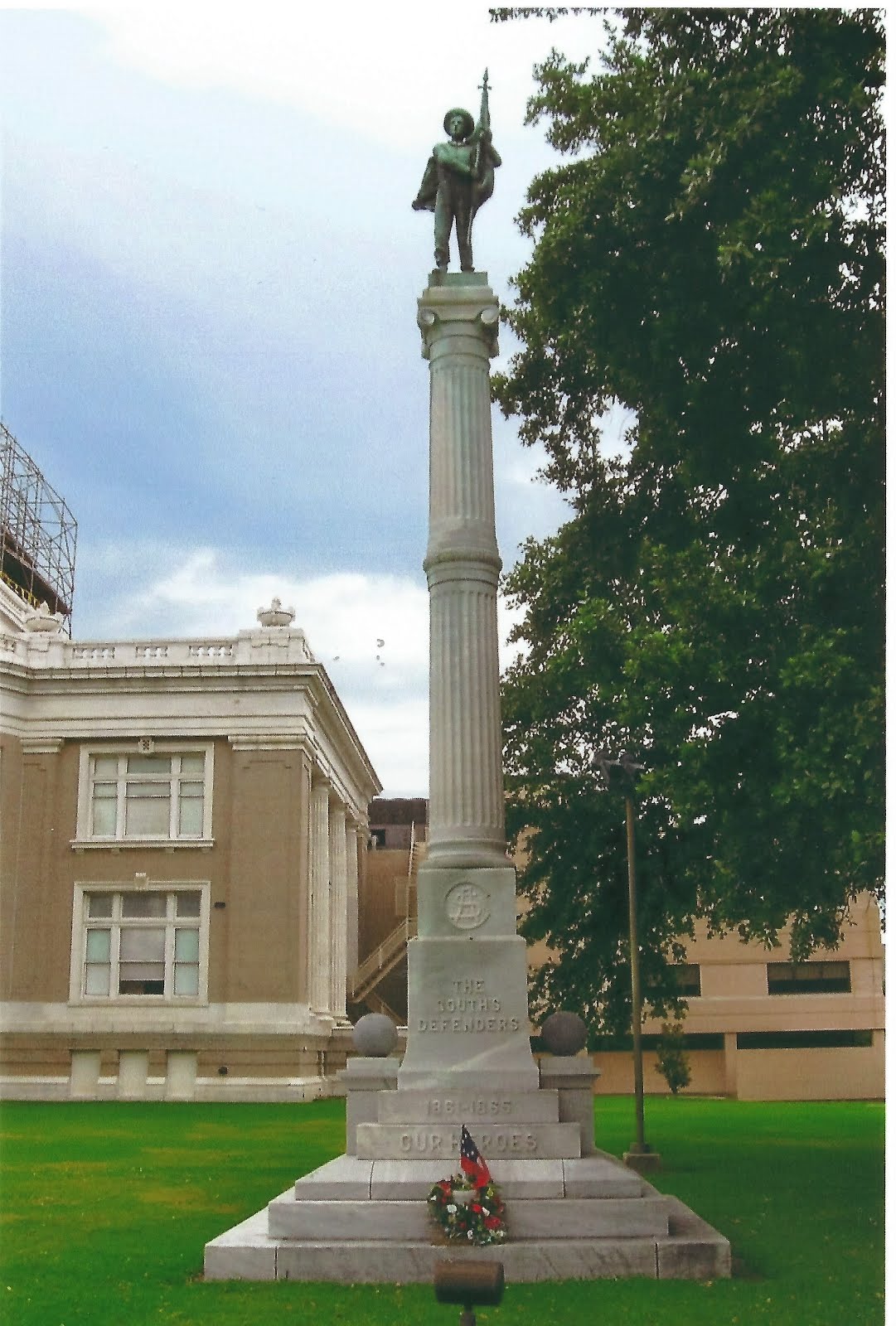
Baton Rouge Confederate Statue Back on Display

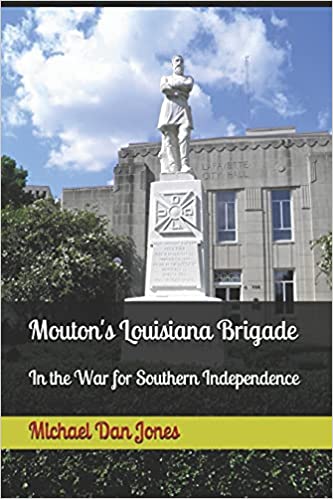
Baton Confederate Statue
on the base it rested before
it was put into storage. The statue
is now on display in the Old
State Capitol Rotunda.
(Phot by Mike Jones)
          MANSFIELD, La. -- The Baton Rouge Confederate Monument, which dates back to 1886, was put in storage several years ago to reconfigure the street it was on, has been put back on public display in the Rotunda of  the Old State Capitol building, according to Chip Landry of  Brig. Gen. Henry Watkins Allen Camp 133.
         Compatriot Landry gave an update on the  monument October 27  at Mansfield State Historic Site where the annual Fall Assembly of the  Louisiana Division, Sons of Confederate Veterans, was held. State Commander Ted Brode presided.
         The monument is unique because the face of the Confederate soldier statue was modeled on that of local Confederate veteran Adrew S. Herron, Landry said.
         The statue was originally on an ornate marble pedestal until that original base was replaced with a cheap brick one on which it stood until removed due to the street project. Landry said the statue will eventually be put  on permanent display on a new, and hopefully better, base somewhere on the grounds of the Old State Capitol.
         He said at one point there was a threat that the statue would be discarded, but the Louisiana Secretary of State's office, which is in charge of the historic relic, had it moved to a more secure place until it could  be put back on public display.
        Landry said the statue is now on display in the Rotunda as part of its Sesquicentennial display that includes a Confederate First National flag that originally flew over the State Capitol until in 1862 when it was removed by a Yankee soldier who then sent the flag home to Massachusetts.
        A descendant of that Yankee soldier recently returned it to the state and it was refurbished and framed for the  display by the Foundation for Historic Louisiana. He said after the flag will be returned to the Foundation at the end of November, at the Old Governor's  Mansion in Baton Rouge.


Sunday, October 28, 2012

150-Years-Ago -- NEWS FROM GEN. LEE AND ELSEWHERE

From the "Rebel War Clerk's Diary" of J. B. Jones in Richmond, Va.  

Gen. Robert E. Lee was carefully  watching the
Yankees troop  movements in late October, 1862,
         October 29th. [1862] —Gen. Lee writes (a few days since), from Brandy Station, that Meade seems determined to advance again; that troops are going up the Potomac to Washington, and that volunteers from New York have been ordered thither. He asks the Secretary to ascertain if there be really any Federal force in the York River; for if the report be correct of hostile troops being there, it may be the enemy’s intention to make another raid on the railroad. The general says we have troops enough in Southwestern Virginia; but they are not skillfully commanded.
          After all, I fear we shall not get the iron from the Aquia Creek Railroad. In the summer the government was too slow, and now it is probably too slow again, as the enemy are said to be landing there. It might have been removed long ago, if we had had a faster Secretary.
           Major S. Hart, San Antonio, Texas, writes that the 10,000 (the number altered again) superior rifles captured by the French off the Rio Grande last summer, were about to fall into the hands of United States cruisers; and he has sent for them, hoping the French will turn them over to us.
Gen. Winder writes the Secretary that the Commissary-General will let him have no meat for the 13,000 prisoners; and he will not be answerable for their safe keeping without it. The Quartermaster-General writes that the duty of providing for them is in dispute between the two bureaus, and he wants the Secretary to decide between them. If the Secretary should be very slow, the prisoners will suffer.
          Yesterday a set (six) of cups and saucers, white, and not china, sold at auction for $50.
Mr. Henry, Senator from Tennessee, writes the Secretary that if Ewell were sent into East Tennessee with a corps, and Gen. Johnston were to penetrate into Middle Tennessee, forming a junction north of Chattanooga, it would end the war in three months.
          October 30th.—We have nothing new to-day, except the continued bombardment of Charleston. That city has been besieged over one hundred days.
         October 31st.—Letters came to-day from the President (or rather copies in his own handwriting), relieving Lieut.-Gen. Hardee, in Mississippi, and assigning him to a command under Gen. Bragg. He also writes a friendly letter (from Meridian, Miss.) to Gen. Bragg, informing him that Gen. Hardee had been ordered to report to him without delay, and that two brigades might go with him, if needed. This indicates that the President means to sustain Bragg,
notwithstandingthe clamor against him; and that Bragg must have an immense army. Lieut.-Gen. Polk (whom the President will always sustain) is assigned to the Mississippi Department.
           The latest accounts from Chattanooga show that the enemy are stirring a little, and trying to flank Bragg’s left wing.
           The bombardment at Charleston is still without decisive result.

Wednesday, October 24, 2012

150-Years-Ago -- STUART'S RAID INTO CHAMBERSBURG, PA

Stuart's earlier ride around McClellan's Army
(Library of Congress)

The Richmond Daily Dispatch
October 24, 1862
A Highly interesting Yankee account of Stuart's raid into Chambersburg — the Entrance of the rebels — their Behavior, &c.
Gen. J.E.B. Stuart
(Library of Congress)
            It will be recollected that most of the dispatches apprising Gov. Curtin of the Confederate dash into Pennsylvania were signed "Col. A. K. McClure"--That officer has communicated his experience to a friend in a long letter, written in a style that shows the Colonel can appreciate a good joke. He was in command of the post at Chambersburg. The following is an extract from his account:
The "Butternuts" Arrive.
           I had just got word of the movement to Governor Curtin and General Brooks at Hagerstown, when I was sent for to meet the distinguished strangers.--A hasty message to Hagerstown and Harrisburg, stating that the town was about to be surrendered, closed telegraphic communication, and Mr. Gilmore, the operator, prepared at once for the advent of his successors, and struck out at once along the line toward Harrisburg with his instrument. I went up town to meet the flag of truce, and found a clever looking "butternut," dripping wet, without any mark of rank, bearing a dirty white cloth on a little stick. He politely stated that he sought the commander or authorities of the town, and in the name of the General commanding the Confederate forces he demanded the surrender of the village. He refused to give his name, or the name of the general commanding, and he could not state on what terms they would accept a surrender. As I had no command other than the scattered and bewildered home guards--all brave enough, but entirely without drill or organization — and about three hundred wounded men in the hospitals, I acted with the citizens as one of them, and it did not require a protracted council to determine that we could not successfully resist cavalry and artillery. So we concluded that the venerable village had to be consigned over to rebel keeping. We had been kindly allowed thirty minutes to decide, at the end of which time we were informed rebel artillery would demand submission in rather unpleasant tones. Col. T. B. Kennedy, (Colonel by political brevet, like myself,) Judge Kimmell, Provost Marshall and your humble servant, mounted three stray horses and filed in with the rebel escort, amidst a thunder of cheers for the Union and groans for the rebels to meet we did not know whom, and to go we did not know where. Without umbrellas or over coats we had the full benefit of a drenching rain, and I must admit that we were treated with the utmost courtesy by our new associates. They conversed freely and without manifesting any degree of bravado.
Gen. Wade Hampton
(Library of Congress)
An interview.
           After travelling a mile westward we were brought to a halt by a squad of mounted men, and were informed that General [Wade] Hampton was one of the party, to whom we should address ourselves. It was so dark that I could not distinguish him from any of his men. Upon being informed that we were a committee of citizens, and that there was no organized force in town, and no military commander at the post, he stated, in a respectful and soldier like manner, that he commanded the advance of the Confederate troops — that he knew resistance would be vain, and he wished the citizens to be fully advised of his purpose, so as  to prevent needless loss of life and wanton destruction of property. He said he had been fired upon at Mercersburg and Campbell own, and had great difficulty in restraining his troops. He assured us that he would pulously protect citizens — would allow no soldier to enter public or private houses unless under command of an officer, upon legitimate business — that he would take such private property as he needed for his Government or troops, but that be would do so by men under officers who would allow no wanton destruction, and would give receipts for the same, if desired, so that claim might be made therefore against the United States Government. All property belonging to or used by the United States, he stated, he would use or destroy at his pleasure, and the wounded in hospitals would be paroled Being a United States officer myself, I naturally felt some anxiety to know what my fate would be if he should discover me, and I modestly suggested that there might be some United States officers in the town in charge of wounded, stores, or recruiting offices, and asked what disposition would be made of them. He answered that he would parole them, unless he should have special reasons for not doing so, and he instructed us that none such should be notified by us to leave town. Here I was in an interesting situation. If I remained, there might, in Gen. Hampton's opinion, be "special reasons for not paroling me," and the fact that he had several citizens of Mercersburg with him as prisoners did not diminish my apprehensions. If I should leave, as I had ample opportunity afterwards to do, I might be held as violating my own agreement, and to what extent my family and property might suffer in consequence conjecture bad a very wide range. With sixty acres of corn in shock and three barns full of grain, excellent farm and saddle horses, and a number of bast blooded cattle, the question of property was worthy of a thought I resolved to stay, as I felt so bound by the terms of surrender, and take my chance of discovery and parole.
Pvt. David M. Thatcher, Co. B, 1st Va. Cav.
(Library of Congress)
Stipulations for surrender.
           The committee went through the form of a grave but brief commutation, somewhat expedited, perhaps, by the rain, and we then solemnly and formally surrendered the town upon the terms proposed. True, the stipulations were but verbal, and but one side able to enforce them; but the time, the weather, the place, and our surroundings generally, were not favorable to a treaty in form, and history must therefore be without it. We asked permission to go a little in advance of his forces to prepare our people for the sudden transition from the Stars and Stripes to the Stars and Bars. General Hampton permitted my associates to do so, but detailed me to pilot his advance guard at once to the telegraph office. I performed the duty assigned me with no great compunctions, as I had seen Mr. Gilmore, the operator, begin to "fix up" for them fully an hour before, and the rebel that outwits him must take a very early start. Messrs. Kennedy and Kimmell proceeded to town to get the people to retire peaceably and prevent any provoking demonstrations; and so rebel rule began in Chambersburg. --They marched in very orderly, and most of their force started out different roads to procure horses, forage and provisions.
A Whiskey Bout Spoiled.
            I started in advance of them for my house, but not in time to have the horses. I confidently expected to be overrun by them and to find the place one scene of desolation in the morning. I resolved, however, that the thing should be done soberly, if possible, and I had just time to destroy all the liquors about the house. As their pickets were all around me, I could not get it off. A barrel of best old rye, which, Senator Finney had sent me to prove the superiority of the Crawford county article over that of Franklin, was quietly rolled out of a cellar side- door, and a good sized hole bored into it. A keg of Oberhoitzer's best, sent me several years ago, but never tapped, followed Finney's testimonial to Crawford county distillation; and a couple of cases of Presbury's best Girard House importation had the necks of the bottles taken off summarily, and the contents given to the angry storm. I finished just in time, for the were soon out upon me in force, and every horse in the barn--ten in all — was promptly equipped and mounted by a rebel cavalryman. They passed on towards Shippensburg, leaving a picket force on the road. In an hour they returned with all the horses they could find, and dismounted to spend the night on the turnpike, in front of my door. It was now midnight, and I sat on the porch observing their movements. They had my best cornfield beside them, and their horses fared well. In a little while one entered the yard, came up to me, and, after a profound how politely asked for a few coals to start a fire. I supplied him, and informed him as blandly as possible where he would find wood conveniently, as I had dim visions of camp fires made of my palings. I was thanked in return, and the mild-mannered villain proceeded at once to strip the fence and kindle fires. Soon after, a squad came and asked permission to get some water.
Introduced to a pump.
            I piloted them to the pump, and again received a profusion of thanks. Communication having thus been opened between us, squads followed each other closely for water, but each called and asked permission before getting it, and promptly left the yard. I was somewhat bewildered at this uniform courtesy, and supposed it but a prelude to a general movement upon everything eatable in the morning. It was not a grateful reflection that my beautiful mountain trout, from twelve to twenty inches long, sporting in the spring, would probably grace the rebel breakfast table; that the blooded calves in the yard beside them would most likely go with the trout; and the dwarf pears had, I felt assured, abundant promise of early relief from their golden burdens. About one o'clock half a dozen officers came to the door and asked to have some coffee made for them, offering to pay liberally for it in Confederate scrip. After concluding a treaty with them on behalf of the colored servants, coffee was promised them, and they them asked for a little bread with it. They were wet and shivering, and seeing a bright open wood fire in the library, they asked permission to enter and warm themselves until their coffee should be ready, assuring me that under no circumstances should anything in the house be disturbed by their men. I had no alternative but to accept them as my guests until it should please them to depart, and I did so with as good grace as possible.
Hearts Warmed and Mouths opened.
            Once seated around the fire all reserve seemed to be forgotten on their part, and they opened a general conversation on politics, the war, the different battles, the merits of Generals in both armies, &c. They spoke with entire freedom upon every subject but their movement into Chambersburg. Most of them were men of more than ordinary intelligence and culture, and their demeanor was in all respects eminently courteous. I took a cup of coffee with them, and have seldom seen anything more keenly relished. They said they had not tasted coffee for weeks before, and then they had paid from $6 to $10 per pound for it. When they were through they asked whether there was any coffee left, and finding that there was some, they proposed to bring some more officers and a few privates, who were prostrated by exposure, to get what they left. They were, of course, as welcome as those present, and on they came, in squads of five or more, until every grain of browned coffee was exhausted.-- they then asked for ten, and that was served to some twenty more.
On their good Behavior.
             In the meantime a subordinate officer had begged of me a little bread for himself and a few men, and he was supplied in the kitchen. He was followed by others in turn, until nearly a hundred had been supplied with something to eat or drink. All, however, politely asked permission to enter the house, and behaved with entire propriety. They did not make a single rude or profane remark, even to the servants. In the meantime the officers, who had first entered the house, had ll d their pipes from the box of Kinnikinnick on the mantel — after being assured that smoking was not offensive — and we had another hour of a free talk on matters generally.
The proclamation Makes them Wince.
           When told that I was a decided Republican, they thanked me for being candid; but when, in reply to their inquiries, I told them that I cordially sustained the President's emancipation proclamation, they betrayed a little nervousness, but did not for a moment forget their propriety. They admitted it to be the most serious danger that has yet threatened them; but they were all hopeful that it would not be sustained in the North with sufficient unanimity to enforce it. Their conversation on this point bore a striking similarity to the speeches of Frank Hughes and Charles J. Biddle, and had you heard them converse without seeing them, you would have supposed that I was having a friendly confab with a little knot of Pennsylvania Breckinridge politicians. Of the two, I am sure you would have respected the rebels the most; for they are open foes, and seal their conviction with their lives, and they openly avow their greater respect for open, unqualified supporters of war over these who oppose every war measure profess fraternal sympathy with the South, and yet say they are in favor of preserving the Union. They all declared themselves heartily sick of the war, but determined never to be reunited with the North.
They Quit a Hospitable Roof.
           At four o'clock in the morning the welcome blast of the bugle was heard, and they rose hurriedly to depart. Thanking me for the hospitality they had received, we parted, mutually expressing the hope that should we ever meet again, it would be under more pleasant circumstances. In a few minutes they were mounted and moved into Chambersburg. About seven o'clock I went into town, and found that the First brigade, under Gen. Hampton, had gone towards Gettysburg. General Stuart sat on his horse, in the centre of the town, surrounded by his staff, and his command was coming in from the country in large squads, leading their old horses and riding the new ones they had found in the stables hereabouts General Stuart is of medium size, has a keen eye, and wears immense sandy whiskers and mustache. His demeanor to our people was that of a humane soldier. In several instances his men commenced to take private property from stores; but they were arrested by General Stuart's provost guard. In a single instance only that I have heard of did they enter a store by intimidating the proprietor. All our shops and stores were closed, and, with very few exceptions, were not disturbed.
Destroying public property.
           There were considerable Government stores here — some two hundred pairs of shoes, a few boxes of clothing, and a large quantity of ammunition captured recently from Gen Longstreet. It was stored in the warehouse of Wunderlich & Nead About eleven o'clock their rear guard was ready to leave, and they notified the citizens residing near the warehouses to remove their families, as they were going to burn all public property. The railroad station house, machine shop, found house, and the warehouses filled with ammunition, were then fired and the last of the rebels fled the town in a little while a terrific explosion told that the flames had reached the powder, and for hours shells were exploding with great rapidity. The fire companies came out as soon as the rebels left, but could not save any of the beddings fired because of the shells. They saved all the others, however.
Their Plunder.
              So ended a day of rebel rule in Chambersburg.--They took some 800 horses from our people, and destroyed perhaps $100,000 worth of property for the Cumberland Valley Railroad Company, probably $5,000 for Wunderlich & Nead, and $150,000 for the Government. Our people generally feel that bad as they are, they are not so bad as they might be. I presume that the cavalry we had with us are the flower of the rebel army. They are made up, mainly, of young men in Virginia, who owned fine horses and have had considerable culture. I should not like to risk a similar experiment with their infantry. I was among them all the time here, and was expecting every minute to be called upon to report to Gen Stuart, but they did not seem to have time to lock after prisoners, and a luckily escaped. But from the fact that I can't find a horse about the barn, and that my fence is stripped of paling, to remind me of the reality of the matter, it would seem like a dream. It was go unexpected, so soon over, that our people had hardly time to appreciate it.
             They crossed the South Mountain about 11 o'clock to-day, on the Gettysburg pike; but where they will go from there is hard to conjecture. They me evidently aiming to recross the Potomac at or near Edwards's Ferry; and if so, Gettysburg may escape, as they may go by Millerstown to Emmettsburg. If they should recross below Harper's Ferry, they will owe their escape to the stupidity or want of energy of our military leaders, for they were advised in due season of the rebel route.

           Hoping that I shall never again be called upon to entertain a circle of rebels around my fireside, believe me, truly thine, A. K. McClure.
Tuesday, October 23, 2012

150-Years-Ago -- LIFE OF AN INFANTRYMAN

An example of one of Jackson's
'Foot-Cavalry'
SOUTHERN ILLUSTRATED NEWS
October 18, 1862
 
Written for the Illustrated News.
"Foot-Cavalry Chronicle."
By Hard Cracker.

(1.) Man that is born of woman and enlisteth in "Jackson's army" is of few days and short rations.
(2.) He cometh forth at "reveille," is present also at "retreat," and retireth apparently at "taps."
(3.) He draweth his rations from the commissary and devoureth the same; he striketh his teeth against much hard bread, and is satisfied; he filleth his canteen with "aqua pura," and clappeth the mouth thereof upon the "bung" of a whiskey barrel, and after a little while goeth away rejoicing at his strategy.
(4.) Much soldiering hath made him sharp; yea, even the sole of his shoe is in danger of being cut through.
(5.) He covenanteth with the credulous farmer for many chickens, and much milk and honey, to be paid for promptly at the end of each six days, when lo! on the 5th day the army moveth to another part.
(6.) His tent is filled with potatoes, pies, corn and other morsels for his delicate appetite, which abound not in said commissary department; and many other borrowed things, which will never be returned. Of a surety, it must be said of "Jackson's foot cavalry," "they take not that which they cannot reach."
(7.) He fireth his Minie rifle at the dead hour of night, and the camp is roused and formed in line—when, to his mess he cometh bearing a fine "porker"—which he declareth so resembleth a Yankee that he was compelled to pull trigger.
(8.) He giveth the "provost" much trouble; often capturing his guard and possessing himself of the city.
(9.) At such times "lager and pretzels" flow like milk and honey from his generous hand. He giveth, without stint, to his own stomach.
(10.) The grunt of a pig and the crowing of a cock awakeneth him from the soundest sleep, and he sauntereth forth in search or the quadruped or biped that dareth to "make night hideous."
(11.) No sooner hath he passed the sentry's beat than he striketh a "bee-line" for the nearest hen roost, and seizing a pair of pullets, returneth soliloquizing to himself, "the noise of a goose saved Rome, how much more the flesh of the chicken preserveth the soldier."
(12.) He playeth "eucre" with the parson, whether there shall be preaching in camp on the Sabbath, and by dexterously turning jack from the bottom of the pack, postponeth the service.
(13.) And many other marvelous things doeth he; and, lo! are they not already recorded in the morning reports of "Jackson's foot cavalry?"
Camp of the "Turned-Over and Used-Ups," Sept. 27, 1862.

Monday, October 22, 2012

150-Years-Ago -- THE APPROACHING CRISIS

The Southern people were relying on young Confederate
soldiers like this one, holding a Colt revolving rifle, one
of the most advanced small arms of that time, for defend-
ing them agains the massive Northern army then assebling
to subjugate them. (Liljenquiat Family Collection, Library'
of Congress)
The Richmond Daily Dispatcvh
October 22, 1862
 
           The very first day of the late session we appealed to [the Confederate] Congress, in the strongest forms we were capable of employing, to pass all the laws necessary to give conscription full effect as soon as possible. Instead of doing so they wasted six weeks in discussing the conscription bill, which, after all, was passed under the spur of the previous question. --The members seemed to be seized with the same lethargy that benumbed their faculties after Manassas. They thought that because our troops had driven the enemy from Richmond [and] there was to be no more fighting. In this delusion they were encouraged by the President, who told them that no immediate increase of the army was necessary.--The infatuation that dictated such an annunciation was amazing. The Yankees had not only determined on, but had already begun to levy a new force of six hundred thousand men. That force, we declared, would be raised in a very short time, and we were not wrong. It is already in great part; drilling as rapidly as it can and by the time the cold weather sets in it will be upon us. We shall have another "on to Richmond," and that is a very short time. The advance of McClellan indicates thus much. But an advance in that direction will not be all. Sigel's levies, if we are to credit the Yankee accounts, are to bear down upon us from Washington by the line of the Orange and Alexandria railroad. They are to accomplish the two-fold task of taking Richmond and cutting off General Lee. That great military oracle the New York Times, has already laid down the programme. Nothing is easier, it thinks, than to march straight into Richmond, and if permitted to be done, undoubtedly nothing would be easier. The Herald in its peculiar style, calls upon us to lay down our arms and submit to the Yankees.
           Where there is much smoke there is sure to be some fire. Through the mist of all this vaporing we can perceive a steady purpose to push us to the uttermost. An invasion is designed to which that we have yet seen of invasion is mere child's play. We speak it — not for the purpose of creating unnecessary alarm — but warn our people of what they have to expect, and to prepare them for the occasion. We know not what preparations may have been made to meet and repel the foe; but we know that the authorities are well aware of his intentions. We hope, therefore, that everything has been done which the occasion requires.
           The people of the Confederates States will meet this new invasion as they met that which preceded it — with the promptness and gallantry becoming men who have no superior in those qualities, and with that firmness which nerves the soul to dare the utmost that an enemy can inflict. We have no belief that we can be finally beaten here upon our own soil, fighting for our altars and our firesides — But we must dismiss all illusions, agreeable as they may be, and learn to look at the grim reality. It is war in its most gloomy aspect that we are called upon to endure.
 
New publications for soldiers.
           "We have just issued 5,000 copies of the "Life of Capt. Vicars." 2,000 copies of a "Thanksgiving Sermon" by Rev. Dr. Atkinson, Presbyterian Pastor in N. C. We have recently published also, ten tracts on important subjects, by good men of different denominations. These are to be followed by a "Life of General Havelock," and two Tracts by Rev. D Shaver, of the Religious Herald. Within seventeen months over twelve millions of pages have been printed and circulated in the Southern army by this [publisher]. Much remains to be done, and thus we appeal to all — chaplains, pastors, soldiers — to aid in the work of distribution — The Railroad and Express companies have kindly offered to transport gratuitously all packages we may send from the Bible and Tract Depository while we propose to supply, without cost, all who desire our publications.

Friday, October 19, 2012

150-Years-Ago -- Situation in Louisiana in October, 1862

[Excerpted from General Mouton's Regiment: The 18th Louisiana Infantry by Michael Dan Jones

         The Federals were clearly  not concerned with winning the hearts and minds of the Southern people. The Union soldiers rampaged through the town [Donaldsonville, La.] destroying buildings that had not already been destroyed by an earlier Federal raid. The previous atrocity against innocent civilians was an act of retaliation for attacks on Union gunboats by Confederate partisan rangers operating in the area. Rear Admiral Daivd Glasgow Farragut was the Union officer that ordered these attacks on civilians. In that raid the people evacuated the town August 9, 1862, then U. S. Navy gunboats shelled the village for several hours before Northern arsonists torched all the major buildings of Donaldsonville, including warehouses, hotels, and plantations above and below the town. Even St. Vincent's Catholic Institute was destroyed by the shelling. The supervisor of the school, Sister Clara, sent a letter of protest to General Butler in New Orleans, and received an apology. Later, September 11, 1862, Lieutenant F.A. Roe, commander of the U. S. Gunboat  Katahdin, asked his commander, Commodore Henry Morris, to be relieved from duty because of the atrocities being committed by United States soldiers. He wrote that the actions of Federal soldiers were "disgraceful and humiliating." Roe added that he didn't want to be put in the position of guarding troops engaged in such acts against civilians. He said the soldiers treated civilians brutally, were drunk, undisciplined and licentious.
This was the situation and atmosphere that the men of the 18th Louisiana Infantry found themselves in when they returned to their home state. By October 27, [Brig. Gen. Godfrey] Weitzel was advancing down both banks of Bayou Lafourche. He brought barges that could be used as floating pontoon bridges to shift troops from one bank to another. Mouton, who  was laid up by an attack of rheumatism in the home  of P. Cox Lonsdale, decided to make a stand with his outnumbered force at Georgia's Landing, a couple of miles north of the town of Labadieville. He turned over command of the brigade to Colonel Armant.  Grisamore noted the morning of the 27th that sugar cane was frozen to the ground. The position chosen for the Confederate stand was in front of Wynn's Woods on the west bank of the bayou, which would give them cover and the Northerners had to advance across an open field. The Confederate right was anchored by the bayou and the left by a marais (swamp). They were posted along the Texas Road in a drainage ditch. From right to left were posted Ralston's Battery, the Crescent Regiment, the 18th Louisiana and the Terrebonne Militia.


Thursday, October 18, 2012

150--Years--Ago --- MISS BELLE BOYD

Miss Belle Boyd
(Library  of Congress)
Southern Illustrated News
October 18, 1862
 

Miss Belle Boyd,

"The Rebel Spy."


           RICHMOND, Va. - This young lady, who has, by her devotion to the Southern cause, called down upon her head the anathemas of the entire Yankee press, was in our city last week. Through the politeness of Mr. Cowel, the artist at Minnis' gallery, we are enabled, in this issue of our paper, to present her picture.
          
Miss Belle is the daughter of Benjamin B. Boyd of Martinsburg, at which place he was for a long time prominently engaged in the mercantile profession. He afterwards removed to Knoxville, Tennessee, where he lived about three years, but returned to Martinsburg about two years previous to the breaking out of the present war. Her mother was the daughter of Captain Glenn of Jefferson county. Miss Belle is the oldest child of her parents, and is about 23 years of age. An uncle of Miss Belle, James W. Glenn, of Jefferson county, commanded a company during the present war, known as the "Virginia Rangers," until recently, the captaincy of which he resigned on account of ill-health. James E. Stuart, a prominent politician of the Valley, and who was a member of the Virginia Convention of 1850, married a sister of Miss Belle's mother.
           
During her early years Miss Belle was distinguished for her sprightliness and the vivacity of her temper.
          
That our readers may have an opportunity of seeing what the Yankee correspondents say about this young lady, we extract the following article from the columns of the Philadelphia "Inquirer," which was written by the army correspondent of that sheet:
          
"These women are the most accomplished in Southern circles. They are introduced under assumed names to our officers, so as to avoid detection or recognition from those to whom their names are known, but their persons unknown. By such means they are enabled to frequently meet combinedly, but at separate times, the officers of every regiment in a whole column, and by simple compilation and comparison of notes, they achieve a full knowledge of the strength of our entire force. Has modern warfare a parallel to the use of such accomplishments for such a purpose? The chief of these spies is the celebrated Belle Boyd. Her acknowledged superiority for machination and intrigue has given her the leadership and control of the female spies in the valley of Virginia. She is a resident of Martinsburg, when at home, and has a pious, good old mother, who regrets as much as any one can the violent and eccentric course of her daughter since this rebellion has broken out. Belle has passed the freshness of youth. She is a sharp-featured black-eyed woman of 25, or care and intrigue have given her this appearance. Last summer, whilst Patterson's army lay at Martinsburg, she wore a revolver in her belt, and was courted and flattered by every Lieutenant and Captain in the service who ever saw her. There was a kind of Di Vernon dash about her, a smart pertness, a quickness of retort, and utter abandonment of manner and bearing which were attractive from their very romantic unwontedness.
             
"The father of this resolute black-eyed vixen is a paymaster in the Southern army, and formerly held a place at Washington under our Government. She has undergone all that society, position and education can confer upon a mind suited to the days of Charles the Second, or Louis the Fourteenth—a mind such as Mazarin or Richelieu would have delighted to employ from its kindred affinities.
           
"Well, this woman I saw practicing her arts upon our young lieutenants and inexperienced captains, and in each case I uniformly felt it my duty to call them aside and warn them of whom she was. To one she had been introduced as Miss Anderson, to another as Miss Faulkner, and so to the end of the chapter. She is so well known now that she can only practice her blandishments upon new raw levies and their officers. But from them she obtains the number of their regiments and their force. She has, however, a trained band of coadjutors, who report to her daily—girls aged from 16 upward—women who have the common sense not to make themselves as conspicuous as she, and who remain unknown, save to her, and are therefore effective. The reports that she is personally impure are as unjust as they are undeserved. She has a blind devotion to an idea, and passes far the boundary of her sex's modesty to promote its success.
           
"During the past campaign in the Valley this woman has been of immense service to the enemy. She will be now if she can."