Wednesday, December 5, 2012

150-Years-Ago -- GALVESTON BOMBARDED BY YANKEE GUNBOATS

U.S.S. Westfield, flag ship of the  occupying Yankee fleet at Galveston.
(U.S. Naval Historical Center)
Galveston Weekly News
December 3, 1862


Galveston, 9 A.M., via Eagle Grove.
           A terrible bombardment took place last night at 8 o'clock, caused by a man going near Kuhn's wharf and firing a shot at those on the wharf. A brisk fire from musketry and cannon opened at once. Shells, balls, grape and canister were thrown into the city without mercy. None of the citizens were hurt as far as I have been able to learn.
          
One man on the wharf reported killed. Many narrow escapes of citizens; women and children ran screaming through the streets. Bombardment lasted half hour. A number of houses were struck but not damaged seriously. The Italian fruit store on market street, had three shots through it;   Lemmerman's Union House was struck.
          
Dennis Neil's house had two shots in it. A house on the corner of Post Office and 24th streets was struck, and the occupants had a narrow escape. One shot through Tremont House; Ziekereries house on Mechanic street, Journey's shop on Church street, and Osterman's building on Strand street. One woman had her clothes torn off, but escaped injury.
           The fleet had been expecting an attack from our forces since Saturday, and they were hasty in being alarmed. Albert Ball's store on Strand was riddled with grape and canister. Cooper's old stable was struck with five shots; also the Court House.
 
[Editor's note: A Confederate scout, Tom  Barnett, who was an English veteran of the Mexican War, reportedly provoked the incident when he  exhanged fire with a Union picket on Kuhn's Wharf. -- Battle on the Bay: The Civil War Struggle for Galveston by Edward  Cotham, The University of Texas Press, Austin, 1998, 70-71.] 

Thursday, November 29, 2012

150-years-ago -- FEDERALS BOMBARD WOMEN, CHILDREN & THE SICK

[Editor's note: U. S. warships Westfield and Clifton, led by Commodore W.B. Renshaw of the West Blockade Squadron, bombarded Port Lavaca, Texas on October 31, 1862. Later the Westfield was destroyed at the Battle of Galveston and the Clifton captured at the Battle of Sabine Pass.]

(U.S. Naval Historical Center Photograph.)
Austin State Gazette
Nov. 12, 1862

Bombardment of Port Lavaca.
Withdrawal of the Federals.

From the Houston Telegraph.

                The following account of the bombardment of Lavaca is quite incomplete, but it shows the gist of the matter, which is that the Federals attacked and bombarded the town and didn't take it. Nobody hurt.
S_______ I_______, Near Texana,
November 2d, 1862
           Dear Sir--Left Lavaca at half-past twelve yesterday. At twenty-five minutes past one p.m., the tow steamer ceased to fire, and hauled off, taking the small schooner in tow. By 12 m., they had passed Gallinipper Point, and have evidently left us for the season. . . . From 1/4 past 3 p.m. on Friday, the expiration of the one and a half days grace, to 6 p.m., they fired into the town 168 shells and shot; and from 8 o'clock to 10 a.m. yesterday, 74. Some of their guns were of the largest size, the shells weighing 104 lbs., and throwing them two miles beyond the town. Nobody hurt. Most of the stores on Front street were struck, completely demolishing some of them inside. Gutted, as it were by the explosion of shell, and showing almost cellars dug by the force. Many of the dwelling houses also were more or less injured. . . . Instead of being everywhere, looking after the defense of important and exposed points, San Antonio, 140 miles from the scene of danger, seems to be the only place having any attraction for our generals. Truly, they have deserved well of Texas, and should be waited upon by a committee of our gallant ladies, and presented with leather medals and swords of like material. A single rifle gun of fair range, and we could have sunk the miserable old New York ferry-boats that attacked our town, fired upon our women, children, and sick--some of them dying with yellow fever--and which vessels will doubtless return and finish their work of destruction. Our officers and men behaved gallantly, and will sustain the honor of our flag.
 
N'IMPORTE.
          Since the above was in type, we learn that the enemy came up on the 31st within five miles of the town of Lavaca, and sent yards ashore demanding the surrender. Maj. Shea refused.
They then gave notice that an hour and a half would be allowed for the removal of the women and children and sick.
               Promptly at the expiration of the time they opened fire, throwing about 50 shot that day. Next day the firing was continued heavily as is detailed above.

Wednesday, November 28, 2012

DESOLATING THE SOUTH

The Richmond Daily Dispatch
Dec. 1, 1862
 
       Wherever the enemy have penetrated the South a scene of desolation presents itself, which might melt any but Yankee hearts. "The land is as the Garden of Eden before them, and behind them a desolate wilderness." Fields stripped as bare as if locusts had presided over them, fences gone, houses burned down, the once opulent and comfortable proprietors driven homeless and fortuneless from their premises; these are the edifying spectacles which great the conqueror's eyes, and are rapturously recorded by Yankee journals. We cannot deprive them of this temporary consolation; but, after all, it is only temporary. They have made some communities penniless for a time, but it is only for a time. They have disfigured the surface of the earth, but they have not destroyed it, and cannot even impair its powers of recuperation.--With the first surrender of Peace, the desert places will blossom again, and, with the establishment of Independence, the most desolate portions of the South will begin a career of prosperity unexampled in their history. Increase, which can only bring beggary to the North, will, in turn, make the South the wealthiest and most powerful nation on this continent. It has suffered like the patriarch John; but, like him, its latter days will be better than the beginning. The war of the American Revolution reduced whole communities to beggary and scourged the face of the earth, but from their ashes there sprung up a greatness which the world has rarely equalled. So it will be with our own country. Our independence once secured, and our ports opened the great staples of the South will give her the command of the commerce of the world. Norfolk will become the New York of the continent, and the Peninsula, now so down-trodden and cheerless, will resound with the hammer of enterprise and activity. Even in manufactures, the genial climate and unlimited water course of the South will build up many a Manchester and Birmingham. Let us be patient and hopeful. A day rich with compensation is coming.

Monday, November 26, 2012

THE ACTON - LEE CORRESPONDENCE

Lord Acton (1834-1902)
English Catholic politician,
historian and writer.
Bologna
November 4, 1866

Sir,

          The very kind letter which Mrs. Lee wrote to my wife last winter encouraged me to hope that you will forgive my presuming to address you, and that you will not resent as an intrusion a letter from an earnest and passionate lover of the cause whose glory and whose strength you were.
          I have been requested to furnish private counsel in American affairs for the guidance of the editors of a weekly Review which is to begin at the New Year, and which will be conducted by men who are followers of Mr. Gladstone. You are aware, no doubt, that Mr. Gladstone was in the minority of Lord Palmerston's cabinet who wished to accept the French Emperor's proposal to mediate in the American war.
           The reason of the confidence shown in my advice is simply the fact that I formerly traveled in America, and that I afterwards followed the progress of the four years' contest as closely and as keenly as it was possible to do with the partial and unreliable information that reached us. In the momentous questions which have arisen since you sheathed the sword, I have endeavoured to conform my judgment to your own as well as I could ascertain it from the report of your evidence, from the few English travelers who enjoyed the privilege of speaking with you, and especially from General Beauregard, who spoke, as I understood, your sentiments as well as his own. My travels in America never led me south of Maryland, and the only friends to whom I can look for instruction, are Northerners, mostly of Webster's school.
            In my emergency, urged by the importance of the questions at issue in the United States, and by the peril of misguided public opinion between our two countries, I therefore seek to appeal to southern authorities, and venture at once to proceed to Headquarters.
           If, Sir, you will consent to entertain my request, and will inform me of the light in which you would wish the current politics of America to be understood, I can pledge myself that the new Review shall follow the course which you prescribe and that any communication with which you may honor me shall be kept in strictest confidence, and highly treasured by me. Even should you dismiss my request as unwarranted, I trust you will remember it only as an attempt to break through the barrier of false reports and false sympathies which encloses the views of my countrymen.
           It cannot have escaped you that much of the good will felt in England towards the South, so far as it was not simply the tribute of astonishment and admiration won by your campaigns, was neither unselfish nor sincere. It sprang partly from an exultant belief in the hope that America would be weakened by the separation, and from terror at the remote prospect of Farragut appearing in the channel and Sherman landing in Ireland.
           I am anxious that you should distinguish the feeling which drew me aware toward your cause and your career, and which now guides my pen, from that thankless and unworthy sympathy.
            Without presuming to decide the purely legal question, on which it seems evident to me from Madison's and Hamilton's papers that the Fathers of the Constitution were not agreed, I saw in State Rights the only availing check upon the absolutism of the sovereign will, and secession filled me with hope, not as the destruction but as the redemption of Democracy. The institutions of your Republic have not exercised on the old world the salutary and liberating influence which ought to have belonged to them, by reason of those defects and abuses of principle which the Confederate Constitution was expressly and wisely calculated to remedy. I believed that the example of that great Reform would have blessed all the races of mankind by establishing true freedom purged of the native dangers and disorders of Republics. Therefore I deemed that you were fighting the battles of our liberty, our progress, and our civilization; and I mourn for the stake which was lost at Richmond more deeply than I rejoice over that which was saved at Waterloo.
             General Beauregard confirmed to me a report which was in the papers, that you are preparing a narrative of your campaigns. I sincerely trust that it is true, and that the loss you were said to have sustained at the evacuation of Richmond has not deprived you of the requisite materials. European writers are trying to construct that terrible history with the information derived from one side only. I have before me an elaborate work by a Prussian officer named Sander. It is hardly possible that future publications can be more honorable to the reputation of your army and your own. His feelings are strongly Federal, his figures, especially in estimating your forces, are derived from Northern journals, and yet his book ends by becoming an enthusiastic panegyric on your military skill. It will impress you favourably towards the writer to know that he dwells with particular detail and pleasure on your operations against Meade when Longstreet was absent, in the autumn of 1863.
            But I have heard the best Prussian military critics regret that they had not the exact data necessary for a scientific appreciation of your strategy, and certainly the credit due to the officers who served under you can be distributed and justified by no hand but your own.
            If you will do me the honor to write to me, letters will reach me addressed Sir J. Acton, Hotel [Serry?], Rome. Meantime I remain, with sentiments stronger than respect, Sir,

~ Your faithful servantJohn Dalberg Acton

Gen. Robert E. Lee
Lexington, Vir.,
15 Dec. 1866

Sir,

          Although your letter of the 4th ulto. has been before me some days unanswered, I hope you will not attribute it to a want of interest in the subject, but to my inability to keep pace with my correspondence. As a citizen of the South I feel deeply indebted to you for the sympathy you have evinced in its cause, and am conscious that I owe your kind consideration of myself to my connection with it. The influence of current opinion in Europe upon the current politics of America must always be salutary; and the importance of the questions now at issue the United States, involving not only constitutional freedom and constitutional government in this country, but the progress of universal liberty and civilization, invests your proposition with peculiar value, and will add to the obligation which every true American must owe you for your efforts to guide that opinion aright. Amid the conflicting statements and sentiments in both countries, it will be no easy task to discover the truth, or to relieve it from the mass of prejudice and passion, with which it has been covered by party spirit. I am conscious the compliment conveyed in your request for my opinion as to the light in which American politics should be viewed, and had I the ability, I have not the time to enter upon a discussion, which was commenced by the founders of the constitution and has been continued to the present day. I can only say that while I have considered the preservation of the constitutional power of the General Government to be the foundation of our peace and safety at home and abroad, I yet believe that the maintenance of the rights and authority reserved to the states and to the people, not only essential to the adjustment and balance of the general system, but the safeguard to the continuance of a free government. I consider it as the chief source of stability to our political system, whereas the consolidation of the states into one vast republic, sure to be aggressive abroad and despotic at home, will be the certain precursor of that ruin which has overwhelmed all those that have preceded it. I need not refer one so well acquainted as you are with American history, to the State papers of Washington and Jefferson, the representatives of the federal and democratic parties, denouncing consolidation and centralization of power, as tending to the subversion of State Governments, and to despotism. The New England states, whose citizens are the fiercest opponents of the Southern states, did not always avow the opinions they now advocate. Upon the purchase of Louisiana by Mr. Jefferson, they virtually asserted the right of secession through their prominent men; and in the convention which assembled at Hartford in 1814, they threatened the disruption of the Union unless the war should be discontinued. The assertion of this right has been repeatedly made by their politicians when their party was weak, and Massachusetts, the leading state in hostility to the South, declares in the preamble to her constitution, that the people of that commonwealth "have the sole and exclusive right of governing themselves as a free sovereign and independent state, and do, and forever hereafter shall, exercise and enjoy every power, jurisdiction, and right which is not, or may hereafter be by them expressly delegated to the United States of America in congress assembled." Such has been in substance the language of other State governments, and such the doctrine advocated by the leading men of the country for the last seventy years. Judge Chase, the present Chief Justice of the U.S., as late as 1850, is reported to have stated in the Senate, of which he was a member, that he "knew of no remedy in case of the refusal of a state to perform its stipulations," thereby acknowledging the sovereignty and independence of state action. But I will not weary you with this unprofitable discussion. Unprofitable because the judgment of reason has been displaced by the arbitrament of war, waged for the purpose as avowed of maintaining the union of the states. If, therefore, the result of the war is to be considered as having decided that the union of the states is inviolable and perpetual under the constitution, it naturally follows that it is as incompetent for the general government to impair its integrity by the exclusion of a state, as for the states to do so by secession; and that the existence and rights of a state by the constitution are as indestructible as the union itself. The legitimate consequence then must be the perfect equality of rights of all the states; the exclusive right of each to regulate its internal affairs under rules established by the Constitution, and the right of each state to prescribe for itself the qualifications of suffrage. The South has contended only for the supremacy of the constitution, and the just administration of the laws made in pursuance to it. Virginia to the last made great efforts to save the union, and urged harmony and compromise. Senator Douglass, in his remarks upon the compromise bill recommended by the committee of thirteen in 1861, stated that every member from the South, including Messrs. Toombs and Davis, expressed their willingness to accept the proposition of Senator Crittenden from Kentucky, as a final settlement of the controversy, if sustained by the republican party, and that the only difficulty in the way of an amicable adjustment was with the republican party. Who then is responsible for the war? Although the South would have preferred any honorable compromise to the fratricidal war which has taken place, she now accepts in good faith its constitutional results, and receives without reserve the amendment which has already been made to the constitution for the extinction of slavery. That is an event that has been long sought, though in a different way, and by none has it been more earnestly desired than by citizens of Virginia. In other respects I trust that the constitution may undergo no change, but that it may be handed down to succeeding generations in the form we received it from our forefathers. The desire I feel that the Southern states should possess the good opinion of one whom I esteem as highly as yourself, has caused me to extend my remarks farther than I intended, and I fear it has led me to exhaust your patience. If what I have said should serve to give any information as regards American politics, and enable you to enlighten public opinion as to the true interests of this distracted country, I hope you will pardon its prolixity.
            In regard to your inquiry as to my being engaged in preparing a narrative of the campaigns in Virginia, I regret to state that I progress slowly in the collection of the necessary documents for its completion. I particularly feel the loss of the official returns showing the small numbers with which the battles were fought. I have not seen the work by the Prussian officer you mention and therefore cannot speak of his accuracy in this respect.– With sentiments of great respect, I remain your obt. servant,

~ R.E. Lee

Thursday, November 22, 2012

BATTLE OF GALVESTON SESQUICENTENNIAL COMING UP

[From Galvestonhistory.org]
 
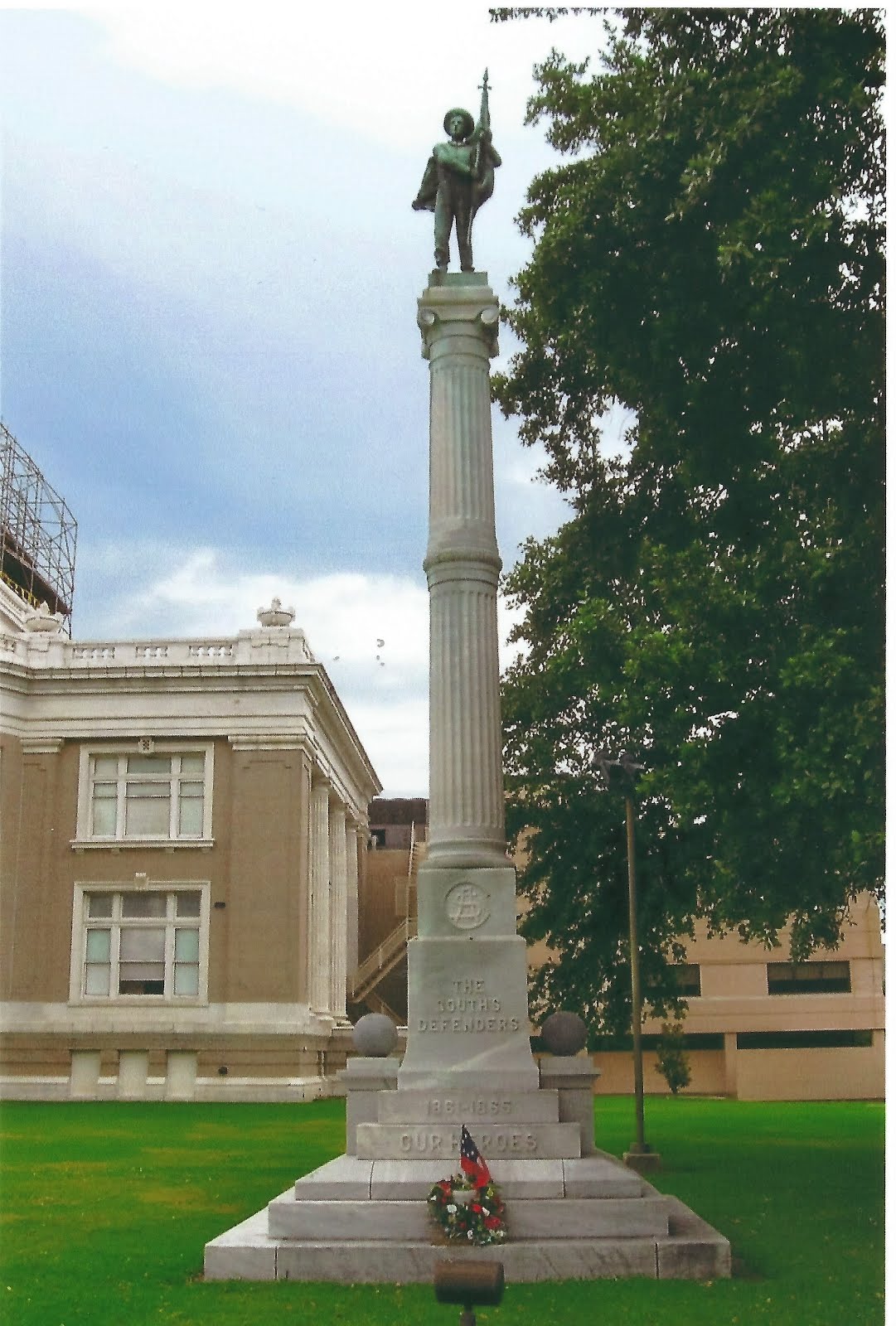
Confederate monument,
Galveston. (M. Jones collection)
          Galveston Historical Foundation will mark the 150th anniversary of the Civil War Battle of Galveston on January 11-13, 2013. The Battle of Galveston, which took place during the early morning hours of January 1, 1863, is widely acknowledged as the most important military event in Galveston’s history. Commemorative events taking place include battle re-enactments, lectures, living history encampments, a wet-plate collodion photography demonstration and a variety of special tours and programming focusing on Galveston’s part in the 1863 battle.
          Living history encampments will be established by the 19th-Century Living History Association, Inc. and the 1st Texas Brigade. The public is invited free of charge to visit the encampments, located in Galveston’s historic downtown, from 10 a.m. to 6 p.m. Saturday and 10 a.m. to 4 p.m. Sunday.
          Noted author and Civil War historian Edward T. Cotham, Jr., will be conducting various paid tours visiting the sites of the battle. Cemetery historian Linda McBee will also offer a Civil War cemetery tours of Galveston’s historic Episcopal cemetery on Broadway. Tours, lectures and other programs are currently being developed and will be announced soon.
           “The Battle of Galveston brings life to an important historic event for Galveston. This year we add new events that bookend the reenactments and help to educate visitors on the strategy employed by each side on January 1, 1863.” says Dwayne Jones, Executive Director of Galveston Historical Foundation. “The participants and spectators really get a first-hand view of this historic event.”
            Played out on both land and sea over the course of several months, the Battle of Galveston ended with Confederate forces driving out the Union ships that had held Galveston Harbor since October, 1862. As part of the Union blockade of the Texas coast, Commander William B. Renshaw and his squadron of eight Union ships demanded surrender by Confederate Forces of Galveston Harbor, the most important Texas port, on October 4, 1862.
          But Confederate Major General John Bankhead Magruder led a successful campaign to retake Galveston early on New Year’s morning, January 1, 1863. Confederate “cottonclads” struck from the rear of the Union squadron. A naval battle ensued with Magruder’s forces retaking Galveston. Confederate losses numbered 26 killed and 117 wounded. Union losses included the captured infantry and the Harriet Lane, about 150 casualties on the naval ships, and destruction of the Westfield. The port remained under Confederate control for the rest of the war.
           For more information about Battle of Galveston Commemoration tours, tour reservations or for information on re-enactor guidelines, go to www.galvestonhistory.org or call Galveston Historical Foundation at 409-765-3409.

Tuesday, November 20, 2012

FLAG PRESENTATION TO MADISON LIGHT ARTILLERY

American Citizen
Canton, Mississippi
Dec. 5, 1862
 
Correspondence of the Citizen.

Camp Reid, Near Richmond,
 
Nov. 17th, 1862.
           
Friend Bosworth:--Permit me to transmit to you a correspondence relating to a flag which was presented to the Madison Artillery, by three young ladies of Richmond, on the 8th inst. As it is the only thing that has transpired worthy of note since our company left Canton, I send it to you for publication, if you consider it worthy of a place in the columns of your paper, hoping it may be of some interest to your readers and the friends of the company.
          
The flag is a very handsome and tasteful one, made of cherry colored silk bound with yellow, with a blue cross about four inches in width bound with white satin ribbon, extending diagonally across it, having thirteen stars worked in white, the central one being considerably larger than the others, with the names of Emma, Ella and Alice worked in blue; on the reverse side, the letters M. A., Madison Artillery, the staff being ornamented by a handsome blue silk cord and tassels. It is a beautiful design of the battle flag used in our Army.
          
It was quite a surprise to the company, no one being aware that anything of the kind was in contemplation. . . .
          
Winter quarters has been talked of several days, but nothing has been done as yet. We have made our present quarters very comfortable by building them flues and chimneys to our tents. The way they are constructed is by digging a hole about two feet square, on the inner side of the tent, the front side being considerably sloped; we then lay a large stone over it, partially covering it. The smoke is conducted out by a flue, built on top of the ground, of stone and mud, extending from the hole to the outer side of the tent, at an elevation of about twenty degrees; they are generally from two to three feet long, with a chimney at the end, varying from three to seven feet in length; they throw out heat very well, and the draught nearly equal to that of a brick chimney.
          
Since the above was written our company has been ordered off. This morning, (18th,) about 4 o'clock, orders came for us to cook four days rations and be in readiness to march in two hours. . .
Wesley.
--------

Richmond, Nov. 8, 1862.
Capt. Geo. Ward:
            
Will our friends, the Madison Artillery, accept this little Flag as a token of our high esteem? We regret that it is not in our power to have it larger, but knowing the difficulty in obtaining material, we hope you will overlook that deficiency. May it wave above you in the hour of danger and be as a guardian angel to shield and protect those who are fighting for homes, friends and Liberty, and may the career of the Company be ever bright and successful, and the Flag be but another link in the chain that shall bind you to your soldier home, Virginia.
Ever your friends,
Emma,
Ella,
Alice.
------
Camp Reid, Near Richmond, Nov. 6, 1862.
Misses Emma, Ella, and Alice:
          
Dear Ladies:--I have the pleasure of herewith transmitting a communication from a Committee, appointed at a meeting of the Madison Light Artillery, held upon the receipt of the beautiful Flag presented by you this day, and conveyed in such handsome and complimentary terms in your note of this date.
          I cannot sufficiently express for myself and Company, our grateful appreciation of your beautiful gift. Coming from the hands of those who possess such claims to our admiration and esteem,--most fit representatives of Virginia's fair daughters,--we shall ever look upon this Battle-Flag with pride and pleasure, and in the hour of trial and of danger, will derive new strength and inspiration from this token of their approval and esteem.
         
That we may so bear and defend it as to prove ourselves not unworthy of the interest you have thus manifested in us, and the sacred cause for which we are in arms, shall be our constant effort and highest aim.
           
Henceforward, the names of "Emma, Ella, and Alice," will be talismanic words with every Madison Light Artilleryman, inciting their hearts with the names of the loved ones in their Southern homes.
With renewed assurances of my high esteem, I am, Ladies,
Very respectfully,
Your friend and ob't serv't,
Geo. Ward,
Capt. Madison Lt. Artillery.

--------

Camp Reid, Near Richmond, Nov. 8, 1862                                                                     .
Misses Emma, Ella and Alice:
          
Ladies:--On behalf of the officers and members of the Madison Light Artillery, permit us to tender you our grateful acknowledgements for the beautiful Guidon your own fair fingers have so tastefully fashioned and committed to us as a sacred trust and inspiring talisman to defend and look to in the hour of battle. 
           
Receive the assurance that its beautiful star-lit folds will ever flaunt defiance to the foe, so long as a member of our corps survives to stand to the guns; and so often as our eyes shall salute this treasured souvenir, inscribed with the names of "Emma, Ella and Alice," it will never fail to recall most pleasing associations, and, forcibly reminding us of the dear ones we have left behind in our far distant Southern homes, will incite us to still higher deeds of empire and prove a beautiful bond of connection between Virginia and Mississippi.
Yours, Ladies,
Every most gratefully,
J. Quitman Moore,}
C. R. Dudley,} Committee.
W. F. George,}

Monday, November 19, 2012

SPIELBERG'S "LINCOLN" MOVIE -- A REVIEW

President Abraham Lincoln (Daniel Day-Lewis) looks across
 a battlefield in the aftermath of a terrible siege in this scene
from director Steven Spielberg’s drama “Lincoln”
 from DreamWorks Pictures and Twentieth Century Fox.
 © DreamWorks II Distribution Co., LLC. All Rights Reserved
          Steven Spielberg's movie "Lincoln" delivers what most of the movie going public wanted to see --a reverent, loving, film of "Saint Abraham" "saving the Union" and "freeing the slaves." Of course the real, historical Lincoln gets lost in all the "heavenly" music, worshipful Union soldiers, poor old touchy-feely "Father Abraham" and of course the usual, stereotypical "evil" Southerners.
         What is delivered is the typical, 21st Century, Hollywood version of Northern wartime, Anti-Southern propaganda which very neatly advances the 150-year-old, misleading myth about what the war was all about and who the good guys and bad guys were. It was a very well done movie, technically, and had the right look as far as the sets and costumes go. As would be expected with professional actors, Daniel Day-Lewis, as Lincoln, Sally Field, as Mary Todd Lincoln, and Tommy Lee Jones, as Thaddeus Stevens, all performed their roles well. I think Sally Field delivered the best performance of all. At least she could talk back to her husband.
        Most of the movie was about the political wrangling that went on to get the House of Representatives to approve the proposed 13th amendment freeing the slaves. I'm not sure how historically accurate it was, but  it did seem too melodramatic and too drawn out. Considering the  ruthless ways Lincoln violated the Constitution, such as shutting down opposition newspapers and throwing the editors in jail, military arrests without charge for Northern opponents of his policies, and violating the right of habeas corpus, I think the vote was a foregone conclusion. I doubt there was that much drama over passage of the bill. The amendment wasn't passed by the states until the end of the year, well after Lincoln's death.
        Perhaps the most laughably bad scene was the opening one of what was supposed to be fierce hand-to-hand combat, but which came off looking like a ridiculous, modern mud wrestling fight. That was followed by other silly scenes of a touchy-feely Lincoln sitting on a trunk chit-chatting with adoring Union soldiers, some of  whom spontaneously burst out in recitations of the Gettysburg Adress. I'd like to see the documentation for that. Incidentally,  the "battle" scene is the obscure Battle of Jenkin's Ferry, Arkansas in 1864. It was a very bloody and fierce battle, but I doubt there was any mud wrestling going on.
       My favorite part was the scene of the meeting on the River Queen steamboat at Hampton's Roads, Virginia on Feb. 3, 1865, when Lincoln met with a peace commission made up of Confederate Vice President Alexander Stephens, Senator R. M. T. Hunter and Assistant Secretary of War  John A. Campbell, who was also a former U. S. Supreme Court Justice. The inference in the movie that the South would have rejoined the Union if Lincoln blocked the 13th Amendment freeing
 the slaves, did not seem to me to be historically correct. The Southern commissioners were tasked with ending the war but Southern Independence was non-negotiable. I thought the actor who played Stephens, Jackie Earle Haley, did it with dignity and respectability. He was the main  "Confederate" character in the movie with a speaking role. Incidentally, Lincoln and Stephens had been close
personal friends from their days of serving together in the House  of Representatives in the 1840s, when both were members of the Whig Party.
        There was a scene toward at the end of the movie showing Robert E. Lee leaving Appomattox Courthouse. It was okay and showed that Lee was treated respectfully, but I thought the actor playing Lee didn't quite look the part. He had no speaking lines. Other than that, Confederate soldiers were portrayed in the silly mud wrestling scene, or as dead bodies on the Petersburg battlefield.
        The Lincoln assassination was not presented at all, just the Lincoln death scene in the boarding house across from Ford's Theatre.
        According to the facts of history, the real Lincoln was a tough, crafty, self-serving politician who bumbled his way to victory because he had overwhelming advantages in manpower and supplies. That Lincoln is not portrayed in the movie. His closest friends and associates, Ward Lamon, William Herndon and others, rejected the politically inspired myth-making that was created about  their old friend, after his assassination. They would have resented this movie. But the mythological Lincoln is the image that lives today. There's no changing it. That is what most people want to see and that is what sells.