Click 👉 TODAY IN HISTORY (general history) Jan. 9.
ON THIS DAY IN CONFEDERATE HISTORY, Jan. 9.
1861: The State of Mississippi's Secession Convention votes 85-15 to secede from the Union. Federal transport The Star of the West, bringing 250 reinforcements to the Federal garrison at Fort Sumter, Charleston, South Carolina, is fired upon by a battery manned by South Carolina Military Academy (The Citadel) cadets and assisted by Charleston Zouave Cadets. The cadets were operating four 24-pounders under the command of Maj. P.F. Stevens on Morris Island fired a shot across the steamer's bow. It continued on, and Fort Moultrie joined in the firing. After being fired upon and hit, the ship turned around and headed back to New York without reaching Fort Sumter. No one was injured, and the garrison at Fort Sumter did not return fire. Negotiations with the Buchanan administration resumed.
Cadets from the S.C. Military Academy fire
on the steamer Star of the West, bringing
reinforcements for Fort Sumter.
Citadel Cadets of the South Carolina Military Academy
like these fired the first shot of the war.
1865: General Hood's Army of Tennessee arrives in Tupelo, Mississippi, where it can regroup and recover from the defeat at the Battle of Nashville, Tennessee. Lt. Gen Richard Taylor, commander of the Department of Alabama, Mississippi, and East Louisiana, is briefly in command of the Tennessee army after Gen. John Bell Hood resigned. Tupelo was an important refuge for Confederate armies throughout the war at Town Creek, as well as a strategic railroad center and food-growing area that soldiers considered "good duty." It usually had plenty of food for them to eat, with kitchens to cook it and canvas tent flies for them to sleep under. Tupelo was also the site of the Battle of Tupelo on July 14, 15, 1864. Pvt. Jacob Gerhard, Co. B, 20th La. Inf.
Gibson's Brigade, Army of Tennessee
(Library of Congress)
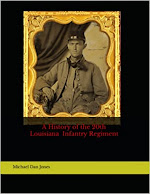
This is the story of one of the most unique infantry units in the Confederate Army, the 20th Louisiana Infantry Regiment. It was made up largely of recent immigrants to New Orleans from the cities and farms of Germany and Ireland. Raised by Colonel Augustus Reichard, a naturalized citizen of the U.S. born in Germany who was very prominent in the New Orleans German community, and the consul for several German states. He and other Germans had been active in the Louisiana State Militia and were eager to prove themselves loyal Confederates once the state seceded. They saw plenty of action during the war in such notable battles of Shiloh, Perryville, Murfreesboro, Chickamauga, Chattanooga, Missionary Ridge, Resaca, New Hope Church, Ezra Church, Atlanta, Jonesboro, Franklin, Nashville, and Spanish Fort. The book has footnotes, images, maps, a bibliography, an index, and an annotated roster of over 1,000 soldiers who served in the regiment.
CONFEDERATE GENERAL BIRTHDAYS, Jan. 9.
None.









No comments:
Post a Comment