Friday, June 5, 2015

Centennial of South’s Defenders Memorial to be held

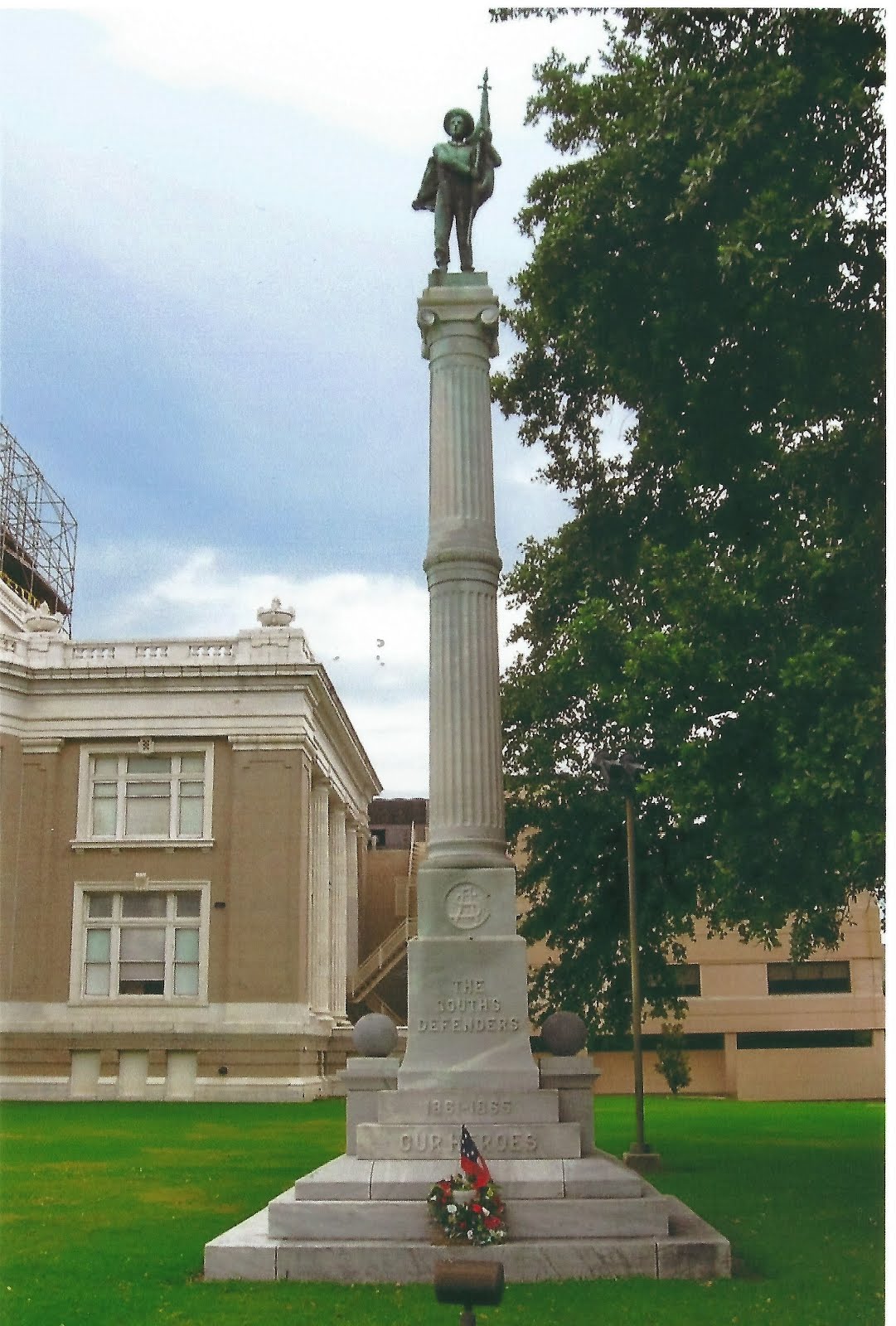
The South's Defenders
(McNeese State University Archives)
              Dr. James E. White, Republican member of the Texas House of Representatives for District 19, will be the keynote speaker for the 100th year anniversary of the dedication of the South’s Defender’s Monument at 10 a.m. Saturday, June 13, 2015, on the grounds of the Calcasieu Parish Courthouse.
         Born and reared in Houston, Texas, White attended public school and graduated in 1982 from Lamar High School. In 1986, White earned the Bachelor of Science degree in Political Science and Military Science from the historically black Prairie View Agricultural and Mechanical University in Prairie View, Texas. From 1986 until 1992, he served in the United States Army as a commissioned officer in the infantry. 
        White was a teacher and now serves as principal. In 2000, he obtained a Master of Education degree from Prairie View. In 2010 and 2012, respectively, he received a Master of Science and a Ph.D. from the University of Houston.
        White is a member of the Sons of Confederate Veterans, American Legion, the Masonic lodge, the National Rifle Association, and Veterans of Foreign Wars.
       The South’s Defenders Monument was originally dedicated June 3, 1915, Confederate Memorial Day in Louisiana, on the courthouse grounds at its current location. More than 12,000 Louisiana Confederate soldiers died in the War Between the States, 1861-65, more than all other American wars combined. About 1,000 Confederate veterans are believed to be buried in Southwest Louisiana cemeteries.
       The monument was dedicated June 3, 1915, during the 50th anniversary year of the War Between the States. Presiding at the ceremony was Lake Charles Mayor George Riling and many other dignitaries were present. 

Tex. State Rep. Dr. James E. White
Keynote Speaker

       Union as well as Confederate veterans were present at the ceremony as a sign of peace and reconciliation between North and South at a time the U.S. needed to come together as World War I was looming in Europe.
       It rests on the front lawn of the classically designed Calcasieu Parish Courthouse in Lake Charles, Louisiana.
       The monument consists of three integral parts: the statue; an ornate marble column and a five-tiered marble base adorned with decorative cannon balls and a marble flower vase.

       Confederate veterans were  also American veterans. The memorial was specially dedicated to the memory of the ordinary Confederate soldiers, who were officially recognized by three acts of the U.S. Congress, in 1906, 1929 and 1957 as military combatants with legal standing who could receive Federal government grave markers and veteran pensions.

Wednesday, June 3, 2015

CONFEDERATE MEMORIAL DAY - AN OFFICIAL STATE HOLIDAY IN LOUISIANSA

The South's Defenders Monument
Lake Charles, Louisiana
(Photos by Mike Jones)
      June the Third, Confederate Memorial Day, is an official state holiday in Louisiana. It commemorates the 12,000 Louisianians who laid down their lives on the altar of Southern Independence between 1861 and 1865. It also pays tribute to the 66,000 Louisiana Confederates who defended their homes and families from ruthless invaders during the War for Southern Independence. The day is also the day of birth in 1808 of President Jefferson Davis.
      There were 982 military units organized in Louisiana for the war, including at least 400 that were state militia units. Most of the companies adopted colorful names, like the Baton Rouge Invincibles, Co. B, 9th Battalion Louisiana Infantry; Beauregard Fencibles, which became Co. K, 12th Louisiana Infantry; the Calcasieu Tigers, Co. I, 28th (Thomas') Louisiana Infantry; Confederate States Rangers, Co. K, 10th Louisiana Infantry; Crescent City Rifles, Co. B, 1st Battalion Louisiana Infantry; Confederate States Zouaves, the 1st Battalion (Coppens') Louisiana Zouaves and the 2nd Battalion (St. Leon Dupiere's) Louisiana Zouaves; and Tiger Rifles, Company B, 1st Battalion (Wheat's) Louisiana Infantry.
Pvt. Edmund Francis Jemison
of Co. C, 2nd Louisiana Infantry,
killed in action at the Battle of
Malvern Hill, Louisiana.
This is one of the most famous
images of the war. (Library of Congress)

      Louisiana was also the scene of over 500 hundred battles, skirmishes raids and campaigns during the war, including such battles as the Battles of Forts Jackson and St. Philip; the Battle of Baton Rouge; the Bayou Lafourche Campaign; the Bayou Teche Campaign; the Red River Campaign; the Siege of Port Hudson; the Battle of Mansfield; the Battle of Pleasant Hill; and small battles, such as the Battle of Calcasieu Pass; the Battle of Stirling Plantation; the Battle of Bayou Bourbeau; the Battle of Irish Bend; the Battle of Bisland Plantation; the Battle of Lafourche Crossing; and many others.
      Historic sites related to the War for Southern Independence are also numerous in Louisiana, including Forts Jackson and Saint Philip; Confederate Memorial Hall in New Orleans; Camp Moore Confederate Cemetery and Historic Site; Niblett's Bluff Park; Port Hudson State Historic Site; Young-Sanders Center for the Study of the War Between the States in Louisiana, in Franklin; Mansfield State Historic Site; and dozens of Confederate monuments, statues and plaques scattered around the state on courthouse lawns, cemeteries and city streets. The second largest collection of Confederate memorabilia in the world is at Confederate Memorial Hall in New Orleans. The Cabildo Museum in New Orleans also displays many Confederate artifacts, including one of the original Confederate battle flags sewed by the Cary Sisters and their cousin, and given to the top Confederate generals.
     Louisiana fielded such famous Confederate generals as P.G.T. Beauregard, Richard Taylor, Alfred Mouton, Henry Gray, and Henry Watkins Allen. General Allen also became the governor of Louisiana in the last two years of the war. Noted Southern historian Douglas Southall Freeman called Allen the greatest administrator in the Confederacy. Shreveport became the capital of Louisiana after Baton Rouge was occupied, and it was also the headquarters of the Confederate Army's Trans-Mississippi Department, which was commanded by General Edmund Kirby Smith. Shreveport was also the site of the last official Confederate flag being lowered on May 26, 1865.
    God Bless Louisiana and God Bless the South!

Wreath and First National Confederate
Flag placed at The South's Defenders
Monument for Confederate Memorial Day
2015 by Compatriot S.T. Lanier of Capt.
J.W. Bryan Camp 1390, Sons of Confederate Veterans.


Monday, June 1, 2015

150-years-ago, Robert E. Lee - Standing in the Gap

Gen. Robert E. Lee continued
"Standing in the Gap" after the
war in defense of his beloved
Southland by educating the next
generation of Southern leaders.
    General Robert E. Lee "Stood in the Gap" between the invaders and his beloved Southland many times during the War For Southern Independence. But when he could not stand with his sword anymore, after Appomattox, he continued standing in the gap the best way he knew how--educating the next generation of Southern leaders at Washington College in Lexington, Virginia.
    He received lucrative offers after the end of the war. In defeat, he stood taller than the vindictive, hateful, victors ever did. Once, before he accepted the college presidency, he was offered $50,000 to accept a position at a questionable company. He was told, "You have to do nothing. All we want is the use of your name."
     General Lee raised himself from behind his desk and responded, "Sirs, my name is the heritage of my parents. It is all I have, and it is not for sale."
     Lee lived modestly with his wife and family at Lexington, revived the college, and his main goal was to see that every student was a sincere Christian and an honorable gentleman.
     He wrote to Governor John Letcher of Virginia in August 1865, saying, "We must look to the rising generation for the restoration of the country." Lee also wrote after the war, "I have fought against the people of the North because I believed they were seeking to wrest from the South its dearest right. But I have never cherished toward them bitter or vindictive feelings, and I have never seen the day when I did not pray for them."
      Robert E. Lee set an example for the people of the South on how to deal with the Northern carpetbaggers and military occupiers of their land, and live with dignity during the humiliation and corruption imposed on them in those post-war years.

Monday, May 11, 2015

150-Years-Ago The Battle of Palmito (Palmetto) Ranch, Texas

[National Park Service]
         The Battle of Palmito (Palmetto) Ranch was the last battle of the War for Southern Independence on May 12, 13, 1865 near Brownsville, Texas in Cameron County. Here is the National Park Service Summary:
Col. John S. "Rip" Ford
led Texas forces in the
last batttle of war
(Lawrence Jones III Collection,
 SMU Library
)

Since March 1865, a gentleman’s agreement precluded fighting between Union and Confederate forces on the Rio Grande. In spite of this agreement, Col. Theodore H. Barrett, commanding forces at Brazos Santiago, Texas, dispatched an expedition, composed of 250 men of the 62nd U.S. Colored Infantry Regiment and 50 men of the 2nd Texas Cavalry Regiment under the command of Lt. Col. David Branson, to the mainland, on May 11, 1865, to attack reported Rebel outposts and camps. Prohibited by foul weather from crossing to Point Isabel as instructed, the expedition crossed to Boca Chica much later. At 2:00 am, on May 12, the expeditionary force surrounded the Rebel outpost at White’s Ranch, but found no one there. Exhausted, having been up most of the night, Branson secreted his command in a thicket and among weeds on the banks of the Rio Grande and allowed his men to sleep. Around 8:30 am, people on the Mexican side of the river informed the Rebels of the Federals’ whereabouts. Branson promptly led his men off to attack a Confederate camp at Palmito Ranch. After much skirmishing along the way, the Federals attacked the camp and scattered the Confederates. Branson and his men remained at the site to feed themselves and their horses but, at 3:00 pm, a sizable Confederate force appeared, influencing the Federals to retire to White’s Ranch. He sent word of his predicament to Barrett, who reinforced Branson at daybreak, on the 13th, with 200 men of the 34th Indiana Volunteer Infantry. The augmented force, now commanded by Barrett, started out towards Palmito Ranch, skirmishing most of the way. At Palmito Ranch, they destroyed the rest of the supplies not torched the day before and continued on. A few miles forward, they became involved in a sharp firefight. After the fighting stopped, Barrett led his force back to a bluff at Tulosa on the river where the men could prepare dinner and camp for the night. At 4:00 pm, a large Confederate cavalry force, commanded by Col. John S. “Rip” Ford, approached, and the Federals formed a battle line. The Rebels hammered the Union line with artillery. To preclude an enemy flanking movement, Barrett ordered a retreat. The retreat was orderly and skirmishers held the Rebels at a respectable distance. Returning to Boca Chica at 8:00 pm, the men embarked at 4:00 am, on the 14th. This was the last battle in the Civil War. Native, African, and Hispanic Americans were all involved in the fighting. Many combatants reported that firing came from the Mexican shore and that some Imperial Mexican forces crossed the Rio Grande but did not take part in the battle. These reports are unproven.
An unidentified private in the 34th
Indiana Infantry, one of the Federal
regiments in the Battle of Palmito Ranch.
(Liljenquist Family  Collection, Library
of Congress)

Thursday, April 16, 2015

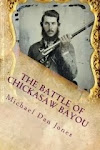
New Book -- THE BATTLE OF CHICKASAW BAYOU

The Battle of Chickasaw Bayou in late December 1862 and early January 1863 was possibly the greatest failure of the war for the fearsome Federal duo, generals William T. Sherman and Ulysses S. Grant. The new book, The Battle of Chickasaw Bayou by Michael Dan Jones, provides a concise history on the major defeat for Lincoln's drive on the Gilbraltar of the South, Vicksburg, Mississippi.
     Sherman and Grant hoped to quickly subdue Vicksburg by a two-pronged attack: Grant was supposed to attack from the east and fix Confederate General John C. Pemberton's focus on him, while Sherman, with 30,000 men, forced its way into Vicksburg from the North. 
     The campaign fell apart when Confederate cavalry, under General Earl Van Dorn and General Nathan Bedford Forrest, wrecked Grant's supply line and forced him to call off his phase of the assault. Sherman didn't get word in time and suffered a shattering defeat by a much smaller Confederate Army.
     The Confederates, on the other hand, performed magnificently. Pemberton swiftly reacted to Grant's failure and sent three brigades back to Vicksburg, under the immediate command at that time of General Martin Luther Smith. Likewise, Smith chose his best young field commander, newly minted Brigadier General Stephen Dill Lee, with an initial contingent of 2,700 men in a provisional division, to hold back the blue tidal wave coming at them.
      Lee, a brilliant young commander, smartly placed his men and guns in the best positions in the rugged terrain to block the Federal invaders. The provisional brigade commanders of the Confederates, Colonel William T. Withers of the 1st Mississippi Artillery Regiment, and Colonel Allen Thomas of the 28th Louisiana Infantry, and their men acted with fierce determination to hold their ground.
      The book tells the story from both viewpoints, Federal and Confederate, with quotes from official battle reports and memoirs of participants. There are detailed battle maps, photographs of participants and historic illustrations to round out the full story in this crucial phase of the year-long Vicksburg campaign.
      The Battle of Chickasaw Bayou is available at Createspace.com, Amazon.com and other online booksellers. The list price is $11.95.
      Publication Date:


Apr 08 2015
ISBN/EAN13:
1505221951 / 9781505221954
Page Count:
100
Binding Type:
US Trade Paper
Trim Size:
6" x 9"
Language:
English
Color:
Black and White
Related Categories:
History / Military / United States

Tuesday, April 14, 2015

150-years-ago LINCOLN ASSASSINATION


[Excerpted from The Assassination of Lincoln by E.W. Coggeshall, published by W.M. Hill, Chicago, 1920]

It was a little before ten o'clock when Booth
led his horse to the back door of the theater
and gave it to "Peanuts," a boy who worked
about the theater, to hold ; then he went to a
saloon on Tenth Street, next door to the the-
ater, and took a drink.

A man now passed along the aisle to the
president's box and appeared to hand a card
to the messenger who sat on the steps. He
immediately entered the box and when he re-
appeared the man returned to the front of
the theater.

In a few moments Booth passed rapidly
through the crowd in the rear of the dress
circle, noticed only by those whom he incom-
moded, and without interference entered the
passage way to the president's box.

Without attracting the attention of any of
its occupants, between whom and himself
there was now only the door through which
he had bored the hole, he fastened the outer
door by wedging the wooden bar between it
and the wall behind.

It was the second scene of the third act
the dairy scene and Harry Hauk as Asa
Trenchard alone occupied the stage  the
situation being doubtless selected by Booth as
most favorable to his escape. "Not one, not
even the comedian on the stage, could ever
remember the last words of the piece that
were uttered that night the last Abraham
Lincoln ever heard on earth. The whole
performance remains in the memory of those
who heard it a vague phantasmagoria, the
actor the thinnest of spectres. The awful
tragedy in the box makes everything else
seem pale and unreal. Here were five hu-
man beings in a narrow space  the greatest
man of his time, in the glory of the most stu-
pendous success in our history, the idolized
chief of a nation already mighty, with illimit-
able vistas of grandeur to come, his beloved
wife, proud and happy; a pair of betrothed
lovers, with all the promise of felicity that
youth, social position, and wealth could give
them; and this young actor, handsome as
Endymion upon Latmos, the pet of his little
world.

"The glitter of fame, happiness, and ease
was upon the entire group, but in an instant
everything was to be changed with the blind-
ing swiftness of enchantment. Quick death
was to come on the central figure of that com-
pany the central figure we believe of the
great and good men of the century.

"Over all the rest the blackest fates hov-
ered menacingly fates from which a
mother might pray that kindly death would
save her children in their infancy. One was
to wander with the stain of murder on his
soul, with the curses of a world upon his
name, with a price set upon his head, in
frightful physical pain, till he died a dog's
death in a burning barn; the stricken wife to
pass the rest of her days in melancholy and
madness; of these two young lovers, one was
to slay the other and then end his life a rav-
ing maniac."

With a pistol in one hand and a knife in
the other Booth entered the box, put the
pistol to the back of the president's head, and
fired, crying as he did so, "Revenge," or
"Revenge for the South."

Major Rathbone sprang forward to seize
him, but dropping his pistol on the floor
Booth turned upon him and inflicted a deep
wound with his knife, in the left arm between
the elbow and shoulder.

He had reached the front of the box when
Major Rathbone caught him by his clothes,
crying, "Stop that man," but placing his left
hand on the railing Booth vaulted lightly to
the stage. A trained athlete and accustomed
to making sensational leaps in his plays, this
one of fourteen feet would probably have
been accomplished in safety, but his spur
caught in the folds of the flag in front of the
box and he fell heavily to the stage with his
back to the audience, splintering horizontally
the fibula of his right leg.

From that moment his doom was sealed,
for though there was to be an interval of
hope, it was to be accompanied by torture
greater than the utmost cruelty could have
devised for him, and escape was as impos-
sible as though he were already in the hands
of the government he had outraged.

He rose quickly to his feet, turned to his
last audience, brandishing his knife and
shouting, Sic semper tyrrannis, he moved rap-
idly diagonally across the stage.

William Withers, the leader of the orches-
tra, had had some business on the stage and
was returning to the orchestra when Booth
came towards him and stabbed at him, cut-
ting great gashes in his coat. This was the
only interruption to his escape from the
theater.

In all that assembly, at first stunned and
then wild with excitement, there was but one
man with presence of mind enough to spring
upon the stage and attempt to capture the
assassin. This was Joseph B. Stewart, a
lawyer of Washington.

Reaching the alley and knocking down the
boy who was holding his horse, Booth
mounted, while Stewart who had followed
close behind twice attempted to seize the
bridle. The quick wheeling of the horse
thwarted his attempt and at a rapid pace
Booth galloped through the alley to F Street,
passed for two miles through the heart of
the city, and giving his real name to the
picket at the Navy Yard bridge, with the
statement that he lived near "Beantown in
Charles County and had been detained in the
city" was allowed to cross.

Walt Whitman graphically described the
scene in the theater :
"A moment's hush a scream the cry
of murder Mrs. Lincoln leaning out of
the box, with ashy cheeks and lips, with in-
voluntary cry, pointing to the retreating fig-
ure, 'He has killed the president? And still
a moment's strange incredulous suspense
and then the deluge! then that mixture of
horror, noises, uncertainty (the sound some-
where back, of a horse's hoofs clattering with
speed), the people burst through chairs and
railings and break them up there is in-
extricable confusion and terror women
faint quiet feeble persons fall and are
trampled on many cries of agony are
heard the broad stage suddenly fills to suf-
focation with a dense and motley crowd, like
some horrible carnival the audience rush
generally upon it, at least the strong men
do ”the actors and actresses are all there
in their play costumes and painted faces, with
mortal fright showing through the rouge
the screams and calls, confused talk re-
doubled, trebled two or three manage to
pass up water from the stage to the presi-
dent's box” others try to clamber up.

"In the midst of all this, the soldiers of the
President's Guard, with others, suddenly
drawn to the scene, burst in (some two hun-
dred altogether), they storm the house,
through all the tiers, especially the upper
ones, inflamed with fury, literally charging
the audience with fixed bayonets, muskets and
pistols, shouting 'Clear out ! Clear out !'

"Such the wild scene or a suggestion of it
rather, inside the play house that night.

"And in the midst of that pandemonium,
infuriated soldiers, the audience and the
crowd, the stage and all its actors and act-
resses, its paint pots, spangles and gas
lights the life blood from those veins, the
best and sweetest of the land, drops slowly
down and death's ooze already begins its
little bubbles on the lips."

The president's head had dropped for-
ward and his eyes were closed. Without
thought of his own condition, Major Rath-
bone rushed to the door to call for aid. He
found it barred from within while people on
the outside were clamoring for admission.
One of the first to enter, when with some dif-
ficulty the door had been opened, was Dr.
Charles A. Leale, assistant surgeon of
United States Volunteers who at that time
was in charge of the United States General

Hospital in Washington. Dr. Leale found
Mr. Lincoln pulseless at the wrist and ap-
parently dead. Stretching him out upon the
floor, the heart failure was relieved and
pulsation resumed. He then made a careful
examination, discovering that the wound was
positively fatal and that recovery even to
consciousness was impossible. A large der-
ringer bullet had entered the back of the
head on the left side, passed through the
brain and lodged just behind the left eye.

Dr. Leale immediately resorted to forced
respiration and it was through his prompt
efforts that Mr. Lincoln's life was prolonged
until morning.

Under the doctor's directions the presi-
dent was removed to the nearest available
house, that of a Mr. Peterson, 516 Tenth
Street diagonally opposite the theater.
He was carried into a small room at the rear
of the hall on the first floor, then occupied by
a Mr. William S. Clark and before him by
the actor, Matthews, the friend to whom
Booth had confided the manuscript intended
to justify his act. Mrs. Lincoln, half dis-
tracted, followed, attended by Miss Harris,
while Major Rathbone having fainted from
loss of blood was taken to his home.

With this great tragedy Ford's Theater
closed never to be re-opened.

It was taken by the government, and after
alteration used as a medical museum until on
June 8th, 1893, it fell by a singular co-
incidence, on the day of the death of Edwin
Booth.
Tuesday, April 7, 2015

150-years-ago BATTLE OF APPOMMATOX STATION


The Confederates who fought to
the bitter end  were determined
to achieve Southern Independence.
This determined looking un-
identified Confederate is wearing
a plain uniform typical of those of
the late war period. (Library of
Congress, Liljenquist Collection

            With the Confederate failure to breakout at Fort Stedman, Grant increased pressure on the Southern defenses all up and down the siege line. The 10th Louisiana returned to its position at the right center of the defenses. The week following the Battle of Fort Stedman, the Federal pressure was ramped up until it reached the crescendo of a great attack on the Confederate flank – The Battle of Five Forks – in which Gordon’s Second Corps did not participate. Grant mounted the pressure on all parts of the Confederate line to cement them in place, and on March 29 sent Sheridan’s cavalry, Humphreys’ 2nd  Corps and Warren’s 5th  Corps – 50,000 men – to cut Lee’s last supply line, the South Side Railroad. Sheridan was in overall command. Lee countered by sending Major General George Pickett with about 10,000 infantry and cavalry to hold the vital strategic intersection of Five Forks at all hazards. If Five Forks fell to the enemy, not only would his last major supply line be threatened, but also his last avenue of retreat. The bluecoats maneuvered into position with the battles of Quaker Road, March 29; White Oak Road and Dinwiddie Court House on March 31. Then on April 1, while Pickett was absent at a shad bake, Sheridan directed  Warren’s 5th  Corps to attack Pickett’s Five Forks position with 22,000 men on April 1. The Confederate position was turned with the loss of 2,000 prisoners to 633 casualties for the Federals.
On the next day, April 2, Grant ordered a major assault all up and down the Confederate line. The seizure of the Southside Station severed the railroad link and A.P. Hill was killed in the fight. The 10th Louisiana was at Graves’ Salient and repulsed the assault on their part of the line, but it was pierced in three other places. It was also on that day that the last man of the 10th Louisiana was killed in the war. Colonel Waggaman and Major Powell were preparing to go to Sunday Mass. Waggaman asked Powell if they had time to make it, looking at his watch and seeing it was 10:30, Powell replied, “Hardly. Unless we leave now.” It was at that very moment that that the Federal assault commenced and Powell was struck in the head by a sharpshooter’s bullet. He was the last man of the regiment killed in the war.          The Second Corps was ordered to hold the line but not try to retake any lost positions. The Louisianians were holding 200 yards of the line and endured a fierce storm of shot and shell for the next 22-hours. To test the strength of the enemy assault, occasionally a man would hold up a hat on a stick to see how many times bullets pierced it. Once again Waggaman’s men were covering the retreat of the Army of Northern Virginia at great cost to themselves.
            Lee notified President Davis that he had to evacuate Richmond and Petersburg so that the government could move to Danville, Virginia. He then issued orders to the some 58,000 men he had scattered through the Northern Virginia region to rendezvous at Amelia Court House on the Richmond and Danville railroad line. He planned to have rations and ammunition there to replenish the army and then march to North Carolina to unite with Johnston’s Army of Tennessee. But the rations were not there when the army arrived and Lee was forced to send  foraging  parties out to gather food for the army, so it could continue south. This gave Grant and the Army of the Potomac and the Army of the James, about 76,000 men, a chance to catch up with Lee, who had a one day lead. Sheridan and the Federal cavalry also started a running fight with the Confederate rear guard. That rear guard included the Louisiana brigade, and the remnants of the 10th Louisiana Infantry.
            At 1 o’clock in the morning of April 3, the 10th Louisiana finally got orders to evacuate and catch up with the rest of the army at Ameilia Court House. They got across the Appomattox River and then took the Woodpecker Road toward Amelia. On April 5 they re-crossed the Appomattox River and just passed through Amelia Court House, there being no rations, and headed for Burksville. The next day, April 6, the regiment skirmished with the Federals on the road to Burksville. At one point they doubled back to stop the enemy while the rest of the army moved on, then retrace their steps to catch up with the rest. The regiment then defended a bridge and at dusk, supported one artillery piece on the road while the rest of the army continued to retreat to Farmville. At 9 o’clock they moved out to rejoin the army at High Bridge, rest and then continue marching and reached Farmville by daylight of April 7. At Farmville they found 40,000 bread rations, 80,0000 of meal waiting for them and begin issuing the food. The Federals, however, arrived and Lee had to send the train on to Lynchburg, but it was captured the next day at Pamplin Depot. The Confederates then crossed the Appomattox River again at High Bridge, and hoped to delay the Federals by destroying the four bridges there, but one was left and the enemy also crossed. They then built entrenchments three miles north of Farmville and fought off enemy attacks until the supply train could safely pass.
            In spite of this discouraging retreat, many in the Southern army were not ready to surrender. Colonel Pendleton of the 15th Louisiana wrote to his wife on April 6, noting, “Our Army is not whipped – indeed it is strong & ready to fight to-day . . . .” Pendleton was likely commanding the 10th Louisiana as well as the 15th. The two fragments of each regiment had been consolidated to form Company D of the unofficial Louisiana battalion. Waggaman was commanding the brigade and Pendleton would have been senior to Lieutenant Colonel Monier. But the whole army was dwindling every day, losing men in each skirmish. The 10th Louisiana had lost 12 men on April 2 and 3 at Petersburg, including one man killed and 11 others captured. Private Peter Shery of the Confederates States Rangers was among those taken captive. On April 6, three more men were captured, including Private Joseph L. Strange of Company K. Then on April 7, an additional six 10th Louisiana men were captured at Farmville, including Private Maxile Marcantel of the Confederate States Rangers. Lee had his men do another night march to reach Appomattox Court House, the next place they hoped to find more food rations. It was 38-miles away.
       The march to Appomattox was relatively uneventful. But on April 8, the Army of Northern Virginia found that their supply train had been captured and Sheridan’s cavalry had arrived there before them. In addition, part of his artillery and wagons were captured that day at the Battle of Appomattox Station. Grant was now sending Lee notes inviting him to surrender. Lee decided to make one last desperate attempt to break through the Federal cavalry in his front. Lee ordered Gordon’s infantry, Fitzhugh Lee’s cavalry and Long’s artillery to assault the Federals in front of them at daylight of April 9. Gordon positioned Evans’ division on the left, Walker’s in the center and Grimes’ on the right. Fitzhugh Lee would be to Grimes’ right. They had, altogether, about 5,400 men  to make the last charge of the Army of Northern Virginia. Taking part in the charge was the decimated Louisiana brigade, now down to just 178 men, including the small fragment of the 10th Louisiana. At daylight the Louisianians gave one last rebel yell as they charged toward the formidable Federal line. The Yankees were dismayed. They thought the Confederates would surrender at any time. Nobody wanted to be the last man killed in the war. Fitzhugh Lee’s cavalry swept around the Sheridan’s left flank, while Evans, Walker, Grimes and Long’s artillery launched the frontal assault. “I take especial pride in recording the fact that this last charge of the war was made by the footsore and starving men of my command with a spirit worthy of the best days of Lee's army,” Gordon said.

           Surprisingly, the Federal breastworks were carried, two cannons captured and a battle flag captured after a Louisiana infantryman bayoneted the color bearer. After they had swept Sheridan’s cavalry aside, they were met by a bone-chilling sight – a solid phalanx of Federal infantry. The 5th  Corps, now commanded by Griffin, who had replaced the sacked Warren, was now up and in support of the cavalry. Gordon brought up the artillery and the infantry, opened fire and the combination of the two stopped the advance of the bluecoats. But the massive numbers were quickly flanking the Confederates on both flanks. Longstreet’s corps was also being assaulted. “My troops were still fighting, furiously fighting in nearly every direction, when the final note from General Lee reached me. It notified me that there was a flag of truce between General Grant and himself, stopping hostilities, and that I could communicate that fact to the commander of the Union forces in my front.”