Tuesday, June 21, 2016

BIG NEWS FROM THE CONFEDERACY -- June 21, 1862

Brig. Gen. Richard Taylor's Louisiana
Brigade played a major role in 

Jackson's Valley Campaign
of 1862.  (M.D. Jones Collection)
[Richmond Daily Dispatch, June 21, 1862]

The battle near Port Republic.
     It seems to be generally admitted that this battle must be designated as the battle of "Cross Keys"--The term, although derived from Yankee sources, seems to have been adopted by both parties. The subjoined account of the affair is from the Lynch burg Virginian, received from an officer who participated in the engagement:
    The battle ground is five miles from Port Republic. General Ewell's division fought this action, and chiefly by Brigadier-General Trimble's brigade on the right, who, by skillful selection of his position, and judicious maneuvers, with 1,705 men — defeated in four several charges two full brigades of the enemy, numbering over 6,000 men and two batteries of artillery; killing and wounding of the enemy over 2,000 and with a loss in his own brigade of over 124 killed and wounded.
     Perhaps no action during the war has exhibited such brilliant results, obtained by skill in maneuvering on the field, as well as hard fighting, Gen. Trimble's theory seems to be unexpected and sudden assaults upon the enemy, and desperate fighting only when a great point can be gained.
     No officer of the army has gained suddenly more distinction than Gen. Trimble has done by his quick perceptions and swift movements, showing the highest qualities to command.
     After the battle, Gen. Trimble, we understand, strongly counselled a night attack on Fremont's whole army, urging its complete success, but in view of the decision of Gen. Jackson to attack Gen. Shields next day, the night attack was not sanctioned.
     Events afterwards fully showed that this night attack would have demolished Fremont's whole army and captured all his artillery, as his army was broken down and demoralized to such a degree as to have made but little resistance.
     Prisoners of Fremont's army acknowledge 1,000 killed in this battle, and near 4,000 in killed, wounded and missing. Large numbers of his men availed themselves of the chances of a battle to desert.
      The famous Dutch Bucktalls, and Eighth New York Dutch regiment, Blenker's men, were entirely demolished in this action a just retribution for their excesses in the Valley, by insults, abuse, robbery, and destruction of property.
     After the defeat of Shields on Monday, Fremont retired rapidly down the Valley, no doubt fearing a pursuit, and did not stop until he reached Mount Jackson, where he has halted, as if to make a stand.
     Jackson's army is resting both men and horses, and taking care of the sick. What his next move will be no our known — something Western beyond the Ohio.


Sunday, June 19, 2016

BIG NEWS FROM THE CONFEDERACY -- June 19, 1862

A Wheat's Battalion Zouave (reenactor) from Company B,
Tiger Rifles, waving the flag of the Louisiana Republic.
(Photo by M.D. Jones)
[Richmond Daily Dispatch]

Wheat's battalion.

This battalion, which came from Louisiana early in the war 500 strong has been reduced by various causes to about 150 effective men. Being active participants in Jackson's campaign in the Valley, they have marched 200 miles within a short period, and fought in nine different engagements. On Monday, the 9th inst., near Port Republic, they were in the glorious bayonet charge which resulted in the capture of the Yankee battery. In this charge Major Wheat's horse was shot through the head within twenty yards of the guns, after which he led his command on foot, and was the first field officer who reached the coveted prize. Of eight officers who went into the fight, five were badly wounded--Lieuts. Coyle, Cockroft, McCarthy, Ripley, and Adjutant Bruce Putnam--and thirty casualties occurred among the ninety-five men carried into action. The officers and men of Major Wheat's battalion think that his gallantry in this and many other battles entitles him to promotion. He has sacrificed much and suffered much in the cause of his country, and has been frequently congratulated by General Officers on his prospect of advancement, but has never received it from the Government; yet his zeal has shown no abatement, nor has his courage ever faltered when there was work to be done.

Tuesday, June 14, 2016

BIG NEWS FROM THE CONFEDERACY - June 14, 1862

[The Richmond Daily Dispatch]
Jackson's marches.
Stonewall Jackson's "foot cavalry" were on epic marches in May-June 1862.
Bonaparte, in his first campaign in Italy, wrote to the Directory that his troops had outdone the Roman legions. The latter, he said, marched eight leagues (twenty-four miles) a day, whereas the French marched ten, and fought a battle every day. The French are proverbially rapid marchers; but the great exploits alluded to by Napoleon in this letter extended only over a space of one week, during the time of Wurmser's first invasion, when the battle of Castiglione was fought. The General-in-Chief himself, during that time, never took off his clothes, or slept in a bed, and sometimes kept on horseback for twenty-four hours, changing only from one horse to another. At other periods the French enjoyed comparative repose, while engaged in blockading Mantna.
       For rapid marching, continued steadily through a long period of time, it may be doubted whether any troops — even those of Bonaparte in Italy — ever surpassed the troops of Jackson. For a whole mouth they are said to have made twenty-five miles a day; and when we look at the ground they passed over, we are induced to believe the distance not overstated. He has discarded all suspicious baggage, has few wagons and no tents, and makes his men move with no knapsacks on their backs. They carry nothing but a haversack, in which they thrust their rations, to supersede the necessity of stopping to eat when it is not convenient. Only one blanket is allowed, and this the men tie around their shoulders. Everything is brought down to the condition which allows of most speed, and is subject to least stoppage. The men who make these prodigious marches are the healthiest in the whole service. They complained at first, and were weary and foot sore, but they soon got over it, and grew every day more and more capable of enduring fatigue, until now they can bear as much as the deer that used to feed on the mountains around them. Stone. wall has moulded them into the very form for great exploits, and great exploits we are confident they will perform. Already they see that victory seems chained to his standard.--Already his name begins to exercise over them that magical influence which is the best omen of success. They think him invincible, and they will do their best to make him so.

Saturday, June 11, 2016

BIG NEWS FROM THE CONFEDERACY--June 11, 1862.

[Richmond Daily Dispatch, June 11, 1862]

Soldiers of 1st Texas Infantry, Hood's Texas Brigade, in Winter Quarters.
(Library of congress)

The Texas Brigade.
On the Lines, June 2nd.
To the Editors of the Dispatch:
     A modern philosopher, whose teachings are to be valued more for their worldly wisdom, perhaps, than for their classic antiquity, whose proverbs are more practical than poetic, used to get before his son as a perpetual monitor, for his intercourse with his fellow man, this injunction. "Slow your own horn." At the risk of bring numbered as of this school, I claim a short space in your columns.
      In your account in this morning's Dispatch of the skirmish in which the Texans were engaged, there are some inaccuracies which. I wish to correct, by simply telling she story as it is, myself being a witness on the spot, and a participator in the fight.
     On yesterday morning, beneath the warm garb of the Sabbath sunshine, while yourself and other friends in the city were no doubt quietly perverting your Sabbath ablutions, this skirmish took place, and inasmuch as military men here think it was creditable to as, I give you the facts:
     A detail of one hundred and fifty men, from the 1st, 4th and 5th Texas regiments, was made on the morning, not to --that's not our style — but for the purpose of securing the woods in front of our line on the Nine-mile road, seeing what Yankee force there way in the woods, and to drive them out if possible.
      We found the enemy posted in the woods a few hundred yards from our front line of pickets. After reconnoitering, we discovered a strong force of the enemy's whole brigade, it was supposed — to the left of the wood, and a large force, then unknown, immediately in our front. The force on the left were silent, calculating that they had a dead thing on us, while those in front were bold and impudent, keeping up a constant fire at us from among the trees. We let them amuse themselves for a while in this manner, occasionally silencing one as he became too annoying, until our line was fully established and safeguards placed against our friends on the left of the road.
     The command was then given, "Forward, bays! Give them!--11!" The Texas war whoop rose on the and a thousand Yankees rose like dark spirits through the gloom of the forest. The voice of their officers could be heard amid the din of battle urging their men to stand, but it was in vain they essayed to stop our fast-advancing line. they fired but one volley and took to their heels, our boys following. We pursued them out of the timber, under cover of their batteries, when they took refuge in their trenches, and fired back at us. Here we had a comrade killed; but regardless of the fierce fire poured upon them, four men bore him on their shoulders out of the field back to our camp.
     In the mean while our friends on the left of the road attempted to succor their companions and to "suck us in" They started to come in our rear, but a small "family battery" we had in the right place opened on them and deterred them from their purpose." One well aimed shell fell in their midst, killing seven and wounding a number.
      The enemy's loss in this engagement was forty-five killed, including a Lieut.-Colonel and two Lieutenants. We secured the sword of one Lieutenant and a revolver from the other. On the pistol was engraven, "Presented to. Lieut. M. C. Flost, by the citizens of. --Ward. Philadelphia." The force against us was one regiment, the 71st Pennsylvania, besides those gentry who threatened as on the left. We suppose the force that routed them did not exceed one hundred men, as a notion of our small party had to defend points in the woods to protect our flanks.--Our men were under command of Lieutenant Baizizi, of the 4th, Lieut. Jammeson, of the 1st, and Lieut. Nash, of the 5th regiment, who all acted discreetly and bravely, and led their men to the charge. Our less was one Mile; and four wounded, slightly.
     Texas scouts run these same, Yankees to their batteries a week ago yet nothing not have even been many to that the Richmond picket.
     We are too much pre occupied to give details of our engagements, but we think that the by which intelligences every fight in which Virginia are engaged are open to the press, and ought to be brought into requisition. An prevails with the arms that you are disposed to magnify on the one side and to neglect the other.
     Not partaking of this opinion. I send you this, with a simple prediction that when " the fight" takes place the Texas Brigade will kill more Yankees, storm more batteries, and capture fewer prisoners than any in the service. A Texas Scout.

Thursday, June 9, 2016

George 3d and a Lincoln.
[Richmond Daily Dispatch, June 9, 1864]
     If George the Third had been as great a tyrant as Abraham Lincoln, what would he have done with the Divine referred to in the following, which was published at the time in the English papers, from one of which, now before us, Lloyd's Evening Post, we make the extract?
     "The following is the conclusion of the daily family prayer of a very pious, respectable Divine of the Church of England, at the West end of the town: 'Finally, we recommend to Thy fatherly goodness our poor, distressed brethren in America; enable them to support the severe trials that a wicked Administration have laid upon them; may it not alienate their affections, nor oblige them to seek
protection in a Foreign Power; may the sacred ties of blood, friendship, justice, and humanity, never be violated by our soldiers; on the contrary, may they excite in them a just abhorrence of the cruel, arbitrary measures they are sent over to enforce, and firmly unite them with our friends in the glorious cause of liberty and their country; may their present sufferings be their future security, and a removal of bad counsellors from the ear and person of our Sovereign prove the salvation of the Colonies of the Mother Country.'" To which the editor adds: "When clergymen pray in this manner, what must some people think of themselves?" But no one molested the minister arrested the minister, nor"gutted" the printing offices.
     If George the Third had been as great a tyrant as the vulgar despot, who has every public man who draws a free breath tried for his life, what would he have done to Cumings, when he exclaimed, in the House of Commons, "I rejoice that America has resisted?" What would he have done to Chatham, when he said, in one of his famous speeches:
     "As to conquest, therefore, my lords, I repeat, it is impossible. You may swell every expense and every effort still more extravagantly; pile and accumulate every assistance you can buy or borrow; traffic and barter with every little petty German prince that sells and sends his subjects to the shambles of a foreign country; your efforts are forever impotent and vain, doubly so from this mercenary aid on which you rely, for it irritates, to an incurable resentment, the minds of your enemies, to overrun them with the sordid sons of rapine and of plunder — devoting them and their possessions to the rapacity of hireling cruelty. If I were an American, as I am an Englishman, while a foreign troop was landed in my country. I never would lay down my arms — never! never! never!"
     In another speech: "In such a war as this, unjust in its principle, impracticable in its means, and ruinous in its consequences, I would not contribute a single effort nor a single shilling."
     And again: "This barbarous measure (employing Indians--a superior race to negroes — against the Americans,) has been defended, not only on the principles of polity and necessity, but also on those of morality; for it is perfectly allowable," says Lord Suffolk, "to use all the means which God and nature has put into our hands. I am astonished, shocked, to hear such principles confessed, to hear them avowed in this hour, or in this country." The outburst of indignant eloquence which followed is familiar to every school boy. Again we ask, if George the Third had been as great a tyrant as Abraham Lincoln, what would have become of Lord Chatham.

     Vallandigham, for not one-tenth of his offence, is banished; others sent to dungeons, others threatened with the loss of life. No one in the United States dares to sympathize with the South, or to utter one word in behalf of outraged humanity, except at the peril of liberty or life. Yet George the Third was such a tyrant that America stands vindicated before the world in throwing off his Government. Abraham Lincoln is the pink of Republican Presidents!

Monday, June 6, 2016

Stories of Georgia by Joel Chandler Harris. American Book Company, 1896, p. 78
  
 
[Richmond Daily Dispatch, June 6, 1862]
The "Nancy Harts" of Lagrange.
      --We are informed, says the LaGrange (Ga.) Reporter, that the ladies of LaGrange, to the number of about forty, organized themselves, on Saturday last, into a military corps for the purpose of drilling and target practice. They elected Dr. A. C. Ware as their Captain; and, we believe, resolved to meet every Saturday. The following are the officers: Dr. A. C. Ware, Captain; Mrs. Nannie Morgan, First Lieutenant; Mrs. Peter A. Heard, Second Lieutenant; Miss Aley Smith, Third Lieutenant; Miss Andelie Bull, First Sergeant; Miss Augusta Hill, Second Sergeant; Miss M. E. Colquitt, Third Sergeant; Miss Pack Beall, First Corporal; Miss Lelia Pullen, Second Corporal; Miss Sallie Bull, Third Corporal; Miss Ella Key, Treasurer.
       The corps not having a name, and it being their determination to prepare to defend their homes, if necessary, as did Nancy Hart of olden time, we have taken the liberty of calling them the "Nancy Harts," until they shall adopt one. We have no doubt they will prove as true as did Nancy Hart if the emergency ever presents itself; and, therefore, we do not think a more appropriate name could be suggested. The "Nancy Harts" of LaGrange! That's it, ladies. 

[Nancy Morgan Hart (c. 1735–1830) was a heroine of the American Revolutionary War noted for her exploits against Loyalists in the Georgia backcountry. Because stories about her are mostly unsupported by contemporary documentation, it is impossible to entirely distinguish fact from folklore.]

Thursday, June 2, 2016

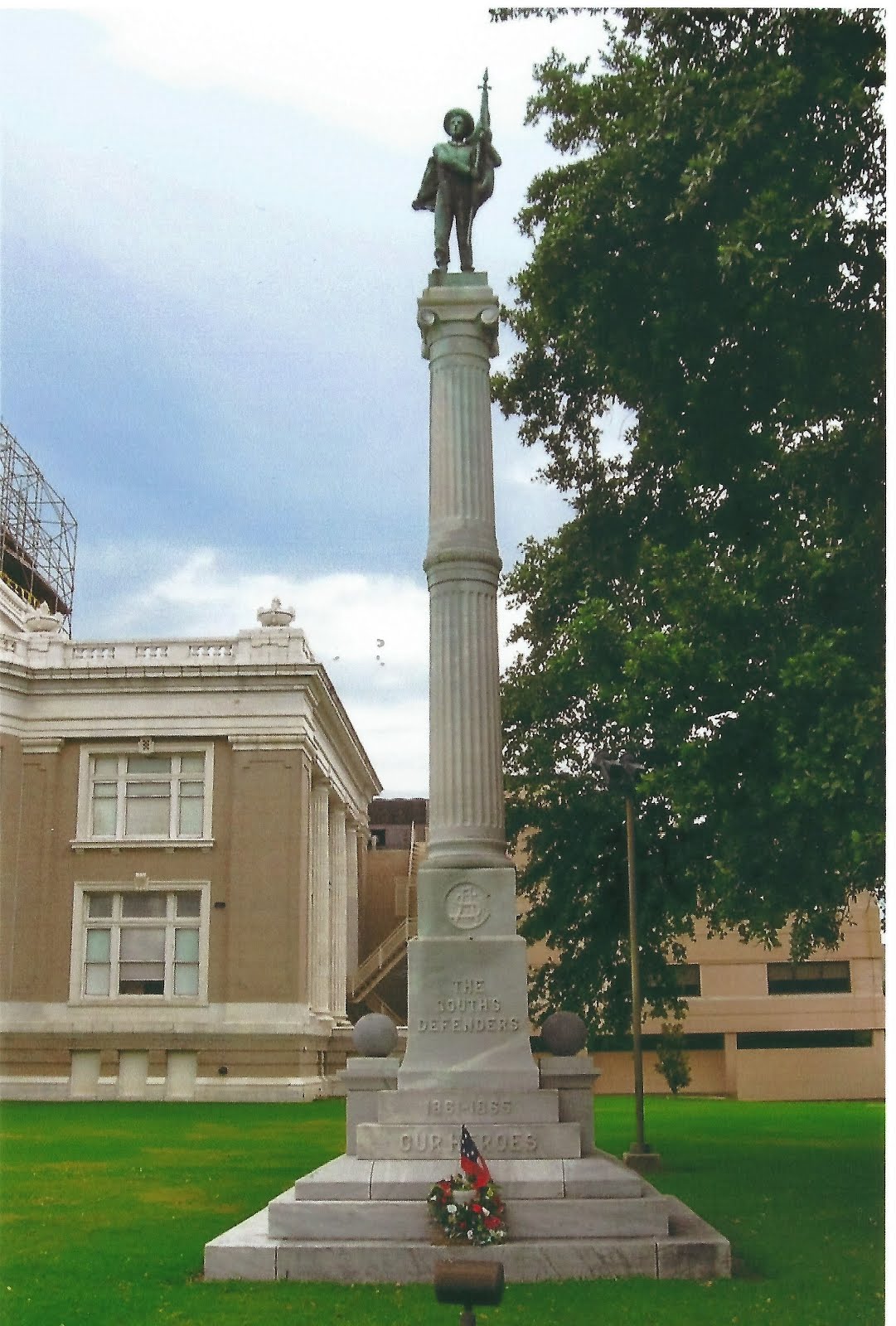
Louisiana Confederate Memorial Day--June 3, 2016

Closeup of The South's Defenders Monument

In Honor of the Confederate Dead.

Lake Charles, Louisiana


Dedicated June 3, 1915.
(Photo by M.D. Jones)