Saturday, February 7, 2026

Today in History (general history)/ On This Day in Confederate History/ Confederate General Birthdays, February 7.

 Click πŸ‘‰TODAY IN HISTORY (general history) Feb. 7. 

ON THIS DAY IN CONFEDERATE HISTORY, Feb. 7.

1861: The Choctaw Nation in Indian Territory (modern-day Oklahoma) declared itself free and independent and became allies with the Confederacy on the basis of state sovereignty and other issues. Robert M. Jones, a Choctaw and cotton planter, served as the nation's non-voting representative in the Confederate Congress. Albert Pike was appointed the Confederacy's envoy to the Choctaw Nation. The First Choctaw and Chickasaw Mounted Rifles served in the Confederate Army in the Trans-Mississippi as well as the First Choctaw Cavalry Battalion, First Chocktaw (Battice's) Cavalry Battalion, First Choctaw (McCurtain's) Cavalry Battalion, First Choctaw War Regiment, First Choctaw Regiment, Second Choctaw Regiment, Third Choctaw Regiment as well as a number of other companies.

1862: Brigadier General Bushrod Rust Johnson was appointed commander of Fort Donelson at a crucial time when it was coming under a major attack by Federal forces. However, Brig. Gen. Gideon Pillow, who outranked Johnson, arrived and took command just a few hours after Johnson became commander. Johnson then became a division commander. Later in the war, he commanded a Tennessee brigade and a division with distinction in the Army of Tennessee and the Army of Northern Virginia.

Brig. Gen. Bushrod R. Johnson

1863: Confederate troops at Williamsburg, Virginia fire on Federal cavalry, killing and wounding 11 of the Yankee troopers. 

Also, on this day in 1863, three Confederate Navy raiders run the Federal blockade and enter the port at Charleston, South Carolina. In Texas, Confederate Major General John Magruder declares the ports at Galveston and Sabine Pass to be open. The action followed naval victories off Texas in January.

1864: Meridian Campaign: Lieutenant General Leonidas Polk's Confederate continue their strategic withdrawal as Sherman's bluecoats continue their advance to Meridian, Mississippi. Skirmishing occurs at Brandon, Morton, and Sataria, Mississippi.

1865: Carolinas Campaign: Confederates skirmish with Sherman's Federal Army at Blackville, South Carolina during the Carolina Campaign.

CONFEDERATE GENERAL BIRTHDAYS, Feb. 7. 

Brigadier General Leroy Pope Walker was born on this day in 1817, in Huntsville, Alabama. Walker was a prewar lawyer, circuit judge, and active secessionist. At the beginning of the war, he promoted Jefferson Davis as the president of the new Confederacy. After Davis became president, the president appointed him the first Secretary of War in spite his not having any military experience. Walker resigned in September 1861 after a disagreement with President Davis. However, the day after he resigned, Davis appointed him a brigadier general and he was given command of army garrisons at Mobile and Montgomery. Walker resigned from the army in March 1862. In 1864, Walker returned to the Confederate Army as a colonel to serve as a military judge. Following the war, he practiced law and at one time represented Jesse James as a defense lawyer on a robbery charge and won the case. In 1875, Walker was made president of the Alabama Constitutional Convention which ended Reconstruction in the state. He died Aug. 23, 1884, and was buried in Maple Hill Cemetery in Huntsville.

Brig. General Leroy P. Walker

Friday, February 6, 2026

Today in History (general history)/ On This Day in Confederate History/ Confederate General Birthdays, Feb. 6.

Click πŸ‘‰ TODAY IN HISTORY (general history) Feb. 6.

ON THIS DAY IN CONFEDERATE HISTORY, Feb. 6.

1861: Alabama finances Confederacy. Alabama made a $500,000 loan to the Confederate Provisional Congress on Feb 5, which is equal in buying power to $19,525,421.69 in 2026. The Congress accepted with the following resolution:

      1st. Resolved by the Confederate States of America in Congress assembled, That this Congress accept the liberal offer of the General Assembly of the State of Alabama, to place at the disposal of this body the sum of five hundred thousand dollars as a loan to the Government of the Confederacy now being formed.

        2d. Resolved by the authority aforesaid, that this Congress place the highest appreciation upon this generous, patriotic and considerate action of the State of Alabama and realize in it the zealous devotion of the people of that State to the cause of "Southern Independence."

        ADOPTED February 8, 1861.

Alabama Gov. Andrew Moore
He supported Jefferson Davis for president at the convention.
(Alabama State Archives)

 1862: General Lloyd Tilghman, the commander, evacuated most of the 3,000-man garrison from Fort Henry to Fort Donelson and returned to Fort Henry with about 100 men when the Federal Navy struck. The artillery duel lasted from 11 o'clock A.M. until 2 o'clock P.M. when all the Confederate guns had been knocked out. Tilghman surrendered with 78 men and 16 hospital patients. He also lost 5 killed, 11 wounded, and 5 were missing. Yankee General Grant arrived with 15,000 soldiers too late to engage in the fighting. The Federals lost 11 men and 31 injured.

1864: The Confederate Congress passes legislation banning imports of luxury items and the circulation of U.S. currency. It also requires that half of the shipments of food and tobacco be given to the government before the ships leave port.

Confederate forces at the Rapidan River in Virginia repulse a Federal attempt to cross the river. The bluecoats retreat under the cover of darkness.

1865: General John Pegram's Division attacked the V Corps at the Battle of Hatcher's Run and was repulsed. Pegram is killed but Brig. Gen. Clement A. Evans blocked a Federal advance. Later in the day Pegram's and Maj. Gen. William Mahone's divisions attack the Federal line at Dabney's Mill and break it and drive them back. General Pegram is killed. Total losses for the Federals are 1,539 and Confederates suffer 1,161 casualties.

CONFEDERATE GENERAL BIRTHDAYS, Feb. 6.

Major General John Brown Gordon was born on this day in 1832 in Upson County, Georgia. Brown was a citizen soldier with no military experience before 1861. However, at that fateful time, being a community leader, he was elected captain of a volunteer company in the 6th Alabama Infantry. Although present at the First Battle of Manassas, the Alabamians saw no action. He was elevated to colonel of the 6th Alabama when the army was reorganized in May 1862in compliance with the First Conscription Act. He and his regiment were active in the Battle of Seven Pines, after which he became the temporary commander of his brigade. During the Seven Days Battles, he was wounded in the eyes at the Battle of Malvern Hil. At the Battle of Sharpsburg, he suffered numerous wounds. When he returned to duty, he was promoted to brigadier general rank on May 7, 1863. More battles and wounds followed, and he was promoted to major general and command of a corps. In all, he served in about 30 major campaigns and battles and the last one at Appomattox at the end of the war. After the war he had an equally impressive political career, serving as the governor of Georgia and in the U.S. Senate from Georgia. He also was a popular lecturer, and writer and was the first commander of the United Confederate Veterans. Brown died Jan. 9, 1904, while visiting his son in Miami, Florida, and is buried in Oakland Cemetery in Atlanta, Ga.

Maj. General John B. Gordon
πŸ‘±

Major General William Dorsey Pender was born on this day in 1834 in Edgecombe County, North Carolina. Pender attended West Point and graduated with the Class of 1854, ranking 19th in his class out of 36 cadets. In the prewar U.S. Army, he served as a second lieutenant in the 2nd U.S. Artillery and as a first lieutenant in the 1st Dragoons. Pender served on the frontier in the Washington Territory in one of the Indian conflicts. Resigning from the U.S. Army on March 21, 1861, Pender joined the C.S. Army and served as a captain of the artillery and colonel of the 3rd/13th N.C. Infantry. His battles included Seven Pines, the Seven Days Battles, Second Manassas, Harpers Ferry, Sharpsburg, and Chancellorsville, and he was mortally wounded July 2, 1863, at the Battle of Gettysburg and died July 18, 1863, in Staunton, Virginia. Pender is buried in Calvary Episcopal Church in Tarboro, N.C.


Maj. General William D. Pender
πŸ‘±

Major General James Ewell Brown Stuart was born in 1833, in Patrick County, Virginia. He was mortally wounded at the Battle of Yellow Tavern on May 11, 1864, and died on May 12, 1864, in Richmond, Virginia.  Of Scottish heritage, Stuart attended West Point graduating with the Class of 1854, 13th in a class of 46 cadets. In the U.S. Army, he served with distinction and was wounded on July 29, 1857, while fighting the Cheyenne Indians in Kansas. Stuart also served as a volunteer under Colonel Robert E. Lee during the storming of the Harpers Ferry Arsenal which had been taken over by the insurrectionist John Brown and his men in 1859. He resigned from the U.S. Army on April 22, 1861, and joined the Confederate Army and served as colonel of the 1st Virginia Cavalry at the First Battle of Manassas, Va. gaining fame as a great cavalryman there. He was promoted to brigadier general on Sept. 24, 1861, and to major general on July 25, 1862, and commanded a cavalry division and later to corps commander of the cavalry. His other battles and campaigns included the Peninsula Campaign, N. Va. Campaign, Maryland Campaign, Fredericksburg, Chancellorsville, Brandy Station, Gettysburg, the Overland Campaign, and the Battle of Yellow Tavern where he was mortally wounded and died in Richmond Va., and died May 12, 1864, the day after the battle, in Richmond Va. Stuart is buried in Hollywood Cemetery in Richmond.


Maj. Gen. James E.B. Stuart

πŸ‘‹ 

Thursday, February 5, 2026

Today in History (general history)/ On This Day in Confederate History/ Confederate General Birthdays, Feb.

Click πŸ‘‰TODAY IN HISTORY (general history) Feb. 5. 

ON THIS DAY IN CONFEDERATE HISTORY, Feb. 5.

1861: Southern Confederacy Organizing: Delegates from the seven seceded states, South Carolina, Mississippi, Alabama, Florida, Georgia, Louisiana, and Texas, met on Feb. 4, 1861, at Montgomery, Alabama to form the Provisional Government of the Confederate States of America. Howell Cobb of Georgia was elected president of the convention. Among the delegates are former Louisiana senators Judah Benjamin and John Slidell. Benjamin would be one of the members of President Jefferson Davis's cabinet for its entire existence. The top political leaders of the South moved swiftly to form the government, and the military and find a way to finance the new nation. The Southern people, for the most part, were wildly enthusiastic about their new Southern Republic.

Flags of the 
CONFEDERATE STATES OF AMERICA

1862: The Role of Black Soldiers in the Confederate Army: The Confederate House of Representatives in Richmond, Virginia debated enlisting free black men in the Confederate Army. The Richmond Examiner newspaper endorses the concept.

Pvt. Charles F. Lutz, Co. F, 8th La. Inf. Reg't.
He enlisted on June 23, 1861, at Camp Moore, La. 
Lutz saw action at First Winchester, Cross Keys,
Port Republic and Second Manassas. He was captured
near Fredericksburg, Va., on May 3, 1863, and imprisoned
at Ft. Delaware, paroled & exchanged on May 23, 1863. 
Lutz was severely wounded in the left arm and captured 
at Gettysburg, Pa. Hospitalized for his wound, his left arm was 
amputated. He was paroled & exchanged on Sept. 16, 1863. 
The Confederate Army sent him home on wounded furlough. He
was discharged for disability at the Confederate Hospital in
Houston, Texas on May 9, 1865. Lutz was born on 20 June 1842, 
a farmer, and lived in Opelousas, La., a "free man of color."
He received a Confederate pension from the State of 
Louisiana in 1900. He married after the war and had 12 children.
He died April 9, 1910, and was buried at Magnolia Cemetery in Westlake, La.
 His wife received a Confederate widow's pension from the State of Louisiana.

1865: Confederates skirmish with Sherman's Federals in South Carolina at Angley's Post Office and Buford's Bridge. Among the units involved was the 4th South Carolina Cavalry.

1st Lt. Thomas S. Nelson, Co. I, 4th S.C. Cav.

CONFEDERATE GENERAL BIRTHDAYS, Feb. 5.

Wednesday, February 4, 2026

Today in History (general history)/ On This Day in Confederate History/ Confederate General Birthdays, February 4.

Click πŸ‘‰Today in History (general history) July 25. 

On This Day in Confederate History, July 25.

1861: The U.S. Congress on this day in 1861 passed the Crittenden-Johnson Resolution which specifically stated the Federals were fighting for the Union and the Constitution, and not for freeing the slaves. The vote was unanimous for the passage of the resolution.

1862: The Camden Confederate newspaper in South Carolina reported on this day in 1862 that the numerical strength of Maj. Gen. George B. McClellan's Army of the Potomac was less than previously reported. The paper also reported on a bombardment at Vicksburg, Miss., and exchange of prisoners with "the Yankee Government," and that Yankee Maj. Gen. John Pope had taken command of his Army of Virginia in which he bragged that "I have come to you from the West, where we have always seen the backs of our enemies. . . ." It also had an outraged story about Brig. Gen. Benjamin "Beast" Butler's infamous "women's order." The article stated, "Transparent hypocrite and unblushing liar, as well as beast."

1st Lt. William R. Macbeth
Co. B, Confederate Guards Response Battalion
KIA April 6, 1862, in the Battle of Shiloh.
He was, about 26-year-old,f born in Ireland
and in 1860 had a personal estate of $20,000. 
He was married to Martha Selser Bass and had a daughter,
Lydia Bass Macbeth was born in 1861.
His uniform hat is at the Confederate Memorial  Hall in New Orleans.
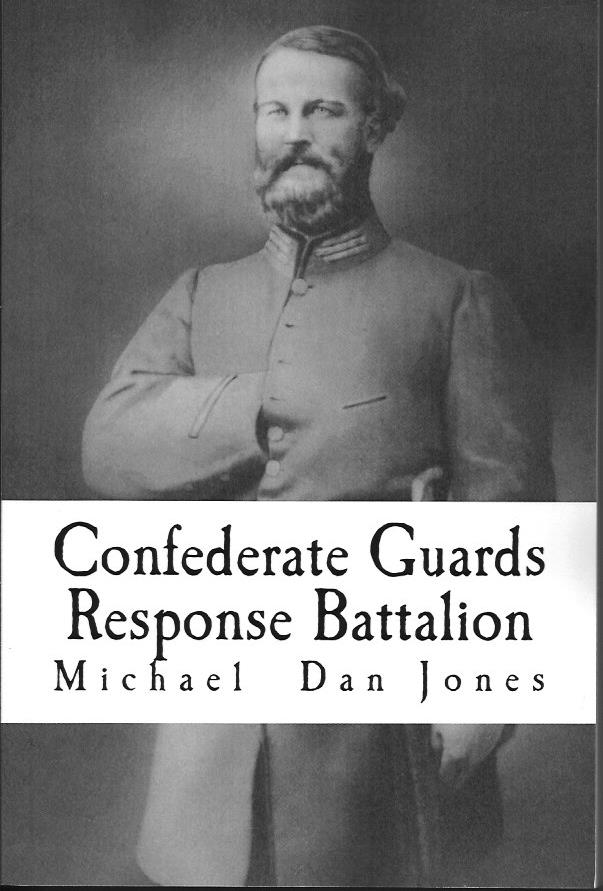
This is the history of one of the hardest fighting Louisiana units in the War for Southern Independence, the Confederate Guards Response Battalion. It covers the units organization in New Orleans, the Battle of Shiloh and their campaigns in Louisiana. The book includes photographs, maps, illustration, bibliography and index.

1864: Lt. Gen. Jubal Early and his Army of the Valley followed up the victory at Kernstown, Va. by pursuing Maj. Gen. George Crook's Federal forces and heavily skirmishing with them at Martinsburg, Va. Gen. Robert E. Lee reported on this pursuit in a report dated July 26, he wrote, "General Early states he attacked Major-General Crook on the 24th instant on the old battle-field of Kernstown, completely routing him, and pursued him five miles beyond Winchester, where he was compelled to halt from the exhaustion of his men, they had marched twenty-five miles that day. The pursuit was continued by the cavalry. Among the prisoners captured was General [James A.] Mulligan, mortally wounded.  Brigadier-General [Robert D.] Lilley and our other officers and men captured on the 20th were recovered. The strength of the enemy is stated to have been 15,000 infantrymen, besides the cavalry under [William] Averell."

Brig. Gen. Robert D. Lilley, who 
had been captured July 20, 1864, at
Stephenson's Depot but was recovered. He was also
wounded three times and his right arm amputated.

Confederate General Birthdays, July 25.

None.

Tuesday, February 3, 2026

Today in History (general history)/ On This Day in Confederate History/ Confederate General Birthdays, February 2.

Click πŸ‘‰TODAY IN HISTORY (general history) Feb. 3. 

ON THIS DAY IN CONFEDERATE HISTORY, Feb. 3.

1862: War at Sea: At Southampton, England, the Confederate steamer Nashville leaves the port, and the U.S.S. Tuscarora moves to intercept the Southern vessel. However, the British Warship HMS Shannon prevents the confrontation in English waters in line with British neutrality.

1863: Second Battle of Fort Donelson, Tenn. Confederate cavalry under generals Fighting Joe Wheeler and Nathan Bedford Forrest attack Fort Donelson. The Federals hold the fort. The Yankees lost 12 dead and 30 wounded, while the Confederates suffered 100 dead and 400 wounded.

1864: At Richmond, President Davis recommends suspension of habeas corpus for such crimes as spying, desertion, and associating with the enemy.

1865: Carolinas Campaign. At River's Bridge and Dillingham's Crossroads along the Salkehatchie River, Confederate troops battle Sherman's Federals as they approach Charleston, South Carolina.

CONFEDERATE GENERAL BIRTHDAYS, Feb. 3.

General Joseph Eggleston Johnston was born on this day in 1807 in Farmville, Virginia. Of Scottish heritage, his grandfather was from Scotland, and his father was a Revolutionary War veteran. He graduated from West Point in 1829 in the same class as Robert E. Lee. Johnston was 13th in a class of 46 cadets. Johnston resigned from the army in 1837 to study civil engineering. He did serve, as a civilian engineer, in the Second Seminole War and was wounded but was back in the army in 1838 as a first lieutenant with the topographical engineers and received brevet captaincy for the battle in which he was wounded. In the Mexican-American War, he was on the staff of Gen. Winfield Scott and the Siege of Vera Cruz and was wounded in the Battle of Cerro Gordo. His army career prospered in between wars and in 1860 was promoted to Quartermaster General with the rank of brigadier general. He resigned in 1861, the highest-ranking officer to do so when his native state left the Union. Johnston was made a full general in August 1861 in the Confederate Army. He was the ranking general at the First Battle of Manassas on July 21, 1861, but let Gen. Beauregard handle it tactically since Beauregard was more familiar with the ground. Johnston and President Jefferson Davis had a falling out early in the war that greatly hampered his service. Johnston was one of the developers of the famous St. Andrew's Cross Style Confederate Battle flag, along with General Beauregard and William Porcher Miles. He led the army in the Peninsula Campaign and was severely wounded in the Battle of Seven Pines in 1862. On November 24, 1862, still recovering from his wound, he was given command of the Dept. of the West, which was primarily a desk job. His continuing trouble with his wound also plagued him. He did lead an attempt to relieve the Siege of Vicksburg in 1863, but his army was too small to even attempt to break the siege. President Davis appointed Johnston to the command of the Army of Tennessee on Dec. 27, 1863, and gave the Northern Army under Sherman fits in the Atlanta Campaign in 1864 with his Fabian tactics. But President Davis, dissatisfied with Johnston's tactics, relieved him of the command and gave it to Gen. John Bell Hood. The change proved to be a disaster for the Confederacy. Johnston was again appointed to the much-diminished Army of Tennessee in the final days of the war, for the Carolinas Campaign, but it was too little too late and he surrendered the army on April 26, 1865. Johnston worked at various jobs after the war, wrote his memoir, and engaged in the various post-war controversies left over from the conflict, with Jefferson Davis and others. He died on Feb. 19, 1891, and was buried at Green Mount Cemetery in Baltimore, Maryland.

Gen. Joseph E. Johnston
πŸ‘±

Brigadier General George Thomas "Tige" Anderson was born on this day in 1824, in Covington, Georgia. Anderson was attending college when the Mexican-American War broke out and left his studies to serve as a second lieutenant with the Georgia cavalry. After that war, he served in the Georgia militia as a major general of the 11th Division but entered the U.S. Army in 1855 as a captain in the 1st Cavalry Regiment but resigned in 1858. During the War for Southern Independence, he became colonel of the 11th Georgia Infantry and fought in most of the major battles of the Army of Northern Virginia. He was promoted to brigadier general on Nov. 1, 1862, and was wounded at Gettysburg. Anderson surrendered with General Lee at Appomattox on April 9, 1865. Following the war, he became a railroad freight agent in Atlanta and then the police chief and tax collector in Anniston, Ala. He died there on April 4, 1901, and was buried in Edgemont Cemetery.

Brig. Gen. George T. Anderson
πŸ‘±

Brigadier General Nathan George Evans was born on this day in 1824 at Marion, South Carolina. He attended West Point and graduated in 1848 36th in a class of 38 cadets. His service in the U.S. Army as a second lieutenant was with the 1st U.S. Dragoons and 2nd U.S. Dragoons mostly at frontier outposts. Evans resigned from the U.S. Army on Feb. 27, 1861. At the First Battle of Manassas, he led a small brigade as a colonel made up of the 4th South Carolina Infantry and the 1st Special Battalion (Wheat's) Louisiana Volunteers (the famous Louisiana Tigers) and held off an overwhelming Yankee flanking force long enough for reinforcements to make a crucial stand on Henry House Hill. Evans was promoted to brigadier General effective to July 21, 1861, the date of the First Manassas. He then led his brigade at the battles of Ball's Bluff, Secessionville, Second Manassas, Sharpsburg, Kinston, and in the Vicksburg Campaign. Evans was severely injured in a buggy accident in Charleston, S.C. in 1864 and was never returned to command of his brigade. Following the war, he became a school principal and died on Nov. 23, 1868, in Midway, Alabama. Evans was interred in Tabernacle Cemetery in Cokesbury, Alabama.

Brig. Gen. Nathan G. Evans.
πŸ‘±

Brigadier General William Lowther "Mudwall" Jackson was born on this day in 1825 in Clarksburg, Virginia. Prior to the war, he was a lawyer and Democrat politician who was a lieutenant governor of Virginia. During the War for Southern Independence Jackson became the lieutenant colonel of the 31st Virginia Infantry Regiment and served in the Western Virginia Campaign in the battles of Rich Mountain and Cheat Mountain. Jackson was promoted to colonel and served on the staff of Stonewall Jackson in 1862. In 1863, he raised the 19th Virginia Cavalry and served in the Jones-Imboden Raid and then under Brig. Gen. Albert G. Jenkins at the Battle of Cloyd's Mountain and Early's Valley Campaign of 1864 and was promoted to brigadier general on Dec. 19, 1864. His brigade disbanded on April 15, 1865. Jackson refused to surrender and headed west but finally decided to take his parole on July 26, 1865, in Brownsville, Texas on July 26, 1865. He lived for a short time in Mexico and returned to West Virginia to practice law and then relocated to Louisville, Ky. where he became a circuit judge. He died March 26, 1890, in Louisville and was buried at Cave Hill Cemetery.

Brig. Gen. William L. Jackson
πŸ‘‹

Monday, February 2, 2026

Today in History (general history)/ On This Day in Confederate History/ Confederate General Birthdays, Feb. 2.

Click πŸ‘‰ TODAY IN HISTORY (general history) Feb. 2.

ON THIS DAY IN CONFEDERATE HISTORY, Feb. 2.

1862: Confederate batteries on the Vicksburg, Mississippi, bluffs fire on the Federal ship Queen of the West, but it slips by the city. The gunboat had a 30-pounder bow gun and three 12-pounder howitzers; it was also protected by cotton bales behind wood sheathing. 

1864: On the second day of the Battle of New Bern, N.C. Confederate raiders led by Commander John Taylor Wood boarded the Federal gunboat USS Underwriter and killed the commander. Three crewmen were going to sail it away, but the guns of Fort Stevenson opened fire and set it on fire. The Confederates evacuated the scene the next day.

CONFEDERATE GENERAL BIRTHDAYS, Feb. 2.

General Albert Sidney Johnston was born on this day in 1803 in Madison County, Kentucky. After attending Transylvania University in Lexington, Ky., Johnston attended West Point and graduated 8th in his class of 41 cadets. As a young second lieutenant, he was posted in New York and Missouri before serving in the Black Hawk War of 1832. Johnston resigned in 1834 to take care of his wife, who was dying of tuberculosis in Kentucky. She died in 1836. Johnston then went to the Republic of Texas, where he served as Secretary of War from 1838 to 1840. He also remarried and settled on the China Grove plantation in Brazoria County. Later, he moved back to Kentucky and then back to Texas for the Mexican-American War as colonel of the 1st Texas Rifles under Gen. Zachary Taylor at the Battle of Buena Vista. He lived on his Texas plantation until 1849, when President Zachary Taylor made him a major in the U.S. Army. Then President Franklin Pierce gave him command of the 2nd U.S. Cavalry and in 1857, gave him a brevet promotion to brigadier general in recognition of his service in the Utah War. At the outbreak of the War for Southern Independence, Johnston resigned and joined the Confederate Army. President Jefferson Davis made him a full general and he was given command of the Western Department. Johnston didn't have nearly enough men to defend his huge department and his forces were

General Albert Sydney Johnston

driven back from Kentucky all the way down to Corinth, Miss., in early 1862. With his second in command, Gen. P.G.T. Beauregard, and the Army of the Mississippi, they counterattacked on April 6, 1862, at the Battle of Shiloh, Tenn., while on the verge of victory, he was killed in action. Johnston is buried in an ornate tomb at the Texas State Cemetery in Austin, Texas.

Brigadier General Abner Monroe Perrin was born on this day in 1827 in Edgefield District, South Carolina. Perrin served in Mexican American War as an infantry lieutenant, after which he studied law in South Carolina and practiced law after being admitted to the bar. In the War for Southern Independence, he became a captain in the 14th South Carolina Infantry in A.P. Hill's famous "Light Division." He rose in rank and was promoted to brigadier general on Sept. 10, 1863. Perrin's battles included the Seven Days, Second Manassas, Sharpsburg, Fredericksburg, Gettysburg, and the Wilderness, and he was killed in action at Spotsylvania Court House on May 12, 1864, after being shot seven times. Perrin is buried in the Confederate Cemetery in Fredericksburg, Va.


Brig. Gen. Abner M. Perrin
πŸ‘‹

Sunday, February 1, 2026

Today in History (general history)/ On This Day in Confederate History/ Confederate General Birthday, Feb. 1.

Click πŸ‘‰TODAY IN HISTORY (general history) Feb. 1

ON THIS DAY IN CONFEDERATE HISTORY, Feb. 1.

1861: Texas Gov. Sam Houston, anti-secession, is angered when the Texas Secession Convention votes to secede, the seventh state to do so. The action will have to be validated by a vote of the people. The convention then establishes the Committee of Public Safety and sends delegates to the meeting of seceded states in Montgomery, Alabama to form the Southern Confederacy. Houston turns down an offer from Lincoln to supply him with troops to fight secessionists.

 At the Texas Secession Convention, Texas Supreme Court Chief Justice Oran Milo Roberts presides. The delegates voted for secession by a margin of 166 to 8. The Committee on Public Safety was given the power to continue operation after the convention adjourned on Feb. 4, 1861. The committee authorized the seizure of all Federal property in Texas and the forced evacuation of 3,000 troops in the state. 

Texas Brigade soldiers in 1861.

1864: Major General George Pickett is ordered to capture New Bern, North Carolina, which has been occupied by the Federals. Brig. Gen. Robert Hoke's Brigade clashed with the 132nd N.Y. Inf. at Bachelor's Creek until dark when the Yankees retreated to New Bern. Meanwhile Brig. Gen. Seth Barton attacked the 17th Mass. Inf. and 3rd N.Y. Light Artillery across the Trent River but fell back when he found the fortifications there too strong for a frontal attack. The battle continued on Feb. 2, 1864.

Brig. Gen. Robert Hoke

1865: The Federal Army under Sherman destroys much private property in the Carolinas Campaign, as they had through Georgia. President Davis appointed Gen. Joseph E. Johnston to command the Army of the South in the campaign. His three corps commanders were Lt. Gen. William J. Hardee, Lt. Gen. Alexander P. Steward, and Lt. Gen. Stephen D. Lee. Johnston's cavalry chief was Maj. Gen. Wade Hampton. Greatly outnumbered, Johnston had to use Fabian's tactics and wait for opportunities to strike the Yankees.


CONFEDERATE GENERAL BIRTHDAYS, Feb. 1.

Brigadier General Edward Higgins was born in 1821 in Norfolk, Va. but his exact month and day of birth are unknown. He was reared in Louisiana by an uncle and was appointed a midshipman in the U.S. Navy on Jan. 24, 1836, when he was about 15 years old. Promoted to passed midshipman on July 1, 1842, Higgins worked his way up to master and then to lieutenant on Aug. 24, 1849, after having seen service in the Mexican-American War. He married Anna Zimmerman in 1851 and resigned from the Navy in 1854. He and his wife settled in New Orleans where he worked as a steamship agent. When the war started in 1861, he served as a captain in the 1st Louisiana Heavy Artillery regiment. He resigned on Jan. 2, 1865, to take the position of lieutenant colonel in the 21st  Louisiana Infantry, which was actually trained as heavy artillery and defended Fort Jackson and Fort St. Philip on the Mississippi River. Higgins fought in the Battle of New Orleans and was captured on April 28, 1862. After being exchanged, on Oct. 16, 1862, he was promoted to colonel while still a prisoner and after his release was given command of the river batteries at Vicksburg. Captured again with the fall of Vicksburg, he was exchanged again on Oct. 13, 1863. He was then promoted to brigadier general and assigned to command the harbor defenses at Mobile, Ala. Higgins was relieved of his command on Feb. 18, 1865, for unknown reasons and never received another command. Following the war, he and his wife settled in Norfolk, Va. where he worked in the insurance and import businesses. They then moved to California in 1872 to work for the Pacific Mail  Steamship Company. Higgins died on Jan. 31, 1875, and was buried in Holy Cross Cemetery in Colma, California.

Brig. Gen. Edward Higgins