Tuesday, January 19, 2016

HAPPY 209th BIRTHDAY GENERAL LEE!


[Below is an excerpt about General Robert E. Lee from The Story of a Soldier’s Life by Field-Marshal Viscount Wolseley. This is a tribute to General Lee on the occasion of his 209th birthday anniversary, January  19, 2016.]
General Robert E. Lee
Robert E. Lee described as 'ablest general' - 'greatest man' by Lord Wolseley

                As soon as I could do so I proceeded to General Lee’s Headquarters, about six miles out of town, on the road to  Harper’s Ferry. Every incident in that visit to him is indelibly stamped on my memory. I have taken no special trouble to remember all he said to me then and during subsequent conversations, and yet it is still fresh in my recollection.  But it should be so, for he was the ablest general, and to me, seemed the greatest man I ever conversed with; and yet I have had the privilege of meeting Vom Moltke and Prince Bismark, and at least upon occasion had a very long and intensely interesting conversation with the latter. General Lee was one of the few men who ever seriously impressed and awed me with their natural, their inherent greatness. Forty years have come and gone since our meeting, yet the majesty of his manly bearing, the genial winning grace, the sweetness of his smile and the impressive dignity  of his old-fashioned style of address, come back to me amongst my most cherished recollections. His greatness made me humble, and I never felt my own individual insignificance more keenly than I did in his presence. He was the about fifty years of age, with hair and beard nearly white. Tall, extremely handsome and strongly built, very soldier-like in bearing, he looked a thoroughbred gentleman. Care had, however, already wrinkled his brow, and there came at moments a look of sadness into his clear, honest, and speaking dark brown eyes that indicated much his overwhelming national  responsibility had already told upon him. As he listened to you attentively, he seemed to look into your heart and to search your brain. He spoke of the future with confidence, though one could clearly see he was of no very sanguine temperament. He deplored the bitterness introduced into the struggle, and also the treatment of the Southern folk who fell into hostile hands. But there was no rancor in his tone when he referred to the Northern Government. Not even when he described how they had designedly destroyed his home at Arlington Heights, the property on the Potomac he had inherited from General Washington. He had merely “gone with his State” – Virginia – the pervading principle that had influenced most of the soldiers I spoke with during my visit to the South. His was indeed a beautiful character, and of him it might truthfully be written: “in righteousness he did judge and make war.”

Gen. Lord Wolseley
Who was Viscount Wolseley?
      Garnet Joseph Wolseley, the First Viscount of Wolseley, was one of the great British generals of the last half of the 19th Century. He was known as a tireless advocate of modernization of the British Army and was the "go-to" man whenever there was trouble in some far-flung area of the British Empire.
      He was  the son of a British Army officer born June 4, 1833 in Dublin, Ireland. Wolseley was educated in Dublin and commissioned into the British Army in  1852 in the King's Own Borderers, but transferred to the 80th Regiment of Foot. He served in the Second Burmese War, wounded at the Battle of Donabyu; the Crimean War in Russia;  the Indian Mutiny; the Anglo-French Expedition to China in 1860; the Fenian Invasion of Canada; the Ashanti Campaign in Africa; the Egyptian Army revo0lt; attempted to relieve Gordon at Khartoum; and the Boer War, 1899-1902.
      Wolseley was promoted to Field Marshal in 1894 and to Commander in Chief of the British Army, 1895-1901. He retired in 1903 and died March 26, 1913 in Mertone, France.
      In October, 1862, while stationed in Canada, took a leave of absence to  visit the Confederate Army. He had interviews with both General Robert E. Lee and Lieutenant General Thomas J. "Stonewall" Jackson. Wolseley left behind his impressions in his auto-biography and in periodical articles.

Friday, January 15, 2016

''NO VOTES FOR TURNCOATS"

Click for story>'NO VOTES FOR TURN COATS'
Louisiana Tiger Zouave

Thursday, January 14, 2016

Wednesday, January 13, 2016

A DAY OF PRAYER AND FASTING FOR SOUTHERN HERITAGE

Compatriots and friends,
 
One hundred fifty years ago the War Against Southern Independence ended with a devastated South. Since that time, the South has rebuilt and stands as a shining symbol of determination and dedication in the face of opposition and hostility. However in our day, there are those who seek to place upon the South another "reconstruction." Some have called this a time of "Southern Cleansing." Their goal is to remove all things Southern. One such attempt is current in the city of New Orleans. The city leaders have ordered the removal of Southern monuments that have stood in this Southern City for decades. Therefore

WHEREAS, on January 14, 2016, the New Orleans case is brought before the legal system for hearing, determination, and decision; and

WHEREAS, it is vital that Southern Heritage be protected via the preservation of the Southern Monuments in the city of New Orleans; and

WHEREAS, the Sons of Confederate Veterans is the premiere Southern Heritage organization in the United States.

NOW, THEREFORE, I Charles Kelly Barrow, Commander-in-Chief of the Sons of Confederate veterans, do hereby proclaim Thursday, January 14, 2016,as:

"A DAY OF PRAYER AND FASTING FOR THE PRESERVATION OF SOUTHERN HERITAGE"

for all members and friends of the Sons of Confederate Veterans,

PROCLAIMED this 13th day of January, 2016.

Deo Vindice!

Charles Kelly Barrow
Commander-in-Chief
Sons of Confederate Veterans
@scvcic
www.scv.org 

Saturday, January 2, 2016

Fascinating Interview with "Gone With the Wind" author, Margaret Mitchell

Click here for interview>Margaret Mitchell Interview, 1936


Margaret Mitchell
(Library of Congress)

Sunday, December 27, 2015

BEN JONES GIVES THOUGHTS ON NEW ORLEANS MONUMENTS


Click here for full story.False Notes From Wynton Marsalis Lead To A Divided City

(Library of Congress)
Gen. P.G.T. Beauregard was the most famous
Louisiana citizen of the 19th Century. His accomplishments
both in the military and civilian life were historic. What
a shame the current New Orleans city officials are
disgracing themselves by attacking his monument.

Wednesday, December 23, 2015

New Orleans Monuments, Followup Editorial


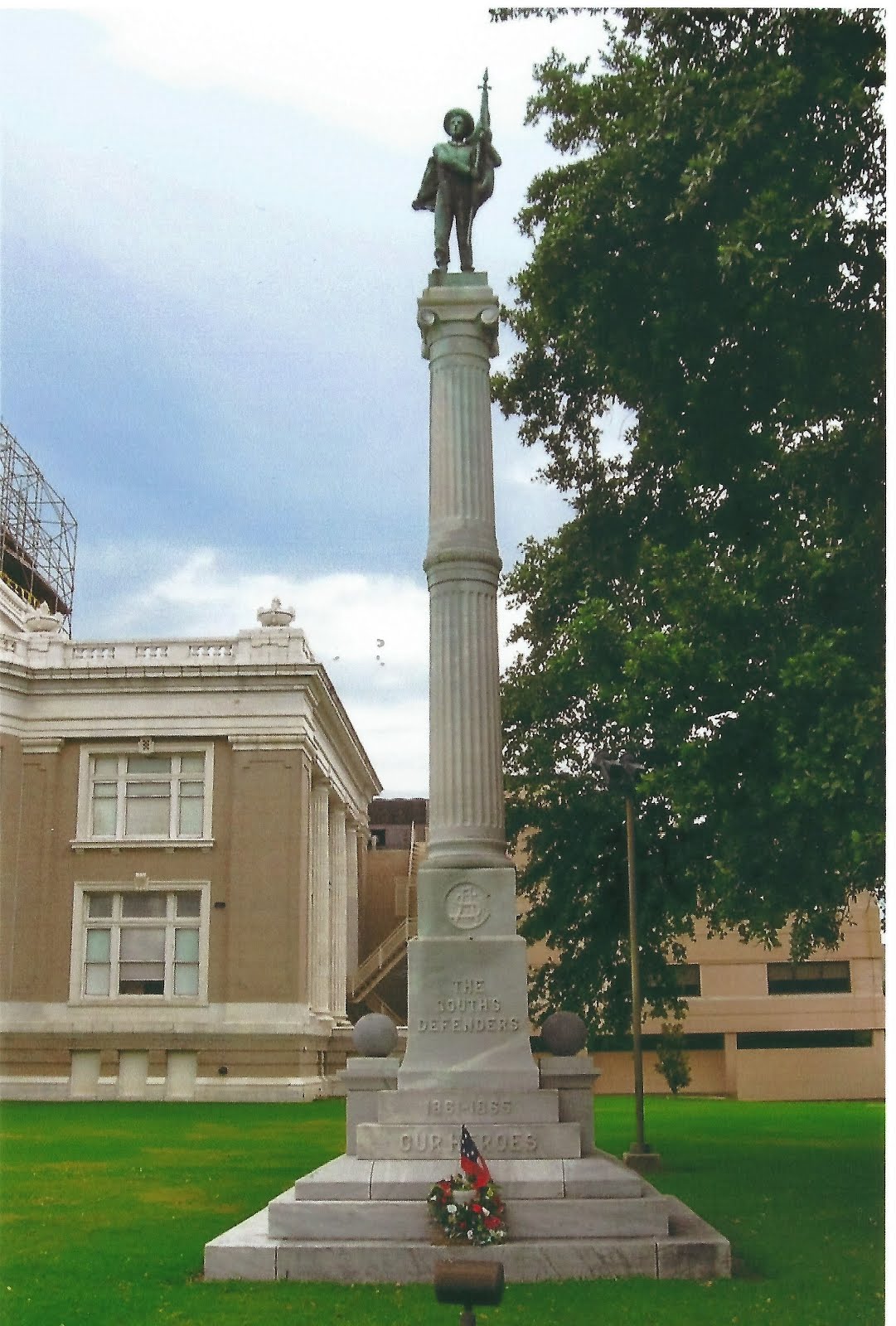
Monuments should not be politicized. The South's Defenders Monument,
Lake Charles, Louisiana (antique postcard, M.D. Jones collection)

Monuments Followup Editorial

Here is an editorial that ran in the Lake Charles American Press today, Dec. 23, as a followup of the New Orleans monuments vote. It concludes a Louisiana monuments protection act is needed to protect these historic treasures from political opportunism.

Monuments shouldn't be politicized

      The New Orleans City Council recently voted to approve an ordinance to declare four of Louisiana's most historic and artistically significant monuments, as "public nuisances."
      This action can lead to the removal, in effect the junking, of these four priceless treasures of Louisiana history - the Robert E. Lee Monument in Lee Circle, the General Beauregard Monument, both on the National Register of Historic Places, the Jefferson Davis Monument, nominated for the National Register of Historic Places, and the Liberty Place Monument.
      In addition, Mayor Mitch Landrieu wants a commission to decide on which of New Orleans' many other historic monuments, street names and plaques that should be junked or the names changed, in a further exercise in intolerant and radical political correctness.
      Fortunately, several groups of historically-minded citizens who respect and want to save all of New Orleans' very diverse cultural heritage have filed a federal law suit to stop this unfortunate exercise in political correctness. The plaintiffs are the Louisiana Landmarks Society, the Foundation for Historical Louisiana, the Monumental Task Committee Inc. and Beauregard Camp No. 130, Sons of Confederate Veterans. Named as defendants are Landrieu and the federal Department of Transportation and various officials.
      The city has agreed to not to remove the monuments before a Jan. 14 hearing before Judge Carl Barbier in Federal District Court in New Orleans.
      There are 13 points of contention in the 51 page suit, ranging from ownership of the property on which the monuments stand, questions of federal law concerning veterans monuments and National Register listed property, the property interests of other parties, and federal responsibilities regarding the street car line and the monuments connection to it, among others.
      The suit also contends that the monuments do not fit the city's definition of a "nuisance."
      Landrieu's state desire for a commission to look at other monuments, plaques and street names could signal a continuing "slippery slope" that will cause even more division and contention.
      The council would not consider a compromise proposal from the only council member to vote against the ordinance, Stacy Head.
      A recent poll showed that 64 percent of the population is against removing the monuments, and 68 percent of the entire state are against it. New Orleans has a rich and proud historical and cultural legacy that impacts the whole state. It is the tourism anchor of Louisiana. Tourism is one of the state's largest industries and historical tourism is a big part of it.
      Besides, New Orleans is a political sub-division of the state government and gets plenty money from the general treasury for infrastructure and other needs.
      It should be obvious now that the state legislature needs to consider a monuments protection act to protect Louisiana's history, heritage and culture, from this kind of destructive, divisive political opportunism.