Tuesday, September 1, 2015

CALCASIEU PARISH CONFEDERATES -- 2nd Lt. Hardy Coward Gill, 1st Louisiana (Nelligan's) Louisiana Infantry


Reminiscences and an Appreciation


[Lake Charles Weekly American Press, July 18, 1924]

By May Kirkwood Wasey

2nd Lt. H.C. Gill
1st La. Inf. Reg't.
A picturesque figure on the horizon of the southwest section of Louisiana is H.C. Gill, for years a leading citizen in the political, church and general activities of Lake Charles and Calcasieu parish.

A commanding silhouette against the sunset of life, is this old soldier: one of those still holding the line of the fast-thinning gray. He stands at attention, as it were, not able to be about awaiting the next command.

Speaking of this one day, he said, “The sweetest words I could hear today wound be the order from my commanding officer to move my baggage into the next country. When that welcome command comes, I’ll leave all this suffering here and go to the land of peace and happiness.” Like another soldier of long ago, he has, “Fought a good fight, and has kept the faith.”

“Uncle Doc” Gill was born in Mississippi, near Brookhaven, the 17th day of February 1844 but, as he says, he couldn’t help that and with his parents, he moved to Louisiana in the 9th month of his first year; “at the very earliest opportunity.”

He claims two native states, anyway, and tells in his peculiarly witty style of his crossing the Mississippi as it was told to him. It seems as they ferried over the river, the nurse girl gave him a piece of beef melt, on which he choked, and it was not until they reached the Louisiana side they were able to bring him back to life. “So, you see,” he concludes, “Louisiana is really my native state, for I started all over here.”

The family settled on Castor Creek, near Leesville, in Vernon parish.

Surprised when I asked him how he spent his time when he was a boy, he said, “Why I picked cotton, picked peas, did everything; I was raised on a farm.”

About the schools of those days there was not much to tell. “They rank about three months in a year. The country was sparsely settled. There were few children to go to school and almost no teachers. And some of the teachers we had didn’t know anything to teach.” But, like most of us, he that stands above all the others in his memory. She must have been an inspiration for he talks yet about her lovely voice and the realistic way she read or told stories to her classes.

He entered Mt. Lebanon college at 14, but left at 17 to join the Confederate army.

After a visit to the old Gill home on the lake front, three years ago, I wrote my note book; “When I am 77, I hope I shall be as jolly and interested in life and folks as is our dear Uncle Doc Gill. We visited him yesterday, the day before his 77th birthday, and he told us of his first visit to Lake Charles, when he was 8.”

“I remember it as if it were yesterday,” he said. “I had  never seen so much water and to me it looked like the [illegible] the Atlantic ocean.” He was visiting Bagdad on the other side of the lake and not being able to read the future, he did not know that he would build his home on the edge of this lake and become a pioneer of a town like Lake Charles.

 His vision of a beautiful residential section along the lake was never realized, and today the commercial interests are edging closer and closer on either side of his wide lawn with the shady trees. Speaking of this, he said, “I fought them all I could.” After all, this was too bad for Lake Charles especially since there were so many miles of river front on which to build warehouses and railroad tracks.

His story of this first journey from Leesville to Bagdad, is something like this: “Mother decided she wanted to see her mother who lived in Bagdad. There were no roads in those days, only a blind trail, so we made the trip down on horseback. Mother and all the children had a horse apiece except me, and I rode behind. I remember how I fussed because I liked a comfortable seat and wanted always to ride behind the one who had a pacing horse. But I had to take turn about with first one and then another, and all the horses didn’t pace. Between home and Bagdad, we only passed one house. We carried our provisions and camped at night along the way.”

The Bear Story

“About half-way down, one day, a black bear crossed the trail just in front of us. Now my big brother was a ferocious fellow and, dare-devil-like, he threw the saddle bags and all the heavy weight from his horse and, with his rope, started off to lasso the bear.

“One of the horses we rode was ‘Old Nance.’ With her, all the young ‘uns on the place, white and black, had learned to plow. Well, when Nance got to the place where the bear crossed the path, she started a rebellion. Brother tried to ride her over, whip her over, or back her across it, but she wouldn’t cross that bear’s track. Finally brother tied her head up, with several thicknesses of sack and started her engine to going round and round. Then reversing her, she went round and round the other way, till she lost her ‘geography’ and as she couldn’t see nor smell, nor hear, she went over. After we got Old Nance on grandmother’s side of the bear path, we were on our way again.”

It was on this visit when he was 8, that he enjoyed his first “excursion on the lake, when Miss Laura Bilbo took us for a ride in a skiff. Her father, Joe Bilbo, lived where Bel’s mill is now.”

Also, he tells of visiting the homes of some of oldest settlers here. One of these was Valentine Moss’ home on the river and he says, “I thought he must be a prince, or something, because he had statues of Jesus and Joseph all around.”

He remembered when they went to the home of Judge Reid, there was a Frenchman named Jean Baptiste La Cox, wrestling with a bear, and that, when asked what he did for a living, he said, Just ‘rassle the bear.”

“However, later, Le Cox built a schooner named John Le Cox,” says Uncle Doc, “and the christening of the craft was a great event in this section. Everybody came from all around. Aunt Babe and Uncile Bill Smart rode in a carriage with two mules. Aunt Babe wore her best silk dress, the only one, I guess, in the country at that time.” Here, he begins to chuckle remembering their son, Tom, and adds, “”Tom rode another mule and somehow or another, Tom got run over before he got home.”

When he went to the Pithon home, he saw Dorice Touchy of whom he says, “I thought she was the prettiest thing that ever made a track in the sand.”

A Fight at Hortman’s Ferry

“We had no prize fights in those days, but there was always a bully in each neighborhood: the strong man, and the men of the different neighborhoods would begin carrying tales of them until finally they would fight.

“All arrangements were made this way for a fight between my grandfather and Martin LeBleu, and they met one day on the high bluff at Hortman’s Ferry. There was a big crowd to see the fight for grandfather’s friends of the west country had gone with him and a crowd from the east country came with LeBleu. They stripped to the waist. LeBleu was bigger than grandfather and I remember that the boys of Big Woods had cut grandfather’s hair off so that LeBleu couldn’t get hold of it, and they had him greased so that he would be hard to hold.

“They fit, and fit and fit and neither one could lick the other, and first thing we know they had rolled down that steep bluff and into the river. The men had to fish them out or they would have drowned.”

I asked him a question of which was the best man was ever settled, and he said. “No, they never fought again.”

His War Record

In 1861, at 17, he came home from Mt. Lebanon college and joined “Red River Rebels” of Rapides parish organized at Alexandria. James C. Wise was elected captain and the company was mustered into service at New Orleans from where it was sent immediately to Virginia to become a unit of the 1st Louisiana Regiment, then stationed at Hampton Roads. “One of the companies of the regiment had become an artillery unit, s0 we filled that vacancy.” He told me, “becoming Company B of the 1st Regiment Louisiana Infantry.

“We enlisted for 12 months only,” he said, “but at the expiration of that time, we reorganized and reenlisted for the war. I had been in a year and was at the turn of 18.

At this reorganization of the troops Mr. Gill was elected junior lieutenant of his company. He was present at the seven days battles around Richmond but was not regularly engaged until the battle of Malvern Hill the last and most severe of the series. After Malvern Hill his company was attached to the corps of the great Stonewall Jackson and served with it through all of the campaigns until the end of the war At the close of the battle of Sharpsburg or Antietam, where his regiment was severely handled, Lieutenant Gill was left in command of the regiment at the age of 18.  He was perhaps the youngest officer who ever commanded a regiment on a field of battle.

He was severely wounded at the battle of Chancellorsville on May 3, 1862 and again at the battle of the Wilderness May 5, 1864.  He said, “After fighting all over the country I came right back there to Chancellorsville and got shot again.” Here he gives  a graphic account of how his life was saved by Aaron Doyle, who rescued him from the battlefield when the others thought it was no use. He always expresses his gratitude and appreciation of this friend who throughout the war took an especial interest in him, remembering him when he had any provisions and calling him “Ye little fellow.”

Camped at Hampton Roads, on March 8, 1862, he witnessed the naval engagement between the Confederate ironclad Merrimac and the frigates Congress and Cumberland and land batteries at Newport News. On the following day he saw the battle between the Monitor and Merrimac. He missed being in this engagement having volunteered and submitted to an examination as one of the crew of the Merrimac, but was refused on account of his youth.

“Talk about your fireworks” he said, speaking of the battle between the Merrimac and Congress and Cumberland, “We had a real one when one of the ships caught fire and its magazine blew up.”

During the valley campaigns of General Early, he became Captain Gill, of the brigade sharpshooters and while commanding them in the battle of Fisher’s Hill was taken prisoner, and confined at Fort Delaware until the close of the war.

“How did the Yankees treat you?” I asked. “Just kept us tied up there. Didn’t give us much to eat but that was a good thing. I guess. We didn’t make ourselves sick eating.”

When they had released him he returned to Alexandria. He said, “We were given transportation to Alexandria and I hired a pony there and rode home.”

      He found later that he had a twin in the Union Army, in the late Col. J.W. Eggleston, who moved to Lake Charles in 1890. Those two soldiers became close friends at the coincidences of their lives were often discussed over their 10 o’clock cups of coffee.

Col. Eggleston made his home in Shreveport during the last years of his life. The picture of the two was taken when he visited Lake Charles on November 24m 1916 and as Uncle Doc says, “It typifies the burial of the hatchet forever.

These two men were both born on February 17, 1844, Mr. Gill in Mississippi and Col. Eggleston in Phelps, N.Y. Each enlisted in his own state in 1861, and served throughout the war. Both were wounded twice each time on the same day and in the same battle. May 3, 1863 at Chancellorsville and May 5, 1864 in the Battle of the Wilderness. Mr. Gill married December 31, 1867, and Col. Eggleston was married in November of the same year. There were three children in both of their families only Mr. Gill’s were two girls and one boy and Col. Eggleston’s were one girl and two boys.

Immediately upon return home at the close of the war Captain Gill moved from Vernon to Calcasieu, settling at Bagdad on the river above Westlake where he engaged in the mercantile and milling business. He built and operated the first steam tram in Calcasieu parish. Selling this interest, he moved to Lake Charles and for a number of years was engaged in the livery business.

In 1892, Mr. Gill was appointed clerk of the district court to fill the unexpired term of C.D. Welsh, deceased. He held this office for three successive terms and of his work in this capacity it was written in a special edition of that time, “Mr. Gill has made a regular and efficient public officer, always prompt, courteous, accurate.” The same article  went on to say: “He has been for years identified with the progress of the parish and city. His residence on the lake front is not only one of the most tastily arranged and picturesquely surrounded. Mr. Gill has an interesting and intellectual family who enjoys an enviable position in the society of the lake city.”

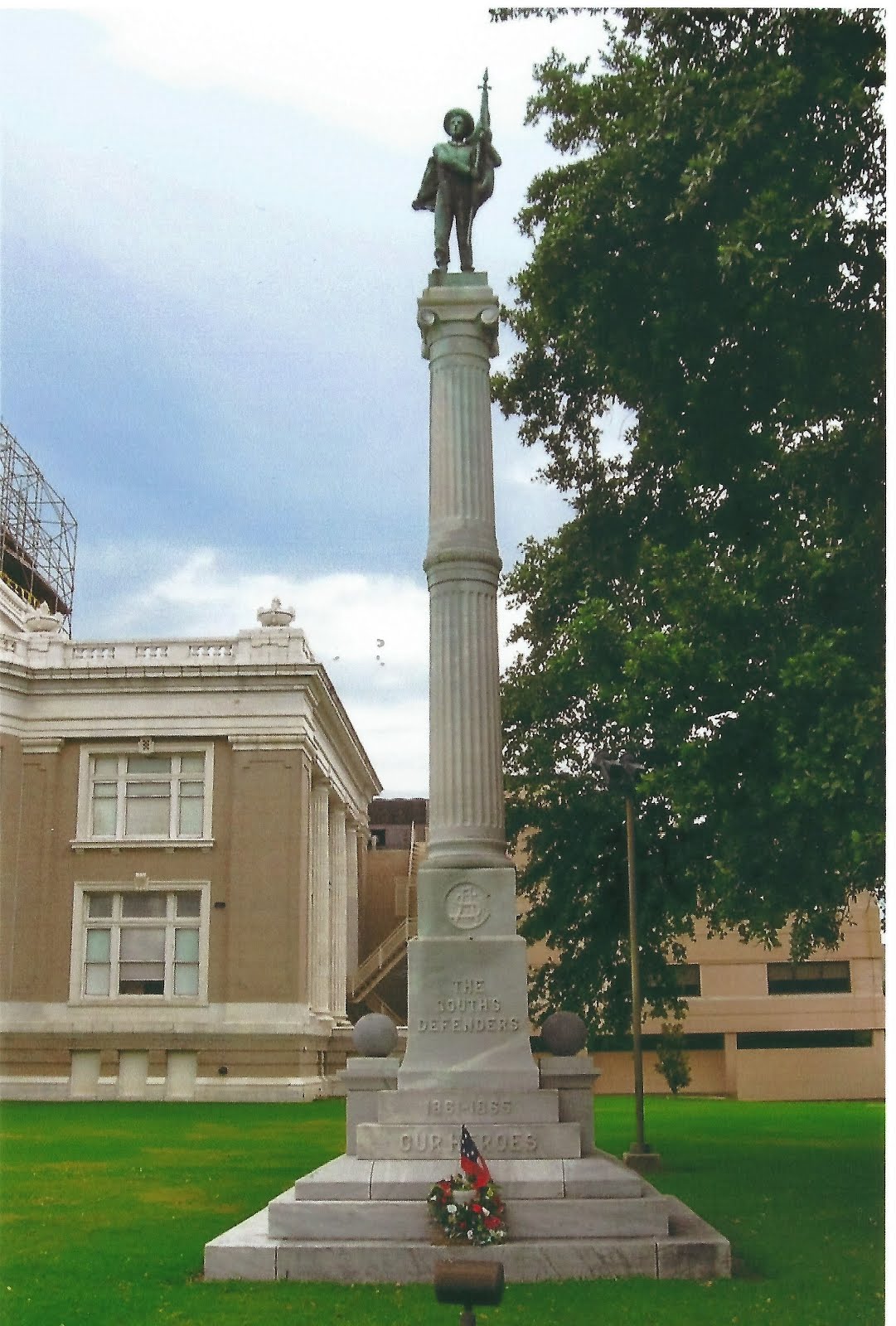
The Confederate Monument

The following is an address delivered by Mr. Gill at the unveiling of the Confederate Monument at Lake Charles, Louisiana, June 3, 1915, which is characteristic of him:
Mr. Chairman, R.E. Lee Chapter, United Daughters of the Confederacy, Comrades, Ladies and my Fellow Citizens:

The Daughters of the Confederacy, having charge of these dedicatory ceremonies, have placed the responsibility upon me of responding on behalf of the veterans, and having closed all avenues of retreat there was nothing left me to do but capitulate.

An occasion of this kind is one of reminiscence. More than fifty years ago the North and South were seriously divided upon a great political and constitutional question. It has always seemed strange to me that the question was not appealed to the Supreme or some diplomatic court, but it was not. Every state in the Union appealed to arms, both sides with equal enthusiasm and patriotism lined up on the question, both sides called their witnesses and the argument was promptly opened at Fort Sumter. When Thomas Overton Moore, governor of this state, called to the colors its citizens, I claim those who responded performed as highly patriotic duty, as any man who responded to the call of Abraham Lincoln.

For more than four years the argument raged with tremendous energy and fury.

Looking backward a half century from the 9th of April last, we catch a vision of Appomattox. On that eventful and historic day two giant characters, two strong men, two great captains met on a patch of nature’s greensward, under an apple tree, in the full fruitage of flower, and without blare of trumpets, without noise, but in the simplicity of greatness, made a covenant honorable to both sides, and closed the argument forever. The commissary wagons were pulled in, refreshments were served and a plug of Brown’s Mule was passed and everybody took a bite, the blue and the gray withdrew to their homes to mend the broken and heal the wounds. How faithfully that covenant has been kept and how well the blue and the gray have wrought, you have but to observe today with what unanimity the hundred million of loyal Americans are standing behind and supporting our chief magistrate and his policies, and not enough Jingoes on the gunwales to rock the boat. Gathered under the shadow of this monument are veterans of the blue and the gray, that squatted on the greensward around the apple tree at Appomattox on the 9th of April, 1865. We have forgiven. Today we send our children to the same schools, we attend the same churches, have extended the right hand of fellowship and would eat chuck together if we had the chance. But we have not forgotten. Would you have us forget? This monument and every Confederate and Union monument in the land answers in one universal chorus — No. We stand for something.

Back in the eighties, when our western frontiers were infested and dominated by a restless, reckless, desperate, lawless, wild and woolly element of daredevil cowboys and rustlers, on one of their carnival occasions at the end of a gun play one of the gang quit the trail and they laid him in the little village cemetery. His friends erected a little modest memorial over his grave. Strolling through the little cemetery, and coming to the plain marble slab, I found this simple inscription: “Bill Boone,” and underneath this unique epitaph, “Bill always done his derndest.” Catching the inspiration of the thought that brought out that inscription I pulled off my hat to that epitaph, and my hat is off to it still.

H.C. Gill in middle age
Search the literature and classics of the world, could you find five words and group them that would give a higher or loftier encomium to human endeavor? If the drapery should be removed from that statue and there should be anything lacking to make it complete and I were called upon to supply it, I would say copy the epitaph in the little village cemetery, and write on that shaft “They always done their derndest.”

And now to this splendid band of women, the R.E. Lee Chapter, United Daughters of the Confederacy, who have been so faithful and worked so hard, consistently, persistently and successfully to this end, and to every donor to the fund that has made this splendid memorial possible, on behalf of these veterans and on behalf of our fallen comrades, whose graves lie in the green bosom of every battlefield from the Rio Grande, and the Round Tops of Gettysburg, I sincerely, reverently and affectionately extend our thanks.

These veterans assembled here have all reached their three score years and ten and better, and in a few more years, at best, will be the lost generation. Their faces are turned toward the sunset of life, and as they move across the stage of action, with warped frames and halting gait, and whitening crowns and visions growing dim, you may catch the faint echo of their receding steps, as they enter upon their last campaign the thin gray line growing shorter and thinner and thinner and thinner as the years go by until they reach the border land and, as the rear guard of the heavy battalions straggle over the line, taps will be sounded, lights extinguished and the thin gray line will fade forever into a memory. The rear guard will cross over the river and mingling with the spirits of their comrades, who have gone on before, together they will lie down to rest under the shade of the trees, on “Fame’s eternal camping ground, the bivouac of the dead.”

Monday, August 17, 2015

THE BATTLE OF SABINE PASS

Courtesy of Sabine Pass Battleground
On September 8, 1863, the battle of Sabine Pass turned back one of several Union attempts to invade and occupy part of Texas during the Civil War.

The U.S. Navy blockaded the Texas coast beginning in the summer of 1861, while Confederates fortified the major ports. Union interest in Texas and other parts of the Confederacy west of the Mississippi River resulted primarily from the need for cotton by northern textile mills and concern about French intervention in the Mexican civil war. In September 1863, Gen. Nathaniel P. Banks sent 4,000 soldiers by transport from New Orleans under the command of Gen. William B. Franklin to gain a foothold at Sabine Pass, where the Sabine River flows into the Gulf of Mexico. A railroad ran from Sabine Pass to Houston and opened the way into the interior of the state. The Western Gulf Blockading Squadron of the U. S. Navy sent four gunboats mounting 18 guns to protect the landing of the transport troops. The Union commander, Lt. Frederick Crocker, formed a plan for the gunboats to enter the pass and silence the Fort Griffin guns so the troops could land.

At Sabine Pass, the Davis Guards –– a Confederate Army unit composed of 45 enlisted men, one engineer, and one surgeon, all Irish and all in their 20s or younger –– manned Fort Griffin, which was constructed by 500 conscripted slaves. The fort consisted of an earthwork that mounted six cannons, two 24-pounders and four 32-pounders.

The U.S.S Clifton shelled the fort from long range between 6:30 and 7:30 a.m. on September 8. The Confederates remained under cover because the ship was out of reach for their cannons. Behind the fort, Confederate officers gathered reinforcements, although their limited numbers would make resistance difficult if the federal troops landed.

At 3:40 p.m. the Union gunboats began their advance through the pass, firing on the fort as they steamed forward. Under the direction of Lt. Dowling, the Confederate cannoneers emerged to man their guns as the ships came within 1,200 yards. One cannon in the fort ran off its platform after an early shot, but the artillerymen fired the remaining five cannons with great accuracy. A shot from the third or fourth round hit the boiler of the U.S.S. Sachem, which exploded, killing and wounding many of the crew and leaving the gunboat without power in the channel. The following ship, the U.S.S. Arizona, could not pass the U.S.S. Sachem and withdrew from the action. The U.S.S. Clifton, which also carried several sharpshooters, continued up the channel near the Texas shore until a shot from the fort cut away its tiller rope. That left the gunboat without the ability to steer and caused it to run aground, where its crew continued to exchange fire with the Confederate gunners. Another well-aimed projectile into the boiler of the U.S.S. Clifton sent steam and smoke through the vessel and forced the sailors to abandon ship. The U.S.S. Granite City also turned back, thus ending the federal assault.

The Davis Guards fired their cannons 107 times in 35 minutes of action, a rate of less than two minutes per shot, which ranked as far more rapid than the standard for heavy artillery. The Confederates captured 350 Union prisoners and two gunboats. Gen. Franklin and the Union forces turned back to New Orleans, although Union troops occupied the Texas coast from Brownsville to Matagorda Bay later that fall. The Confederates, who suffered no casualties during the battle, received the gratitude of the Confederate Congress for their victory. Careful fortification, range marking and artillery practice had produced a successful defense of Sabine Pass.

Source: Handbook of Texas Online

Monday, July 27, 2015

JOSEPH CAMARSAC LEBLEU -- THE LIFE OF A CALCASIEU PARISH, LOUISIANA CONFEDERATE

Color Sergeant Joseph C. LeBleu of Co. K,
10th La. Inf. He carried the regimental
battleflag in the bloody Battle of Malvern
Hill, July 1, 1862. His flag staff was shot in two
but he survived the battle and the war.
(Photo courtesy of Dan Jones)
[Excerpted from the Southwest Louisiana Biographical and Historical, 1892]
JOSEPH C. LeBLEU, Lake Charles.—Joseph C. LeBleu, one of the pioneer planters of Calcasieu parish, who resides at English Bayou, Ward 3, is a native of the parish, born April 8, 1841. He is the son of Arsine and Eliza (Milhomme) LeBleu, natives of Louisiana, born 1783 and 1800, respectively. Arsine LeBleu emigrated to California in 1849l; he died in Sacramento in 1850. His wife died in 1883. By occupation Arsine LeBleu was a planter and stock raiser.
                Our subject is the youngest of a family of eight children, two of whom are now living. Mr. LeBleu spent his youthful days in Calcasieu parish. At the beginning of the civil struggle he entered Company K, 10th Louisiana Regiment [Ed. Note: the original story mistakenly gave his unit as the 18th La. Inf.], under Captain A.B. [Actually William H.] Spencer. He was in the battles of Williamsburg, Seven Pines, [In the 10th La. Inf.] Mansfield, Pleasant Hill, [In the 7th La. Cav.] and numerous other minor engagements. He was paroled at  Natchitoches, Louisiana. After the war he returned home and resumed farming, which he has closely followed ever since. He owns a good plantation where he resides, and upon which he raises, principally, rice. He is president of the Lake Charles Farmer’s Union, 587, and was the organizer of the Union in Calcasieu parish. Mr. LeBleu was married, in 1867, to Leoneze [Laonaise] Hebert, a native of Louisiana. They are the parents of ten children, five sons and five daughters, six of whom are living: Beatrice (widow of Arthur Rosteet), Grace (wife of J.W. Rosteet), Polignac, Evelina, Farrel and Ella.
[Excerpted from the Lake  Charles Daily Press Special Edition, 1895]
      When the war drum sounded, Mr. LeBleu and fourteen other young men in the neighborhood came at once to Lake Charles and started toward the front. At Opelousas they joined a company being organized by Capt. W.H. Spencer, which became connected with the 10th Louisiana Volunteer Infantry.
      He served with this regiment for two years in Virginia, when he was transferred to the 7th Louisiana Volunteer Cavalry, serving for the remainder of the war in the South.
      Since the war Mr. LeBleu has held a number of official positions, among them chief constable of the parish until that office was abolished, and he is at present a member of the police jury from the third ward.

[Obituary of Joseph C. LeBleu, Lake Charles Daily American Press, Saturday, Nov. 7, 1914]
MAJOR J.C. LEBLEU, PRESIDENT OF THE POLICE JURY, PASSES AWAY
     A most distinguished and venerable figure strongly associated with Calcasieu history and Calcasieu up-building, passed from human ken last night when Major Joseph C. LeBleu, president of the police jury and son of Calcasieu’s pioneer settler, passed away at the home of his daughter, Mrs. Henry Little in Seventh street. For the past few years, Major LeBleu has been in failing health, but his energy and strong will triumphed for weeks over the ravages of his ailment. Some weeks ago he came from Chloe to that of his daughter to be in better reach of his physician and here last evening about six o’clock the end came.
      The funeral will take place from the Church of the Immaculate Conception Monday afternoon at 3 o’clock. Interment will be at the Catholic cemetery on Common street. The funeral will be attended by Calcasieu Camp, United Confederate Veterans and Calcasieu council, Knights of Columbus in a body, and by a host of people prominent in public and civic life.
      Joseph C. LeBleu was born April 8, 1841, the youngest of eight children of Arsene LeBleu and Eliza Milhomme, at the old LeBleu homestead east of Lake Charles. His father, Arsene LeBleu, was born in 1787 and was the first settler in Calcasieu east of the river. He made his home on the prairie east of Lake Charles over a hundred years ago, and in this locality Major LeBleu was reared to manhood and spent his whole life. His father was attracted by the California gold discovery in 1849 and was one of the first to cross the plains to the new El Dorado, but did not live to return. He died in Sacramento in 1850. His mother died in 1883, aged 83 years.
      When the war between the state broke out, Major LeBleu enlisted in Co. K, Eighteenth [10th]  Louisiana, and served throughout the war, participating in the battles of Williamsburg, Seven Pines, Mansfield and other engagements. He was mustered out at Natchitoches and returning to the old home, took up residence on the home farm east of Lake Charles where the rest of his life was spent. He was one of the organizers of the Farmers’ union in Calcasieu parish in the 70’s and served as president of the local organization. Eleven years ago he organized the LeBleu Rangers, a troop of cavalry in the Louisiana National Guard, which at that time had no unit in western Louisiana, and officiated as its commander and later as major commanding the cavalry force of the state national guard. Thanks to the interest aroused by his initiative, several other national guard commands were formed later in western Louisiana.
       Major LeBleu was elected a member of the Calcasieu parish police jury in 1888 and served twenty years in that capacity until 1908 when his precarious state of health forced him to retire for a time from public affairs. He was re-elected in 1912. During most of his service he was president of the governing body of the parish and was always a worker for the public improvements which have made this parish pre-eminent throughout the state.
      Mr. LeBleu was married to Leoneze [Laonaise] Hebert who survives him, with five of the ten children. The surviving children are Mrs. Grace Rosteet, Mrs. Beatrice Richard, Mrs. Evalena Little, Mrs. Aarons and Mr. P.D. LeBleu.
Other Historical Notes:

        According to LeBleu’s military service record, he was appointed color-bearer of the 10th Louisiana Infantry 1 Sept. 1861. He carried the regimental battle flag in the Battle of Malvern Hill, July 1, 1862, one of the bloodiest battles in the War for Southern Independence. Lt. Edward A. Seton of his company, wrote that LeBleu’s flag staff was shot in two during the charge, but the color sergeant was miraculously not wounded. The 10th Louisiana was the only Confederate regiment to penetrate the Federal line and temporarily captured 10 Yankee cannons. When the regiment was not reinforced, they were driven back by a powerful Yankee counterattack. His record also states, “Deserted his regiment and joined the Confederate cavalry.” LeBleu later explained he was home on furlough when Vicksburg fell and couldn’t return to Virginia. He then joined the 7th Louisiana Cavalry with the rank of second lieutenant and fought in the battles of Mansfield and Pleasant Hill in the Red River Campaign. The 7th Louisiana Cavalry also helped eradicate Jayhawkers in Southwest Louisiana, who were terrorizing the population. During the Spanish-American War, he raised a cavalry unit, called the LeBleu Rangers, serving as the major, in the Louisiana State Militia. He was an active charter member of Calcasieu Camp No. 62, United Confederate Veterans, and organized the first Sons of Confederate Veterans Camp in Calcasieu Parish in his police jury office in 1911. Joseph Camarsac LeBleu died Nov. 6, 1914 and is buried in the Old Catholic Cemetery in Lake Charles, Louisiana.

Wednesday, July 1, 2015

The Charge of the 10th Louisiana Infantry at the Battle of Malvern Hill, Va., July 1, 1862.

[The below story is excerpted from Confederate States Rangers of the 10th Liouisiana Infantry by Michael Dan Jones, CreateSpace.com 2014. The Battle of Malvern Hill, Va. was the final one of the Seven Days Battles, which halted and drove away Major  General George B. McClellan's Federal Army of the Potomac from the doorsteps of Richmond.]

When [Lt. Col. Eugene] Waggaman [of the 10th Louisiana Infantry] was notified by [Brig. Gen. Paul] Semmes to bring his regiment up, he ordered the men to “Fall in!” They advanced within 300 yards of the enemy, then halted in a dip in the ground. The lieutenant colonel then walked to the center of the soldiers and said, “Men, we are ordered to charge the cannon in our front and take them. The Tenth Regiment has been in reserve all week, and every other Louisiana regiment has been in action. All of them have distinguished themselves, and I trust that the Tenth will not be the first to falter. Not a shot must be fired until we get to the guns. Now, men, we are going to charge. Remember Butler and the women of New Orleans. Forward, charge!”  Waggaman was referring to the infamous and insulting declaration of the military governor of New Orleans, Benjamin “Beast” Butler that any woman acting disrespectfully to the Northern occupiers could be treated as a prostitute. 
      As Semmes noted [in his report], the 10th, with 318 men in the charge, was placed on the right of the brigade. First Sergeant Joseph C. LeBleu, regimental color bearer, was in front as the regiment with Waggaman leading them all, far in advance. They marched forward through a storm of bullets and bomb shells as the Louisianians entered a smoke shrouded nightmare of death and destruction. Semmes watched as Waggaman and the other men of the 10th  disappeared into that cloud of smoke.        
     Lieutenant [Lt. Edward A.] Seton remembered seeing the flagstaff held by Sergeant LeBleu  shot in two. Somehow LeBleu was not wounded. Others, however, were “biting the dust” with every step, especially in the last 50 yards. Then, almost miraculously, they breached the Federal line and captured 10 of those death dealing cannons. Suddenly, the famous 69th New York “Irishers” came up and Waggaman commanded the men from Louisiana to open fire. 


     The 69th fell back. Waggaman told the men to lie down and wait for reinforcements, which of course would never come. They were  then raked by a volley of musketry from right to left. Waggaman thought they were being fired on by their own men. He turned to Sergeant Major [Leon] Jastremski and said, “For God’s sake Sergeant Major, go to those men and tell them to cease firing; they are killing their own men.”  
     Jastremski approached the unknown soldiers, but discovered they weren’t Confederates, but the 12th U.S. regulars and the 69th New York firing at them. Rather than ceasing fire, they made Jastremski their prisoner. The 10th Louisiana was then overwhelmed in a bayonet charge by the 69th New York. Private Daniel Dean of Company H received a bayonet wound in the throat but survived. Next to Dean, cries of “Kill him!” and “Bayonet him!” were directed at Waggaman, who deflected the bayonet thrusts with his sword but was surrounded. He threw away his heirloom sword so the Yankees wouldn’t get it. Private Richard Kelly with the 69th New York was credited with capturing Waggaman. He received a battlefield commission for his feat. About 30 men in all were taken prisoners, but the other survivors of the charge made their way back to Confederate lines the best they could. 
Lt. Col. Eugene Waggaman
(Courtesy of Mrs. Babette Brodie)
      The gallant, but futile, charge of the 10th Louisiana at Malvern Hill has been compared to the “Charge of the Light Brigade” at the Battle of Balaclava in the Crimean War. The men of the 10th were the only Confederates to penetrate the Federal line and temporarily capture 10 cannons. Federal artillery commander Colonel Henry J. Hunt said of the charge, “The last attack was very nearly successful [and] we won from the fact that we kept our reserves in hand for just such an attack . . . .”
      The 10th Louisiana lost 18 men killed, 36 wounded and 38 missing. In Company K, the Rangers’ losses were Corporal Nathan Howell killed; Corporal Guillaume Durio and Private Joseph Dulva Farque, wounded. Father [Louis-Hippolyte] Gache [regimental chaplain] wrote in a July 8 letter in Richmond his feelings at getting the news that Colonel Waggaman was missing. He said in his letter, “My dear friend Colonel Waggman is listed among the missing. Please God he has not been wounded; although he must surely have been, as he was at the head of his regiment when it made a charge against a battery of thirty-two cannons. I miss him very much; his loss is and will be irreparable. The night before the battle he took me aside and said, ‘Father, I’d like to make another confession so the two of us withdrew from the rest of the troops for a few moments and I obliged his request. The following morning before I finally settled down to get some sleep (we had marched during most of the night and weren’t able to snatch even a few winks until 3 a.m.), I noticed that the colonel spent a long time at his prayers. This much is for sure: if he has to face death in some Yankee prison, he’ll not be unprepared.”

Saturday, June 27, 2015

BATTLE OF GAINES' MILL, A bloody Confederate victory!

[Excerpted from Lt. Col. King Bryan of Hood's Texas Brigade:Freedom Fighter for Texas and Southern Independence by Michael Dan Jones, CreateSpace.com 2013]

Hood’s Texas Brigade received a great boost in its reputation at the Battle of Gaines’ Mill on June 27, 1862. This battle was part of the Seven Days Campaign, which was part of George B. McClellan’s drive on  Richmond. With a massive enemy within eyesight of the spires of the churches of the capital of the Confederacy, Robert E. Lee quickly reorganized the Confederate Army. He added the eight infantry companies of Hampton’s Legion to Hood’s Brigade and sent Whiting’s Division to Staunton, in the Shenandoah Valley, to reinforce Lieutenant General Thomas J. “Stonewall” Jackson. Jackson had already beaten the Federal Army of Major General Nathaniel Banks and driven him back to the outskirts of Washington, D. C. McClellan reacted as Lee had  hoped. He sent McDowell’s 30,000 man corps to  Washington to protect the capital. The Texans, Georgians and South Carolinians moved by railroads to Lynchburg, then Charlottesville and then marched to Staunton. Also, when the army was reorganized, Colonel J.J Archer was promoted to brigadier general and J.B. Robertson promoted to full colonel and placed in command of the regiment. W. Brown Botts was promoted to lieutenant colonel and Captain John C. Upton of Company A to major. The officers and men were very happy since they now had an all Texan leadership from top to bottom.
          As was his custom, Stonewall Jackson kept his plans secret but the Texans were very curious and speculation was rampant. The first phase of Lee’s plan was accomplished, weakening McClellan, and now he wanted Jackson to reunite with him to turn McClellan’s flank. A. P. Hill’s Division would cross the Meadow Bridge over the Chickahominy to attack Mechanicsville from the east, open the turnpike bridge there for Longstreet’s and D. H. Hill’s men. The four divisions would begin attacks on Brigadier General Fitz John Porter’s 5th Federal Corps north of the Chickahominy and capture their supply base at White House. The united Confederate Army would then destroy the rest of the Federal corps south of the Chickahominy. Lee placed the divisions of major generals John B. Magruder and Benjamin Huger in the fortifications around Richmond. In all, Lee had 90,000 men, which was the largest Confederate Army he would ever have. But, as with most battle plans, it didn’t go as planned. McClellan at that time had about 70,000 men.
            Jackson started his army on June 18, boarded a train at Meecham’s Station and arrived at Frederick Hall, 35 miles north of Richmond on June 21, where they went into camp. The army then marched to Ashland, north of Richmond, and arrived there June 25. After drawing ammunition and rations, the men started on June 26, for the attack on Porter’s Corps, but numerous obstacles – taking wrong roads, poor maps, and confusing terrain – put Jackson’s command way behind schedule. McClellan had also anticipated Jackson’s move, and had sent reinforcements to Porter. But A. P. Hill’s men were in place and on time, and with Jackson so obviously late, they launched the attack themselves on Mechanicsville at 3 o’clock. Porter withdrew to a prepared position at Beaver Dam Creek while Hill’s men cleared the way for Longstreet and D. H. Hill. The Confederates hurled themselves against the almost impregnable position before calling off the attack. The Confederates lost 1,485 men killed, wounded and missing, while the Federals suffered just 258 casualties. But when Jackson finally arrived that night on Porter’s flank, the Federal position became untenable and they retreated to another prepared position at Boatswain Swamp, near Gaines’ Mill.
            While the battle was going on without them on June 26, Captain [King] Bryan, leading the 59 members of his company available for duty, trudged on as they heard the sounds of battle as they came nearer the field of conflict. During the day they came across Federal outposts and drove off the pickets. They also encountered a burning bridge, felled trees and other obstructions to their progress to reach their launch off point for the attack on Porter. They got as far as Hundley’s Corner on the 26th, and went into camp there. The next morning, June 27th, they started out again for the battle, which was somewhere in the Virginia countryside, but they didn’t know exactly where. Hood’s Texas Brigade was leading the way for Jackson’s command. While on the way, Whiting’s Division was ordered to support Longstreet on the Confederate right. Hood finally found the Confederate line at Boatswain Swamp and soon encountered General Lee himself. Lee explained the situation, that Confederates had been pounding Porter’s position throughout the day and hadn’t been able to dislodge it. Then he told Hood, “This must be done.” He solemnly  asked, “Can you break his line?” Hood replied he would try.
            Lee had his men positioned in a semi-circle around the Federal position. D. H. Hill was on the left, then Ewell, Jackson, A. P. Hill and Longstreet on the Confederate right. Porter’s position was an extremely strong one. He had two divisions in his corps, about 25,000 men, with the division of General George Sykes on the Federal right, and General George W. Morell’s Division  on the Federal left. The position was on a plateau with two lines of entrenchments, one halfway up the hill and the other near the top. The Federal infantry was supported by plenty artillery. During the battle, 10,000 reinforcements would arrive for Porter. The terrain included a creek the Confederate’s had to cross, swampy ground and trees cut down to obstruct their progress. Whiting’s Division of Jackson’s command moved out to the center-right to take up a position in  the Confederate line, which was where they were needed most at that moment. Laws’ brigade was on the right and Hood’s on the left of the division. The plateau before them was called Turkey Hill.
When the 5th Texas moved with the brigade from Jackson’s command to the center-right, Captain Bryan’s company was put out on the left flank of the regiment as flankers. This would have exposed them to enemy  sharpshooters and artillery, as they were moving along the battle line. It was the job of Company F to prevent the regiment from being out-flanked from the left by a Federal counterattack.


As they  were moving along, Private Fletcher noticed two men bobbing up and down as if they could dodge enemy shots. Fletcher pointed out that they were exposing themselves to more enemy fire, both from the standing and stooping positions. Soon afterwards, he noted that both men were hit by enemy fire. When 5th Texas went into line of battle with Longstreet’s Wing, Company F was on the left of the regiment and they had to advance over rugged ground through a dense forest. Under these conditions, it would be hard to keep in contact with the regiment to the left, the 1st Texas, and possibly leave a gap that the enemy could exploit if the opportunity presented itself.
            The battle alignment of Hood’s Texas Brigade was Hampton’s Legion on the left, then the 1st Texas, 5th Texas, the 18th Georgia on the right, and the 4th Texas in reserve. “The brigade moved gallantly forward, soon becoming engaged from left to right,” said Hood in his battle report. “The battle raged with great fury all along the line as these noble troops pressed steadily on, forcing the enemy to gradually give way.”
When Hood ordered the brigade forward, Captain Bryan and his men let go with the famous “Rebel Yell”, which is an eerie, ancient Celtic war cry that is also reminiscent of an Indian war whoop. Fletcher called it a “Texas Yell” and said, Company “F boys  full well knew its meaning was ‘charge’.” They moved forward through an increasing volume of shot and shell as they approached the first Federal line of battle, a trench line reinforced by logs.  The going for Company F was slow as they had to pick their way through heavy underbrush and fallen trees and tree limbs clipped off by Yankee bullets and shells.
Meanwhile, Hood was looking for a place that would offer a more promising opening, and found it to the right of the 18th Georgia. There, he found a field that was open, up to the Federal breastworks. “Holding in reserve the Fourth Texas, I ordered the advance, and galloped into the open field or pasture, from which point I could see, at a distance of about eight hundred yards, the position of the Federals. They were heavily entrenched upon the side of an elevated ridge running a little west and south, and extending to the vicinity of the Chickahominy,” Hood said. They had to cross Boatswain Creek, and brave fire from Federal artillery. He marched the 4th Texas to the field, dressed ranks and ordered them not to fire until he gave the word. Hood was concerned if they stopped to fire and reload, they would never reach the entrenchments. Moving through the open field, in which earlier Confederate charges had been repulsed, they were able to make swift progress. Colonel John Marshall, commander of the 4th, was killed, along with many others as the concentrated fire of the enemy steadily depleted their ranks. After crossing the creek, Hood gave orders for his men to fix bayonets for the last push forward. “With a ringing shout we dashed up the steep hill, through the abatis, and over the breastworks, upon the very heads of the enemy. The Federals, panic-stricken, rushed precipitately to the rear upon the infantry in support of the artillery . .” Hood  said. The 4th Texas, with support from the 18th Georgia, was the first to break Porter’s strong line.

Brig. Gen John Bell Hood
(Library of Congress)

Back at the 5th Texas’ part of the line, Captain Bryan’s Invincibles were benefiting from the rapidly dissolving Federal battle line. The bullets were still coming fast and furious at Company F, so Captain Bryan gave the command for the men to lie down, and Fletcher was ordered forward to investigate. Using his skills in woodcraft, he crept up on an isolated line of Federals in a peculiar position. He could have shot the Yankee colonel, but he felt it was more important to get back to the company and report his findings to Captain Bryan.  The Federals, who turned out to be the 4th New Jersey Infantry, spotted Fletcher and opened fire on him. While Fletcher wasn’t hit, it did draw the fire of the New Jersey unit onto Company F. It got so hot, Captain Bryan had to move them.  When he was  able to head back toward his company, Fletcher couldn’t find the unit. When he did find them, there was a brief exchange of fire between the 4th New Jersey and the 5th Texas. Private George N. Woods of Company F, was killed in this fusillade close to the end of the battle. He was just 17- or 18-years-old at the time and was one of Captain Bryan’s first recruits, having joined the Invincibles June 8, 1861. He was a member of a farm family in Liberty County at the time of his enlistment. The colonel of the 4th New Jersey, James H. Simpson, realizing his regiment was surrounded and in a precarious position, surrendered the regiment. Simpson later talked to Major Upton, who was an old classmate, expressed his chagrin at having to surrender his sword to a private, rather than an officer. Upton told him he was wise in doing so because the privates had been instructed to kill or capture and the killing was not to stop until the capture was complete.
            In his official report, Simpson said his regiment reached the battlefield about 2:30 p.m. at a double-quick march. His regiment advanced into the woods to support the 3rd Pennsylvania Reserves. After about 15 minutes, the New Jersey boys replaced the Pennsylvanians on the battle line. Simpson said they fought steadily for about three hours, until 7 o’clock that evening, when they were relieved by the 11th Pennsylvania Reserves. When they moved to the rear, he noticed a large body of Confederates on his left. “I therefore immediately changed my front so as to oppose these troops and be the better able to cope with them, and at the same time be in a position to cover Colonel Gallagher [of the 11th Pennsylvania], should he be obliged to retreat. The change was effected, but no sooner commenced than the troops referred to, began to pour in upon us a very destructive fire, the hissing of the balls (I can compare them to nothing else) being like that of a myriad of  serpents.” Simpson, realizing he was in danger of being surrounded and cutoff, and seeing the 11th Pennsylvania retreating, he ordered the 4th New Jersey to also retreat. “We had, however, proceeded but a few yards when I noticed we were moving against a large body of the enemy [the 5th Texas], drawn up in several lines, and a battery directly in our rear, to cut us off. The consequence was that being surrounded overwhelmingly on every side, to the front, flanks and rear, like the Eleventh Pennsylvania, which had already been captured, we had to suffer the same fate.” This is when Simpson had to hand his sword over to a private in the 5th Texas.
            After the battle, when he had a chance, Private Fletcher talked to Captain Bryan about the scouting mission. He said, “Captain, I suppose a report now is useless?” The captain replied, “Yes, but little did I expect to see you again. I was forced to move the company, as the position was too hazardous.” Fletcher replied, “ I guess they were shooting at me.” The captain responded, “I thought so, and they would aim lower as you descended.”
            At the end of the Battle of Gaines’ Mill, the Federal Army next retreated to an equally strong position at Malvern Hill, where the last battle of the campaign was fought on July 1,  1862. Federal losses at Gaines’ Mill for the North were 6,387 killed, wounded and missing out of 32,214 men engaged. The South lost 8,751 casualties out of 57,016 engaged. Hood’s Texas Brigade’s total casualties were 89 killed, 479 wounded and four missing. The 4th Texas had the most losses, with 44 killed and 206 wounded. The      1st Texas casualties were 14 killed and 64 wounded. Losses for the 18th Georgia were 16 killed, 126 wounded and three missing. Hampton’s Legion suffered two killed and 18 wounded.
 The Bloody Fifth suffered 13 killed 62 wounded and one missing, in the battle, out of 29 officers and 474 men engaged. They had earned their nickname, the “Bloody Fifth.” Company F lost two men killed, Private Woods and Private W. S. Hall (mortally wounded by an enemy bomb), and six wounded, including: privates John V. Sloan, neck; Joseph C. Ross, leg; John R. Moodie, slightly in the back by a bursting shell; G. W. Knapp, leg shot off by an enemy bomb; Basil Crow Brashear, slightly in the arm by a bullet; Jeff Chaison, slightly in the leg by grape shot. Near misses included privates Dallis Bryan, Captain Bryan’s young nephew,  with bullet holes in his canteen and haversack; Peter Mallory, the captain’s cook, two bullet holes in his blanket roll he had over his shoulder; William Schultz, a spent bullet struck the top of his cap and bounded off “without hurting a hair on his head;” and A. C. Vaughn, part of his handle bar moustache cut off by a rifle ball. Captain Bryan got through the battle without a scratch.